Dangerous DUST
Minimize generation, clean up accumulation, prevent an explosion
OSHA is initiating this National Emphasis Program (NEP) to address the deflagration, other fire, and explosion hazards that may exist at facilities handling combustible dust. A combustible dust hazard study conducted by the U.S. Chemical Safety and Hazard Investigation Board (CSB) found that nearly 280 dust fires and explosions have occurred in U.S. industrial facilities over the past 25 years, resulting in 119 fatalities and over 700 injuries.
The purpose of this NEP is to inspect facilities that generate or handle combustible dusts which pose a deflagration or other fire hazard when suspended in air or some other oxidizing medium over a range of concentrations, regardless of particle size or shape; deflagrations can lead to explosions. Combustible dusts are often either organic or metal dusts that are finely ground into very small particles, fibers, fines, chips, chunks, flakes, or a small mixture of these. Types of dusts include, but are not limited to: metal dust, such as aluminum and magnesium; wood dust; plastic dust; biosolids; organic dust, such as sugar, paper, soap, and dried blood; and dusts from certain textiles. Some industries that handle combustible dusts include: agriculture, chemicals, textiles, forest and furniture products, wastewater treatment, metal processing, paper products, pharmaceuticals, and recycling operations (metal, paper, and plastic).
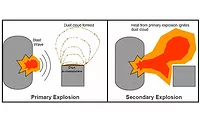
Even if your plant air is below OSHA’s PEL (permissible exposure limit) for process generated dust, over time enough dust may be generated and settle on horizontal surfaces to become dangerous. If an incident such as excessive drafts or building vibrations throws the settled dust into the air near an ignition source, a fire and dust explosion may occur. Before a dangerous condition occurs in your plant, housekeeping action should be taken to safely clean up and remove these accumulations. Then, action needs to be taken to minimize dust generation before combustible dust again accumulates to unsafe levels in your plant.
Minimizing dust accumulations
One way to minimize process generated dust from accumulating in the plant is to install an effective and safe dust control exhaust system or upgrade an existing one. Pneumatic conveying equipment and dust control exhaust systems that transport combustible solids and particulate need to be protected from fire and dust explosions. If the concentration of combustible dust suspended in air is at or above the minimum explosible concentration (MEC) and there is a source of ignition, an explosion may occur within the confines of dust control system components. In general, the concentration of dust is highest within the system’s cyclone and dust collector. Other system components such as the ductwork and fan need to be considered as well. Following are some points to consider when evaluating or designing a dust control or pneumatic conveying system handling combustible dust and solids.
Dust collector explosion relief vents
Designing explosion vents for dust collectors and filter receivers involves on a number of factors. These factors include the explosion pressure and rate of pressure rise of the combustible dust, the strength of the dust collector housing and the available area on the dust collector for venting. The dust can be tested to determine explosion pressure and rate of pressure rise. The stronger the dust collector housing, the fewer and/or smaller the vents need to be. The vents typically need to be installed on the dirty air side of the dust collector. Refer to NFPA 68, Explosion Protection by Deflagration Venting. Knowing the dust explosivity characteristics such as the maximum explosion pressure and the rate of pressure rise of your combustible dust, the dust collector manufacturer and the explosion vent supplier can supply the necessary information for the vented design.
An existing dust collector may be strong enough “out of the box” to accommodate the necessary number and size of explosion vents. If the dust collector needs to be strengthened, reinforcing steel can be welded to the exterior of the dust collector. Calculations for the reinforcing steel size and locations can be performed knowing the dust collector housing wall thickness. Installing explosion vents onto an existing dust collector can be cost effective and can minimize production downtime as compared to replacing the existing dust collector with a new one.
Exhaust fan safety
Negative pressure dust control and pneumatic conveying systems usually have the exhaust fan on the clean air side of the dust collector or filter receiver, especially if the dust or conveyed solids are combustible. NFPA 654, “Standard for the Prevention of Fire and Dust Explosions from the Manufacturing, Processing and Handling of Combustible Particulate Solids”, permits the passing of combustible particulate solids through a fan or blower under certain conditions. See NFPA 654, 2006 Edition, Section 7.12.2.
The Air Movement and Control Association International, Inc., at www.amca.org has publications available concerning exhaust fan safety. Refer to:
- AMCA Standard 99-0401-86, “Classifications for Spark Resistant Construction” and
- AMCA Publication 410-96, “Recommended Safety Practices For Users and Installers of Industrial and Commercial Fans”.
System ductwork: explosion protection
Dust collector explosion vents are not sufficient protection for connected ductwork. The inlet and outlet ductwork of a dust collector or filter receiver are, in effect, open vents. Having explosion vents on the dust collector or filter receiver does not keep fire and debris from entering this ductwork. If the inlet and outlet ductwork are not isolated during an explosion, fire and debris can exit from the dust collector and enter the plant through the connected ductwork. Refer to NFPA 654, “Standard for the Prevention of Fire and Dust Explosions from the Manufacturing, Processing and Handling of Combustible Particulate Solids,” 2006 Edition, Annex B, Explosion Protection.
Take action now
Identify solids that can become combustible when reduced in size by routine handling, grinding or in other ways that reduces its size. Install dust control systems where appropriate. Clean up accumulated dust on exposed areas such as floors, beams and ductwork and in hidden areas such as above ceilings and behind equipment. Eliminate potential ignition sources. Read NFPA 654, “Standard for the Prevention of Fire and Dust Explosions from the Manufacturing, Processing and Handling of Combustible Particulate Solids” for more information on how to make your plant safer.
This article was originally published in Powder and Bulk Engineering magazine and reprinted with permission. The PBE web site address is www.powderbulk.com.
Looking for a reprint of this article?
From high-res PDFs to custom plaques, order your copy today!