Calculating clearance
Know your fall protection’s capabilities
The good old days
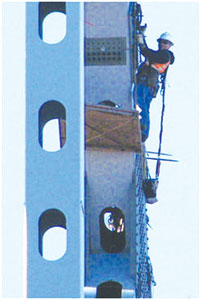
The common 6-foot-long ANSI Z359.1 energy-absorbing lanyard was intended to safely stop a 6-foot free fall of a 310-lb. worker. Unfortunately, the 6-foot length actually allows a worker to have up to a 12-foot free fall if the lanyard is anchored at or even below the worker’s feet (see Figure 1 at right).
|
| Figure 1 |
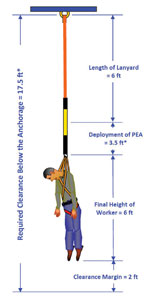
For lanyard systems, knowing the worst-case deployment of the Personal Energy Absorber (PEA) makes clearance calculations very easy. Figure 2 (on p.35) shows how to add up all the factors to understand that the anchor must be at least 17.5 feet above the ground with the old (ANSI Z359.1) equipment.
This way of calculating “required clearance” is not affected by a 12-foot free fall, because the PEA is always assumed to deploy exactly 3.5 feet for ANSI Z359.1 equipment. The problem is that in 12-foot free falls, the impact forces (after “bottoming-out” the PEA) can exceed the 1,800-lb. limit allowed by OSHA.
What has happened?
In the fall of 2009, ANSI Z359.13, “Personal Energy Absorbers and Energy Absorbing Lanyards” was released, providing two new classes of PEAs:
- The new “6 ft FF” PEA is intended for (you guessed it) a maximum 6-foot free fall and can deploy up to 4 feet.
- The new “12 ft FF” PEA is intended for a maximum 12-foot free fall and can deploy up to 5 feet.
Since the new PEAs deploy further, we need to know how “required clearance” might be affected.
What’s wrong with Z359.1 lanyards?
For most workers free falling up to 6 feet, there is absolutely nothing wrong with ANSI Z359.1 lanyards. They properly protect 6-foot free falls, as intended.
The new (Z359.13) lanyards are needed because:
- As discussed above, when using a 6-foot lanyard, unless the anchorage is at or above the worker’s shoulders, free falls will exceed 6 feet.
- Even when free falls are less than six feet, experts now recognize that the test mass in ANSI Z359.1 may not properly represent a 310-lb. worker (as explained in the next paragraph).
|
| Figure 2 |
The old (Z359.1) requirements were developed several decades ago, based on the commonsense principle that the human body absorbs some of the fall energy. Studies at that time showed that (for rope lanyards without PEAs) a 1.4 ratio between human and test mass was appropriate (220-lb. rigid mass for a 310-lb. worker). Recent studies have shown that because we reduce the impact force (using PEAs), the energy absorbed by the worker is now much less. The newest ANSI Z359 standards use a 282-lb. rigid test mass to represent a 310-lb. worker.
The new (Z359.13) PEAs must absorb more fall energy in the tests, so the standard recognizes that they may need to deploy more than 3.5 feet.
Does OSHA allow free falls to exceed 6 feet and PEAs to deploy more than 3.5 feet?
OSHA has not changed free fall and deceleration distance limits. These easily understood objectives provide good guidelines for our workers. However, the agency recognizes that in some situations these objectives are difficult to achieve and that exceeding these limits can be safe if we can meet two (fundamental) objectives:
- keep the impact force to the worker below 1,800 lbs.; and
- stop the fall within the available clearance.
There are interpretation letters posted on the OSHA website stipulating that when you meet these objectives, OSHA will accept greater free fall and deceleration distances. The Z359.13 standard was written, in part, to provide equipment that meets the first objective. This article focuses on how this equipment affects the second.
If we use the new (Z359.13)equipment, do we need to increase required clearances?
At first glance, if you continue to calculate clearance assuming full deployment (bottoming-out) of the PEAs, then yes, you must increase clearances by 0.5 and 1.5 feet respectively for the “6 ft FF” and “12 ft FF” lanyards. However, these increases are rarely warranted in systems that were properly designed for the old (Z359.1) lanyards.
Keep in mind that it is rare for PEAs to fully deploy in actual falls. The new lanyards absorb energy with equal (and often greater) efficiency than the old ones. Thus, we generally expect the same or less deployment (and clearance) in actual falls with the new equipment. Any scenario that would not bottom-out the old PEAs will NOT deploy the new ones beyond 3.5 feet.
The only time deployments greater than 3.5 feet may occur with the new (Z359.13) lanyards is for heavy workers and large free falls that would actually bottom-out the old (Z359.1) lanyards. In this case, your choice is as follows:
- Keep using the old (Z359.1) lanyards to maintain present clearance requirements. Note that impacts will spike when this equipment bottoms-out and impact force should be determined by a “qualified person” to verify compliance with the 1,800-lb. OSHA limit.
- Use the new (Z359.13) lanyards to keep impact force below 1,800 lbs. Sometimes (but not always) this will increase clearance requirements due to greater deployment. This should be checked by a qualified person if a worker’s weight exceeds the guidance provided later in this article.
Can we continue buying ANSI Z359.1 energy-absorbing lanyards?
For now you can, but the Z359 committee is developing individual standards for each type of fall protection equipment so they can eventually withdraw ANSI Z359.1.
Can you provide any guidance about when the new PEAs might exceed 3.5 feet of deployment?
This will only occur for large free falls of heavier workers. It is possible to provide some conservative guidance about when this should be checked, as developed below.
Following ANSI Z359.6, “Specification and Design Requirements for Active Fall Protection Systems”, we can determine a maximum worker weight for both the “6 ft FF” and “12 ft FF” PEAs to cause them to deploy exactly 3.5 feet. To get a universally safe answer, we must work with a minimum average deployment force for the new PEAs. It turns out that the average force must be at least 705 lbs. for a “6 ft FF” PEA and 959 lbs. for a “12 ft FF” PEA to pass ANSI Z359.13. Note that labelling on these devices is mandated to say that the average forces are, respectively, 900 lbs. and 1,350 lbs., but this information is generally NOT reliable. Use of the force shown on the label usually exaggerates (unsafely) the ability of these devices to absorb energy. Anyone doing these calculations must have accurate information obtained from the manufacturer or dynamic tests.
To cause PEA deployment of exactly 3.5 feet for the lowest force PEA that could pass ANSI Z359.13, calculations show:
- for a 6-foot free fall, using a “6 ft FF” PEA deploying at 705 lbs., the worker weight is 285 lbs.; and
- for a 12-foot free fall, using a “12 ft FF” PEA deploying at 959 lbs., the worker weight is 238 lbs.
Recommendations
Correctly developed clearance requirements for fully deployed ANSI Z359.1 energy-absorbing lanyards are still valid and safe if your workers weigh less than the limits stated above (285 lbs. for “6 ft FF” and 238 lbs. for “12 ft FF” lanyards).
Workers heavier than the above limits may still not cause more than 3.5 feet of deployment, but weight limits should be determined by a “fall protection qualified person” for the actual equipment and free falls involved. When your workers are heavier, your expert can also determine the greater deployment and clearance you should be using.
Looking for a reprint of this article?
From high-res PDFs to custom plaques, order your copy today!


