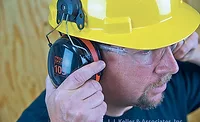
Calculating your noise reduction needs

The answer depends on how loud the noise is and how long the person is exposed to the noise. Generally, more noise reduction is needed at high sound levels and for long exposure times. More protection is also required for workers who have a work-related hearing loss known as a Standard Threshold Shift (STS). Hearing protector ratings, such as the Noise Reduction Rating (NRR), were developed to help inform the buyer about the capability of the hearing protection device (HPD) in reducing noise exposure when worn correctly. The NRR of HPDs on the market today varies widely; from as little as 4 decibels (dB) to as much as 33 dB.

Noise exposure limits
In the U.S., employers are required by OSHA to limit the 8-hour Time Weighted Average (TWA) daily noise exposure of most employees to 90 dBA or less.1 For workers who have already experienced a workrelated STS, the OSHA 8-hour TWA noise exposure limit is 85 dBA. Table G-16 from the OSHA Noise Regulation 29 CFR 1910.95 provides the noise exposure limits for various exposure times from 15 minutes up to 8 hours.1 ACGIH has established 85 dBA as the 8-hour Threshold Limit Value (TLV®) for noise.2
How much is enough?
The most convenient and commonly used method to evaluate the noise reduction (attenuation) of hearing protectors is to subtract the NRR of the device from the measured TWA noise exposure of the wearer. This method provides a rough estimate of the wearer’s noise exposure with that particular HPD, when it is worn correctly, although many contend this is not an accurate estimate of a worker’s exposure (see further explanation below).
Regardless, according to the OSHA Noise Regulation, 29 CFR 1910.95, hearing protectors used in the workplace must provide enough attenuation to reduce the 8-hour noise exposure of the employee to 90 dB or less.1 Various methods for evaluating whether a hearing protector provides enough noise reduction are described in Appendix B of 1910.95, including the octave band method for employers who have conducted a more comprehensive octave-band noise exposure assessment. This method allows calculation of the attenuation of a hearing protector across a range of sound frequencies.
7 dB correction factor
To estimate the TWA exposure under the hearing protector, an employer may subtract the NRR from the employee’s C-weighted workplace TWA. However, when the NRR is used with A-weighted noise values, as is most often the case, OSHA requires the employer to reduce the NRR by 7 dB before subtracting the NRR from the workplace TWA.1 This 7 dB correction factor is necessary to account for the possibility that A-weighted noise measurements may underestimate low frequency noise levels in the workplace.1
Estimating individual noise reduction
In its technical manual on Noise and Hearing Conservation, OSHA advises employers that many users will receive less noise reduction than indicated by the NRR due to variation in earplug fit, earplug fitting skill, and motivation of the user.3 As a result, OSHA recommends that the NRR be reduced by 50 percent to better estimate typical workplace protection before subtracting the value from any individual’s TWA. This practice is commonly known as derating and, according to many, provides a more appropriate measure of individual noise exposure. To learn more, visit the OSHA Noise and Hearing Conservation e-Tool at: www.osha.gov/ SLTC/noisehearingconservation/index.html.
Individual fit testing
New hearing protector fit testing technologies now permit employers to quickly measure the noise reduction obtained by each worker in using his/her hearing protector as an alternative to derating the NRR. Hearing protector fit testing systems also have the potential to improve employee training programs, assist with the OSHA-required audiometric followup procedures, and improve the documentation of an employer’s hearing conservation program.4
Comfort most important
For nearly all noise exposures, the comfort of the hearing protector is a far more important factor than the NRR in predicting how much protection a device will provide. This is because HPD comfort has a greater influence on how long the device will be worn and whether it is worn properly.5 Ultimately, those two factors, wear time and proper fit, play a much greater role in determining the protection provided.6
90 percent of workers don't need a high NRR
OSHA has estimated that approximately 90 percent of workers in the U.S. have average daily TWA noise exposures of 95 dB or less.7 This suggests that 9 out of 10 workers need only about 10 dB of protection to bring their noise exposures down to 85 dB or below. Virtually any model or brand of hearing protector, if worn properly, is capable of providing 10 dB of protection, regardless of the NRR.
Overprotection
Wearing hearing protectors with an NRR of 33 dB for noise exposures between 80 and 90 dB is like wearing shade 12 welding goggles at the beach. They will block a lot of sunlight but they may actually provide less protection than a lighter shade. Why? Because the wearer is more likely to take them off in order to see more easily, which results in no protection. Likewise, workers who are asked to wear high NRR hearing protectors in low noise or moderately noisy situations may be tempted to take the devices off part of the time or wear them improperly in order to communicate more easily. When that happens, the effective protection provided by the hearing protector drops quickly. At the end of the day, the hearing protector that is worn more of the time you are exposed to loud noise is the one that provides the most protection.
References
1. Occupational Noise Exposure, Occ. Safety and Health Admin., Code of Federal Reg., Title 29, part 1910.95, 2003
2. ACGIH (2010) TLVs® and BEIs® based on the documentation of the Threshold Limit Values for Chemical Substances and Physical Agents & Biological Indices. Cincinnati, OH.
3. OSHA Noise and Hearing Conservation e-Tool, Section IV. What Constitutes an Effective Hearing Conservation Program. Retrieved 8-20-2010 from http://www.osha.gov/ dts/osta/otm/noise/index.html.
4. OSHA Alliance Program, Best Practice Bulletin: Hearing Protection-Emerging Trends: Individual Fit Testing. (2008). Retrieved from www.hearingconservation.org.
5. Arezes, P. M. and Miguel, A. S. (2002). Hearing Protectors Acceptability in Noisy Environments, Ann. Occup. Hyg. 46(6), 531-536.
6. Berger, E. H. (2000). Hearing Protection Devices, in The Noise Manual, 5th Edition, edited by E. H. Berger, L. H. Royster, J. D. Royster, D. P. Driscoll, and M. Layne, Am. Ind. Hyg. Assoc., Fairfax, VA, 379-454.
7. Occupational Noise Exposure; Hearing Conservation Amendment, Occ. Safety and Health Admin., Federal Register., Vol. 46, No. 11, p. 4109, January 16, 1981
Looking for a reprint of this article?
From high-res PDFs to custom plaques, order your copy today!