Calculating Noise Reduction Ratings
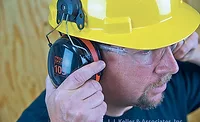
NRRs extend from 0 to 33 decibels in the U.S.

Photo courtesy of Honeywell Industrial Safety
OSHA regulations describe the need for a continuing, effective hearing conservation program for the workplace. The standard requires monitoring of noise levels, notifying employees of monitoring results, and allowing employees or their representatives to observe noise measurements. The requirements of the audiometric testing program are described in detail. The requirement for hearing protection to control employee noise exposure is discussed. The mandates for training and recordkeeping are enumerated.
The requirement for hearing protection to control employee noise exposure seems simple, but whether the hearing protection is effective at controlling the noise exposure is where the issue can become more complex. As consumers, we all want to know that the products we buy perform as advertised – in other words, that they are effective. This is especially true with safety equipment and PPE. With hearing protection, and earplugs in particular, the performance is highly dependent on the user.
Some safety equipment, just like other tools we use, requires the user to be trained on its proper and effective use. For instance, I’m quite sure my tablet computer has capabilities beyond what I am using it for. I need someone to do one-on-one training with me in order for me to truly get the most of its capabilities to meet my needs. Similarly, earplug users often need one-on-one training to get the most of the product’s capability to meet their needs. The theoretical way to determine if hearing protection is capable of controlling the noise is to estimate the adequacy of the attenuation using the Noise Reduction Rating (NRR) per OSHA’s Appendix B.
Capability of the protector (measured by NRR)
If you have studied the attenuation charts on boxes of hearing protectors, you can see the Noise Reduction Rating (NRR) is not simply a mathematical average of the attenuation values. In 1979, the U.S. Environmental Protection Agency* (EPA) standardized the NRR formula that we still use today to rate hearing protectors.
NRR [Noise Reduction Rating] – This rating is used in the United States, and is accepted for use in a variety of other countries. The current range of NRRs available in the U.S. market extends from 0 to 33 decibels. Published by EPA in 1979, the NRR labeling requirement is a standardized format for all hearing protectors distributed in the U.S.
Here are the significant steps used in calculating the NRR, and an explanation of why each step is important:
Laboratory testing
Hearing protectors are tested in a laboratory sound room intended to simulate a typical noisy setting in industry. At least ten subjects participate and each subject is tested no fewer than three times, meaning there are at least 30 attenuation measurements at each frequency. Subjects are taught to take a hearing test.
The hearing protection is fitted by the experimenter for a proper and good fit. Subjects are tested across a range of test frequencies to determine their hearing thresholds with ears open (no hearing protectors) and occluded (with hearing protectors). The difference between those measurements is the noise reduction of the hearing protection device (HPD). Each subject is tested multiple times with the experimenter fitting the hearing protector each time. The attenuation measurements for all subjects’ multiple tests are then input into a formula.
Standard deviation
To account for individual variation in fitting hearing protectors over a large population (remember, the laboratory only tested a minimum of 10 subjects), a correction factor of two standard deviations is subtracted from each attenuation value. By subtracting two standard deviations, we can generalize the results from a small sample of 10 subjects to a larger population: for a population that is properly fitted with the HPD in the same manner as the laboratory subjects, 98 percent of the population would be expected to achieve these same attenuation values in the lab.
Subtraction from hypothetical noise
To account for some differences between the laboratory test sounds and real-world noise, the adjusted attenuation values (mean minus two standard deviations) are subtracted from “hypothetical noise levels,” standardized noise levels at each frequency band. This step is critical so that we might apply the final NRR to a hearing protector user, and not to a laboratory microphone which detects sound differently than a human ear does.
Logarithmic addition
We combine all the adjusted attenuated levels into a single number. Attenuation values are measured in decibels, which are logarithmic numbers. Logarithms cannot just be added mathematically (80 dB plus 80 dB does not equal 160 dB). They are added in a special way that accounts for the exponents.
Correction factor
Finally, a 3 dB correction is built into the NRR calculation to account for the fact that not all noise spectrums are the same. The assumed noise spectrum used in the NRR calculation may be quite different than the actual spectrum in the workplace, so this 3 dB correction is a cushion for “spectral uncertainty.” (Note: There is an additional 7 dB correction factor used in applying the NRR to A-weighted noise measurements, also for “spectral uncertainty.”)
Corrections & cushions
The result of this lengthy calculation is the NRR. The NRR is significantly lower than the average attenuation across all frequencies because the NRR contains corrections and cushions to make it applicable to a broader population. While it is not a perfect real-world measure of attenuation, the NRR is the most standardized method currently in use for describing a hearing protector’s attenuation capability in a single number. The NRR estimates the amount of protection achievable by 98 percent of users in a laboratory setting when hearing protectors are properly fitted.
Confusion about the proper application of a hearing protector’s rated attenuation has led many to assume that most workers obtain protection at a level that equals noise minus NRR. But the amount of noise reaching the eardrum of a particular worker is completely unknown. Various derating schemes have also been proposed but none predict the protection obtained by a given user. The solution for determining if the hearing protection is, in fact, effective for a given user is individual fit testing.
* The EPA labeling standard is defined in Code of Federal Regulations (CFR) 40, Part 211, Subpart B – Hearing Protective Devices.
Looking for a reprint of this article?
From high-res PDFs to custom plaques, order your copy today!