ISHN logo
search
cart
facebook twitter linkedin youtube
  • Sign In
  • Create Account
  • Sign Out
  • My Account
ISHN logo
  • NEWS
    • Today's News
    • Global Safety News
    • Government Regulations
  • PRODUCTS
    • Product Innovations
    • Featured Products
  • TOPICS
    • Environmental Health and Safety
    • Facility Safety
    • Workplace Health
    • Occupational Safety
    • PPE
    • More Topics
  • CONSTRUCTION
  • TECHNOLOGY
  • COLUMNS
    • Best Practices
    • Dave Johnson: What’s going on
    • Editorial Comments
    • Leading Safety
  • MULTIMEDIA
    • ISHN Podcast
    • Videos
    • Cold Stress Education Quiz
    • Webinars
    • White Papers
  • MORE
    • Buyer's Guide
    • Newsletters
    • Convention Companion
    • Polls
    • Events
    • ISHN Store
    • Sponsor Insights
  • EMAGAZINE
    • eMagazine
    • Archived Issues
    • Contact
    • Advertise
  • JOIN TODAY!
Today's Safety NewsFacility Safety

Emergency preparedness eroding, study finds

Cutbacks threaten ability to respond to bioterror attacks, natural disasters
December 28, 2011

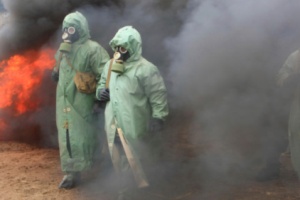
bioterror attackFederal and state budget cuts are endangering key programs that detect and respond to bioterrorism, new disease outbreaks and natural or accidental disasters, a new report finds.

The ninth annual Ready or Not? Protecting the Public from Diseases, Disasters, and Bioterrorism report from the Trust for America's Health (TFAH) and Robert Wood Johnson Foundation (RWJF) identified what it says are at-risk emergency preparedness programs:

• 51 of the 72 cities in the Cities Readiness Initiative are at risk for elimination; the Initiative supports the ability to rapidly distribute and administer vaccines and medications during emergencies;
• All 10 state labs with "Level 1" chemical testing status are at risk for losing top level capabilities, which could leave the U.S. Centers for Disease Control and Prevention (CDC) with the only public health lab in the country with full ability to test for chemical terrorism and accidents;
• 24 states are at risk for losing the support of Career Epidemiology Field Officers - CDC experts who supplement state and local gaps to rapidly prevent and respond to outbreaks and disasters, such as during the H1N1 flu pandemic and responding to the health impact of the Gulf Oil Spill in 2010; and
• The ability for CDC to mount a comprehensive response to nuclear, radiologic and chemical threats as well as natural disasters is at risk due to potential cuts to the National Center for Environmental Health. All 50 states and Washington, D.C. would lose the support CDC provides during these emergencies.

"We're seeing a decade's worth of progress eroding in front of our eyes," said Jeff Levi, PhD, Executive Director of TFAH.  "Preparedness had been on an upward trajectory, but now some of the most elementary capabilities - including the ability to identify and contain outbreaks, provide vaccines and medications during emergencies, and treat people during mass traumas - are experiencing cuts in every state across the country."

Combined federal, state and local budget cuts mean public health departments can no longer sustain a number of basic elements of preparedness. In the past year, 40 states and Washington, D.C. cut state public health funds - with 29 of those states and D.C. cutting their budgets for a second year in a row and 15 states for three years in a row. Federal funds for state and local preparedness declined by 27 percent from fiscal year (FY) 2005 to 2011 (adjusted for inflation) - and the President's proposed budget for FY 2012 represents another $72 million in cuts for Public Health Emergency Preparedness (PHEP) funding.

"Americans expect the public health system to have the capability to competently protect their health during emergencies," according to Mel Kohn, MD, MPH, State Health Officer and Public Health Director of the Oregon Health Authority.  Kohn warned: "We will be unable to absorb reductions of this magnitude simply by finding efficiencies. We have reached the point where our ability to do this work will be seriously compromised, with life and death consequences."

"During the anthrax attacks and Hurricane Katrina, we witnessed what happens when public health doesn't have the technology, resources, workforce or training needed to respond to emergencies," said James S. Marks, Senior Vice President and Director of the Health Group of RWJF. "The old adage is that it's better to be safe than sorry.  Unfortunately if we ignore preparedness now, we'll be sorry later when the next emergency strikes."

The report's authors recommend:

• Assuring dedicated funding and strengthening the public health preparedness core capabilities;
• Improving biosurveillance to rapidly detect and track outbreaks or attacks;
• Improving research, development and manufacturing of vaccines and medications;
• Enhancing the ability to provide care for a mass influx of patients during emergencies;
• Providing better support to help communities cope with and recover from disasters; and
• Coordinating food safety with other preparedness efforts through the strategic implementation of the FDA Food Safety Modernization Act of 2011.
 

KEYWORDS: chemicals disasters health outbreaks

Share This Story

Looking for a reprint of this article?
From high-res PDFs to custom plaques, order your copy today!

Recommended Content

JOIN TODAY
to unlock your recommendations.

Already have an account? Sign In

  • forklift safety

    Exploring the latest technologies in forklift safety

    With more staff and more stock in warehousing now more...
    Facility Safety
    By: Josh Cramer
  • welding

    All about welder’s flash or arc eye

    A flash burn is a painful inflammation of the cornea,...
    Environmental Health and Safety
  • dangerous jobs

    The 10 most dangerous jobs in the U.S.

    On-the-job deaths have been rising — hitting the highest...
    Occupational Safety
    By: Benita Mehta
Manage My Account
  • eMagazine Subscriptions
  • ISHN Newsletter & Other Newsletter Alerts
  • Online Registration
  • Manage My Preferences
  • Subscription Customer Service

More Videos

Sponsored Content

Sponsored Content is a special paid section where industry companies provide high quality, objective, non-commercial content around topics of interest to the ISHN audience. All Sponsored Content is supplied by the advertising company and any opinions expressed in this article are those of the author and not necessarily reflect the views of ISHN or its parent company, BNP Media. Interested in participating in our Sponsored Content section? Contact your local rep!

close
  • man wearing the the Sundström SR200 Full Face Mask Respirator
    Sponsored byOHD

    5 Fit Testing Mistakes That Could Cost You

  • This image shows Magid AcuSpex polarized blue mirrored safety glasses.
    Sponsored byMagid Glove and Safety

    Construction PPE Guide: What Crews Need for Each Task

  • lone worker in confined space
    Sponsored byAlphasense Ltd.

    GET THE LEAD OUT of your Safety Oxygen Sensors!

Popular Stories

SpaceX 7 launch

OSHA Investigating Fatal Fall at SpaceX Starbase

dust explosion

Tennessee OSHA Issues Record $3.1M Fine After Deadly Explosion at Munitions Plant

Worker Impairment

How to Tell When a Co-Worker is Impaired? A Safety Pro’s Challenge

top 10 most dangerous jobs

Poll

Seasonal Readiness

With the federal heat stress prevention rule on the horizon, which area of your safety program needs the most attention?
View Results Poll Archive

Products

Surviving an OSHA Audit A Management Guide, 2nd Edition

Surviving an OSHA Audit A Management Guide, 2nd Edition

See More Products

ISHN Podcasts

Related Articles

  • Study finds surprising differences in CPR willingness

    See More
  • Study finds link between cleaner SoCal air, better lung function in kids

    See More
  • Telling the truth leads to better health, study finds

    See More

Related Products

See More Products
  • 3E

    Safety Professional's Reference and Study Guide, Third Edition

See More Products

Related Directories

  • DQE Inc.

    Since our founding in 1990, DQE Inc. has remained a committed domestic manufacturer of portable decontamination shower systems and developer of preparedness support solutions. We champion a practical approach to product selection and development informed by our background in national healthcare emergency preparedness and on-scene emergency response. We bring our experience, passion, and knowledge to customers every day to address complex industry challenges. We continue to design novel products and solutions for a diverse mix of organizations across several industries. The DQE global distribution network and export experience allow us to efficiently support multi-national organizations as well. Visit us here to learn more about our legacy and how we continue to help organizations like yours be Ready Now for What’s Next! https://dqeready.com/about-dqe/
×

Become a Leader in Safety Culture

Build your knowledge with ISHN, covering key safety, health and industrial hygiene news, products, and trends.

JOIN TODAY
  • RESOURCES
    • Advertise
    • Contact Us
    • Directories
    • Manufacturing Division
    • Store
    • Want More
  • SIGN UP TODAY
    • Create Account
    • eMagazine
    • Newsletters
    • Customer Service
    • Manage Preferences
  • SERVICES
    • Marketing Services
    • Reprints
    • Market Research
    • List Rental
    • Survey/Respondent Access
  • STAY CONNECTED
    • LinkedIn
    • Facebook
    • YouTube
    • X (Twitter)
  • PRIVACY
    • PRIVACY POLICY
    • TERMS & CONDITIONS
    • DO NOT SELL MY PERSONAL INFORMATION
    • PRIVACY REQUEST
    • ACCESSIBILITY

Copyright ©2026. All Rights Reserved BNP Media, Inc. and BNP Media II, LLC.

Design, CMS, Hosting & Web Development :: ePublishing