ISHN’s annual EHS State of the Nation
Compliance under control, most EHS programs cruise
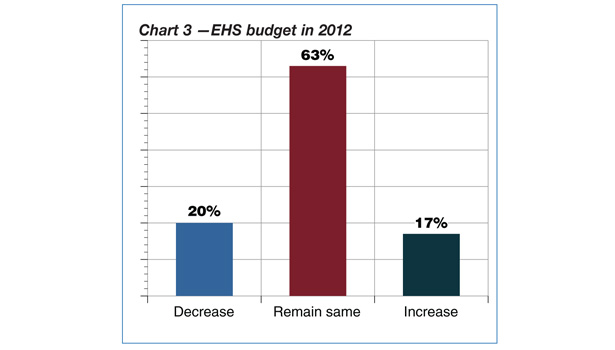
80% will work the same size budgets, or larger budgets; 20% will see budget cuts;
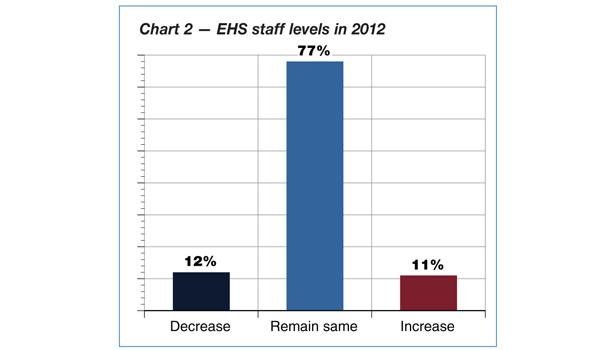
89% will work with the
same size EHS staff or larger; 12% will endure staff cuts;
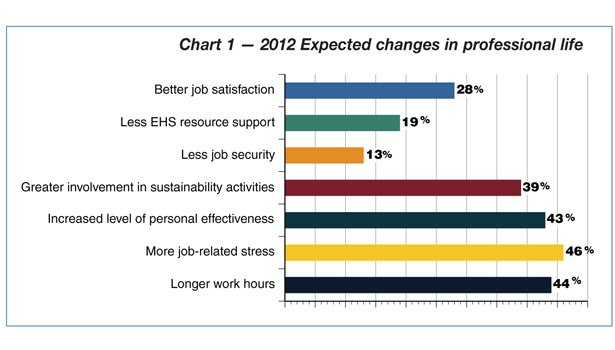
Only 13% of pros believe their job security will wither in 2012;
28% of pros say their job satisfaction will increase; for 64% it will remain the same; for 8% it will decrease.
A mere 4% of pros say the level of their effectiveness as a professional will deteriorate in 2012; 53% say it will remain the same; and 43% say it will increase.
And that’s with 44% of pros working longer hours this year and 46% experiencing higher levels of work stress.
After the storm
|
| Chart 1 Click here to enlarge image |
The calm in the EHS field, with high job satisfaction and few job security concerns, probably reflects that the worst is over in terms of recession-induced layoffs and budget cuts. Downsizing corporate EHS departments began in the early 1990s and after almost two decades seems to have run its course.
That OSHA seems to have run out of gas could be another reason for the calm.
Says one safety trainer: “Man, there’s just nothing coming out of Washington these days.”
Most safety and health pros wouldn’t complain about that.
OSHA’s web site says it all: the lead story on the agency’s homepage in late 2011 was about safe workplace photo contest winners. Contest winners…
OSHA chief Dr. David Michaels apparently hasn’t said anything of note since July — that is the last time one of his speeches was posted on the OSHA web site (as of December 9, 2011). Last speech before that was in April.
Naturally this “OSHA Inaction” irritates safety activists. That is the title of a report issued by Public Citizen in October, 2011. Writes the author: “When it comes to health and safety protections for workers, there has been a regulatory drought.”
You can hear safety and health pros saying, “Now don’t go starting any rain dancing.”
According to Public Citizen, OSHA once was able to develop a rule in less than a year; (that was before K Street became a canyon of lobbyists’ offices); the process now exceeds six years on average.
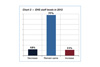
|
| Chart 2 Click here to enlarge image |
Delayed regs
It is true delayed regulations cause continuing harm to certain target populations of workers: those exposed to silica dust, beryllium, diacetyl, for instance, would benefit from stricter protections.
Public Citizen cites OSHA estimates that a rule protecting workers on scaffolding, ladders and towers with fall protection equipment, if issued in 1990 when first proposed, already would have prevented 320 deaths and 104,026 injuries. There is still no final rule.
OSHA also has failed miserably (with the help of K Street trade association attorneys) to keep toxic chemical exposure limits up-to-date for hundreds of substances. And Public Citizen protests that the agency has failed to regulate homicides, a leading cause of workplace deaths, and also failed to regulate heat stress protection.
The country has let down these at-risk employees. Safety and health professionals who consider their job a calling should see that such a calling goes beyond their own worksite to ensure that every employee everywhere goes home safe and healthy at night.

|
| Chart 3 Click here to enlarge image |
Most employees feel safe
But here is why the country is quiet now, and has been for some years, when it comes to workplace safety and health issues:
According to a March, 2011 survey of workers by the American Psychological Association, less than one in ten workers say they are dissatisfied or strongly dissatisfied with the health and safety practices of their employer.
For the overwhelming majority, workplace safety and health is a non-starter, a non-issue. Employer practices are OK. Not all world class certainly, but acceptable to most workers.
Here’s another reason you’re not hearing a hue and cry for more OSHA protections: Most employees feel safe on the job today. It’s not even close to being a significant concern with employees. Only 6 percent according to the APA survey say “unpleasant or dangerous physical conditions” are a very significant source of work stress. 59 percent say work conditions are not at all a significant threat, and 20 percent say they are not very significant.
What, me anxious?

|
| Chart 4 Click here to enlarge image |
Another reason for the calm could relate to the emotional state of work environments today.
A March, 2011 survey by the American Psychological Association on “Stress in the Workplace” found 36 percent of workers typically feel tense or stressed out.
That leaves more than 60 percent not feeling particularly tense or stressed out during the day.
Of course psychologists would be staring at empty waiting rooms in a world without stress, which is why APA places its emphasis where it does in its survey.
And imagine a Time cover story: “Why Most Americans Don’t Feel Particularly Anxious About Anything.”
Well, here’s some good news for you:
77 percent of employees report having a positive relationship with their boss, according to the APA survey.
85 percent enjoy positive relations with their co-workers.
66 percent say they are motivated to do their very best for their employer.
|
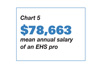
| Chart 5 Click here to enlarge image |
This seems to describe the work environment for most EHS professionals, according to ISHN’s State of the EHS Nation White Paper, based on a survey of readers in October, 2011.
Get this: 92 percent of EHS pros say they expect their job satisfaction to remain the same or increase in 2012. Only 8 percent say the level of satisfaction with their job will deteriorate.
Now it’s true 46 percent of those we surveyed expect their personal work-related stress to increase in 2012. But given the overall high job satisfaction, it seems professionals are saying, “job stress, well sure, what else is new? Comes with the job.”
In other words, it is challenge stress, not distress.
Looking for a reprint of this article?
From high-res PDFs to custom plaques, order your copy today!