Pick the right plug
Fit testing optimizes earplug selection
Several factors should be considered when selecting the best earplug for each worker, including: protection required (noise exposure level, noise reduction, communication), ease of insertion (style, size), compatibility (hygiene, job requirements, other PPE), and fit (comfort, size).
Protection required
Since its inception, the Noise Reduction Rating (NRR) has often been the top factor in selecting hearing protectors — the higher, the better. The NRR is a single number rating that provides an estimation of the capability for that product under controlled test setting, not a predictor of the level of protection any individual will achieve on the job or at home. Using your car’s EPA rated mile per gallon (MPG) as analogy, if you drive on hills, constantly stopping and going, in a vehicle with poor maintenance, your car will not achieve the gas mileage specified for your car. Similarly, if you do not use the earplug exactly as tested, you will not achieve its rated level of protection. And of course, if you had a leak in your gas tank, you’d get poor MPG. It is the same with earplugs; if you have a leak in the seal inside the ear canal, you achieve poor protection.
Ease of insertion
Such a broad variety of earplugs are available that almost everyone can find an earplug that they can insert and fit well — if they know how. Beyond traditional roll-down foam earplugs and multiple-use models that incorporate a firm stem, hybrid earplugs mix the best of both worlds — a firm stem within the foam body — to increase worker utility. There are a few individuals who for one reason or another cannot insert earplugs effectively — banded earplugs or earmuffs are the solution for those workers. Bottom line, training on correct insertion technique of an earplug is critical for a good fit.
Compatibility
An appropriate variety of earplugs should consider compatibility with all required PPE. Gloves can make it hard for workers to roll down foam earplugs. Dirty hands are not good for rolling a foam earplug either. Some environments require certain features for PPE, including hearing protection. For example, in the food industry, many environments require metal and visually detectable earplugs that can be spotted by automated sensors in the production process. Some environments require corded earplugs for workers who often remove their earplugs.
Fit
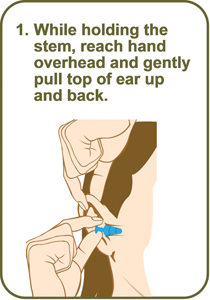
Just as our hands, feet, and waistlines are different sizes and shapes, so are our ear canals! Simply looking at the opening of the ear canal of several people will reveal unique sizes and shapes to each person — and each ear canal! Our ear canals turn and bend to varying degrees; even the openings are round, oval or oblong. Understanding the individual characteristics of each ear is why we coach people to pull their pinna up, out or back [see Figure 1] to get a good fit. By straightening the ear canal, one can achieve a better and more comfortable earplug fit.
Earplug fit testing
There are several strategies employed to select the right hearing protectors for a population of workers, including safety committee evaluations, strategic purchasing programs, and manufacturing sampling. However, research and experience show that earplug fit testing provides the best, quantitative strategy for selection and program optimization.
Through individual earplug fit testing, each worker is provided the opportunity to understand why an earplug is best for their ears and environment, and the one-on-one training to understand how to properly and comfortably fit that earplug. Aggregated over a population of workers, fit testing can make the job of a safety manager easier by showing the appropriate number of earplugs needed for a company’s hearing conservation program. This can guide both purchasing decisions and inventory management.
For example, one company had facilities in northern Wisconsin with an employee population of Caucasian males aged 25-65 and another facility in southern California with a population diverse of genders and ethnicity. At each facility, all employees were fit tested. The facility in Wisconsin had 3-4 different earplugs that fit everyone, whereas the location in southern California required 8-9 different earplugs to appropriately fit its entire noise-exposed population.
Earplug fit testing may not necessarily add more earplugs to the HPD portfolio; it may simply reveal the need for some individuals to change their earplug of choice. For example, one company offered its workers a small selection of earplugs including a few sizes of single-use foam earplugs, and a few sizes of multiple-use earplugs, though most workers wore the large foam earplug.
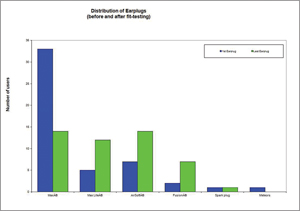
Figure 2 shows the number of workers using each type of earplug initially (blue bars) versus the number of workers using each type after individual fit-testing (green bars). Fit-testing revealed that some workers did not achieve adequate protection with the large foam earplug. The average attenuation on first fit test with their original earplug was 14 dB and increased to 23 dB after appropriate training and selection of a different earplug. Of the 53 employees in this analysis, 14 (26 percent) kept the same earplug since it was providing appropriate attenuation for their noise exposure, while 34 (64 percent) switched to a different earplug in the existing inventory and about 9 percent (5 workers) did not achieve adequate attenuation with any of the earplugs tested. Those individuals must use earmuffs until (and unless) an appropriate earplug can be verified.
Earplug fit testing is a very individual issue. In the above analysis, individual attenuation changed by amounts ranging from a few decibels (dB) to over 25 dB(A).
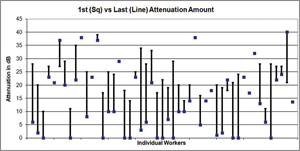
Figure 3 shows the amount of protection provided in the first test using the workers own choice of earplug (blue squares) versus the amount of attenuation achieved with the final earplug of choice (black lines). The vast majority of the workers increased their protection significantly. Also note that one individual (on the right of the chart) went from approximately 40 dB of attenuation to a little over 20 dB. In this instance, the highest attenuation may be overprotecting the worker. With their original earplug, this particular worker might be so isolated with extremely high levels of attenuation that they become a safety risk. By selecting an earplug with a more appropriate level of attenuation, the worker and his team were safely protected and the worker was able to maintain situational awareness without risking noise-induced hearing loss.
Looking for a reprint of this article?
From high-res PDFs to custom plaques, order your copy today!