Obama moves to improve chemical facility safety
Executive Order gets approval from CSB, AIHA
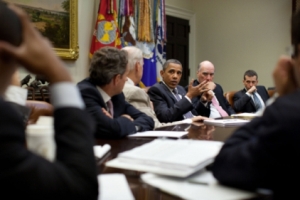 President Barack Obama has issued an Executive Order intended to improve chemical facility safety and security in coordination with owners and operators.
“Chemicals, and the facilities where they are manufactured, stored, distributed, and used, are essential to today's economy,” the order notes. “Past and recent tragedies have reminded us, however, that the handling and storage of chemicals are not without risk. The Federal Government has developed and implemented numerous programs aimed at reducing the safety risks and security risks associated with hazardous chemicals. However, additional measures can be taken by executive departments and agencies (agencies) with regulatory authority.”
Among other things, the plan will:
- take into account the capabilities, limitations, and needs of the first responder community;
- identify ways to ensure that State homeland security advisors, State Emergency Response Commissions (SERCs), Tribal Emergency Response Commissions (TERCs), Local Emergency Planning Committees (LEPCs), Tribal Emergency Planning Committees (TEPCs), State regulators, and first responders have ready access to key information in a useable format
- identify areas, in collaboration with State, local, and tribal governments and private sector partners, where joint collaborative programs can be developed or enhanced
- identify opportunities and mechanisms to improve response procedures and to enhance information sharing and collaborative planning between chemical facility owners and operators, TEPCs, LEPCs, and first responders;
- identify means for Federal technical assistance to support developing, implementing, exercising, and revising State, local, and tribal emergency contingency plans, including improved training; and
- examine opportunities to improve public access to information about chemical facility risks consistent with national security needs and appropriate protection of confidential business information.
A "glaring need"
U.S. Chemical Safety Board (CSB) Chairperson Rafael Moure-Eraso said the order should help prevent chemical accidents, such as the recent explosion and fire in West, Texas. Moure-Eraso said his agency’s investigation into the incident “showed a particularly glaring need for comprehensive regulation of reactive chemical hazards and in particular ammonium nitrate.
“The destruction I personally saw there – the obliteration of homes, schools, and businesses by an ammonium nitrate explosion – was almost beyond imagination. The loss of life was horrible. It is my hope that this Executive Order will spur development of regulation and enforcement for the safe handling of ammonium nitrate and other gaps in the coverage of reactive hazards that the CSB has previously identified to help prevent future incidents.”
Moure-Eraso is especially pleased that the Executive Order calls for the revision and strengthening of EPA’s Risk Management Program and OSHA’s Process Safety Management standard.
“The CSB has long urged such improvements, specifically that reactive hazards - such as ammonium nitrate – be more comprehensively regulated under RMP and PSM.”
A step in the right direction
American Industrial Hygiene Association (AIHA) President Barbara J. Dawson, CIH, CSP said the AIHA supports the order and the increased cooperation of government agencies in information sharing.
“It’s unfortunate that it takes an event such as fertilizer explosion in West, Tx., to move forward with increased efforts to protect workers but this executive order is a step in the right direction,” Dawson said.
Beating the anti-regulatory drum
The National Council for Occupational Safety and Health (National COSH) said the order is an important first step in addressing risks posed by chemical facilities – but it must be followed up by new regulations.
“President Obama should be commended for recognizing the urgent need to act to protect workers and the public, taking action through executive order instead of attempting to work through the legislative and bureaucratic logjam of today’s Washington culture,” said Tom O’Connor, executive director of National COSH.
“If industry stakeholders march in beating the anti-regulatory drum, the administration must not kowtow to their demands,” O’Connor said. “To adequately respond to the dangers posed by chemical facilities and other dangerous workplaces, further federal regulatory action is needed.”
The working group that will implement the order will be co-chaired by the Secretary of Homeland Security, the Administrator of the Environmental Protection Agency (EPA), and the Secretary of Labor. It will also include representatives from the departments of Justice, Agriculture and Transportation.
The order directs the group to consult with with representatives from the Council on Environmental Quality; the National Security Staff; the Domestic Policy Council; the Office of Science and Technology Policy; the Office of Management and Budget (OMB); the White House Office of Cabinet Affairs
Looking for a reprint of this article?
From high-res PDFs to custom plaques, order your copy today!


