Understand weld fume management needs
If a company finds itself exceeding OSHA’s regulations for permissible exposure limits (PEL) of weld fume — currently set at 5 milligrams per cubic meter for manganese, for example — or the threshold limit values (TLV) set forth by ACGIH — 0.02 milligrams per cubic meter for the same element — it is important to implement a practical fume management solution. OSHA’s hierarchy of controls offers a good example of control measures in order of their recommended implementation.
Process modification or substitution is a first step. Companies should move toward a lower fume generation process if possible and/or modify the weld settings. Switching to low manganese wires can further help.
If the above is not possible, engineering controls — implementing source capture via an appropriate fume extraction system — is the next recommended step. Source capture removes contaminated air at the source, before it reaches a welding operator’s breathing zone. It can also help improve visibility by minimizing weld fume accumulation on the helmet lens. This step is among the most effective and practical solutions, and one that will be discussed at length in this article.
Companies should know, however, that administrative/work practice controls — teaching employees proper weld positioning to minimize exposure to the weld fume path — are another important way to protect them, as is the addition of personal protective equipment (PPE). Powered air purifying respirators (PAPRs), air supply helmets and/or half-masks respirators are all designed for this purpose. In addition to removing contaminants, the airflow in the PPE cools the welding operator’s face, making the environment more comfortable.
Source capture options
Every company has different weld fume management needs and will, therefore, require different methods to reduce weld fume exposure. Fume extraction systems come in multiple shapes and sizes, with each type having its own advantages, limitations and best applications.
Portable models work well for applications in small spaces or hard-to-reach areas. They are also good for maintenance and repair operations or contract jobs where welding doesn’t occur on a regular basis. Portable fume extraction systems can couple with fume extraction guns that capture weld fume directly at the source via a fume chamber over the gun nozzle or by way of a flexible funnel nozzle attachment. These attachments offer high levels of suction and employ small diameter hose or ducting with lower overall air volume, meaning the source capture distance is much closer to the weld, usually about six inches away.
Mobile floor models are another option and feature an adjustable extraction arm that the welding operator can move toward the weld pool to remove the fume from up to 18 inches away. These models work well in maintenance and repair operations, fabrication shops and manufacturing facilities where mobility is needed or overhead obstructions make them necessary.
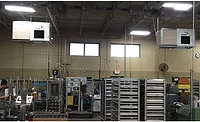
For companies with dedicated welding cells, stationary fume extraction systems (ceiling or wall-mounted) are a good choice. They feature an extraction arm that is adjustable, so it is simple for the welding operator to shorten the distance to the arc and efficiently remove the weld fume from the area. Wall-mounted versions can be expanded to two arms, taking the footprint off the shop floor and allowing for more room in the weld cell to expand welding operations.
Companies with multiple arcs or with robotic welding cells may want to consider a centralized fume extraction system. These systems offer fume capture capabilities ranging from 2,000 to 60,000 cubic feet per minute (cfm). They can be customized with mechanical extraction arms, backdraft hoods and tables and/or overhead collection hoods that cover the welding area.
Advanced technology: Increasing fume extraction distances
While exceptionally effective at protecting the welding operator’s immediate breathing area, the source capture options mentioned previously do have one key disadvantage when it comes to applications with large weldments (such as those found in heavy equipment manufacturing or heavy fabrication) or areas within the weld cell that include obstructions. Namely, the arms are difficult to position over these areas without significant welding operator interaction.
For example, with conventional fume extraction systems, the welding operator must pause repeatedly when working on long welds to reposition the extraction arm over the welding area. That interaction can lead to downtime and, potentially, weld defects due to the repeated starts and stops in the weld. It can also jeopardize the welding operator’s safety, as he or she may focus too much on completing the weld and choose to not adjust the arm in an effort to meet productivity demands.
Advancements in source capture technology are helping to address these issues by increasing the fume extraction area to a greater width and distance — up to four feet wide and five feet away.
This technology operates by way of a negative pressure zone. Air is suctioned into the arm at a standard fume capture rate of around 900 cfm, while simultaneously, clean filtered air moves out of the arm (at a point just above the hood portion of the extraction arm) at approximately a 90-degree angle.
Additionally, some of the air that blows out of the extraction arm “short circuits” and circles back around, effectively allowing a portion of the filtered air to capture more fume particulates before being suctioned up again. Combined, these actions create a defined area of source capture, which funnels the weld fume particulates toward the center of the arm to maximize the extraction process — typically removing up to 95 percent of the weld fume in the area.
Ultimately, the benefit to creating a wider, deeper and more defined source capture zone is threefold: one, there is less downtime for the welding operator to pause during welding to reposition the fume extraction arm. Two, because the fume extraction arm can capture fume at a greater distance, there is less chance of obstructing the welding operator’s vision, offering a greater opportunity to complete a quality weld. Three, and most important, the consistent extraction arm position creates a safer environment.
This advanced technology is most effective when strong air currents or turbulence (e.g., from fans or open doors) are kept at a minimum. Welding operators can manage the air currents by using welding screens, curtains or other similar partitions to block the stronger air movements. They should maintain at least a five-foot clearance on all sides of the fume extraction system when setting up a partition.
The fume extraction capabilities of these systems are best realized when placing the extraction arm at 30 to 45 degrees off horizontal, either in front or at the side of the weld area so that backfill air can flow freely and fume is pulled away from the breathing zone.
Additional features and benefits of advanced technologies
Fume extraction systems with these advanced technologies offer other features to create a safer, more productive welding environment.
When working in restricted areas, for example, welding operators can make the fume capture area narrower, and more direct, by way of a dial. This prevents the discharge airflow from deflecting off parts or swirling around. It also increases suction. Such a feature helps ensure that the airflow won’t interfere with the shielding gas coverage and lead to weld quality issues.
These fume extraction systems, which operate on three-phase power, have auto phasing to assure correct blower rotation, minimizing the need to re-phase the plug when moved. They also feature automatic cleaning mechanisms. Every time the welding operator shuts down the system, it goes through a reverse pulse cleaning cycle, which cleans the filter from the inside out. The process removes the weld fume particulates from the filter, depositing them into a drawer for later disposal. This cleaning cycle helps extend the filter life and minimize downtime for changeover. Welding operators stay safer while also gaining more time to weld instead of having to perform maintenance.
Making the source capture decision
Making the decision to employ source capture in the welding operation is an easy one — it’s simply a good business practice. It can help companies maintain compliance with regulatory bodies, avoid potential fines and create a work environment that is safer and more comfortable for employees.
Selecting the most appropriate system for a given welding operation, however, can be more difficult. There are considerations to make in terms of cost, space requirements and the actual welding application. As a best practice, whether choosing a conventional fume extraction system or one with the advanced technologies discussed here, consult with a certified industrial hygienist and/or source capture equipment provider for recommendations. If the fume abatement needs exceed those of a source capture system, these individuals can also help address the matter of personal protective equipment or respirators as alternative solutions.
Looking for a reprint of this article?
From high-res PDFs to custom plaques, order your copy today!