ISHN logo
search
cart
facebook twitter linkedin youtube
  • Sign In
  • Create Account
  • Sign Out
  • My Account
ISHN logo
  • NEWS
    • Today's News
    • Global Safety News
    • Government Regulations
  • PRODUCTS
    • Product Innovations
    • Featured Products
  • TOPICS
    • Environmental Health and Safety
    • Facility Safety
    • Workplace Health
    • Occupational Safety
    • PPE
    • More Topics
  • CONSTRUCTION
  • TECHNOLOGY
  • COLUMNS
    • Best Practices
    • Dave Johnson: What’s going on
    • Editorial Comments
    • Leading Safety
  • MULTIMEDIA
    • ISHN Podcast
    • Videos
    • Cold Stress Education Quiz
    • Webinars
    • White Papers
  • MORE
    • Buyer's Guide
    • Newsletters
    • Convention Companion
    • Polls
    • Events
    • ISHN Store
    • Sponsor Insights
  • EMAGAZINE
    • eMagazine
    • Archived Issues
    • Contact
    • Advertise
  • JOIN TODAY!
Today's Safety NewsOccupational Safety

All about arc flash: definitions, dangers, stats, causes and prevention
November 28, 2013

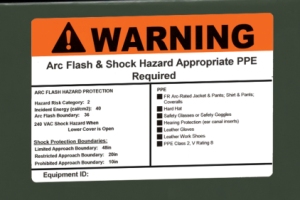
arc flash warningDefinitions and Statistics

According to the National Fire Protection Association (NFPA), arc-flash is an electric current that passes through air when insulation or isolation between electrified conductors is no longer sufficient to withstand the applied voltage. The flash is immediate, but the result of these incidents can cause severe injury including burns. Each year more than 2,000 people are treated in burn centers with severe arc flash injuries.

Five (5) to ten (10) arc explosions occur in electric equipment every day in the United States, according to statistics compiled by CapSchell, Inc., a Chicago based research and consulting firm that specializes in preventing workplace injuries and deaths. This number doesn’t even include cases in which the victim is sent to an ordinary hospital or clinic for medical treatment. Instead, these incidents involve injuries so severe the victims require treatment from a special burn unit. Note that these are burn injuries, not electrical shocks. It is not necessary to touch live components to sustain an arc flash injury.

The flash protection boundary is an imaginary sphere that surrounds the potential arc point “within which a person could receive a second degree burn if an electrical arc flash were to occur,” according to NFPA70E. This standard also defines the incident energy level as “the amount of energy impressed on a surface, a certain distance from the source, generated during an electrical arc event.”

A calorie is the energy required to raise one gram of water one degree Celsius at one atmosphere. Second degree burns occur at 1.2 calories per centimeter squared per second. One calorie per centimeter squared per second can be equal to holding your finger over the tip of the flame of a cigarette lighter for one second.

Electrical arcs produce some of the highest temperatures known to occur on earth, up to 35,000°F (19,426 °C). This is four times the temperature of the surface of the sun which is about 9000°F (4982°C).

Causes of arc flashes

An arc flash may be caused by a tool, rodent or other element in a breaker or service area, that could compromise the distance between energized components. Incidents often occur when personnel fails to ensure that the equipment has been properly de-energized.

The intense heat from arc causes a sudden expansion of air. This results in a blast with very high air pressure (lightning are natural arcs).

When materials vaporize, they expand in volume (Copper-67,000 times, water 1670 times sq).

Dangers of arc flashes

An arc flash can cause minor injuries, third degree burns and potential death as well as other injuries including blindness, hearing loss, nerve damage and cardiac arrest.

Fatal burns can occur when the victim is several feet from the arc. Serious burns are common at a distance of 10 feet. Staged tests have shown temperatures greater than 437°F (225°C) on the neck and hands of a person standing close to an arc blast.

Arcs spray droplets of molten metal at a high speed. Molten metal from an arc can be propelled for distances up to 10 feet. Blast shrapnel can penetrate the body.

Blast pressure waves have thrown workers across rooms and knocked them off ladders. Pressure on the chest can be higher then 2000 lbs/sq. ft.

Clothing can be ignited several feet away. Clothed areas can be burned more severely than exposed.

Arc Flash Safety and Prevention

Arc flash analysis must be performed prior to allowing personnel to work on energized equipment. The analysis defines the flash protection boundary distance and the type of Personal Protection Equipment (PPE) required.

OSHA is an enforcer of safety practices in workplaces within the United States. OSHA 1910.132 (d) and 1926.28(a) states that the employer is responsible to assess the hazards in the work place, and to select, have and use correct PPE and document the assessment. The employer is required to conduct hazard assessment in accordance with 29CFR1910.132(d)(1). Employers who conduct the hazard/risk assessment, and select and require their employees to use PPE, as stated in the NFPA 70E standard, 2004 edition, are deemed in compliance with the Hazard Assessment and Equipment Selection OSHA Standard.

The most common and industry accepted Personal Protective Equipment is flame resistant (FR) clothing.

Source: Rockwell Automation www.rockwellautomation.com

KEYWORDS: Arc flash arc flash protection FR clothing injuries

Share This Story

Looking for a reprint of this article?
From high-res PDFs to custom plaques, order your copy today!

Recommended Content

JOIN TODAY
to unlock your recommendations.

Already have an account? Sign In

  • forklift safety

    Exploring the latest technologies in forklift safety

    With more staff and more stock in warehousing now more...
    Facility Safety
    By: Josh Cramer
  • welding

    All about welder’s flash or arc eye

    A flash burn is a painful inflammation of the cornea,...
    Environmental Health and Safety
  • dangerous jobs

    The 10 most dangerous jobs in the U.S.

    On-the-job deaths have been rising — hitting the highest...
    Occupational Safety
    By: Benita Mehta
Manage My Account
  • eMagazine Subscriptions
  • ISHN Newsletter & Other Newsletter Alerts
  • Online Registration
  • Manage My Preferences
  • Subscription Customer Service

More Videos

Sponsored Content

Sponsored Content is a special paid section where industry companies provide high quality, objective, non-commercial content around topics of interest to the ISHN audience. All Sponsored Content is supplied by the advertising company and any opinions expressed in this article are those of the author and not necessarily reflect the views of ISHN or its parent company, BNP Media. Interested in participating in our Sponsored Content section? Contact your local rep!

close
  • man wearing the the Sundström SR200 Full Face Mask Respirator
    Sponsored byOHD

    5 Fit Testing Mistakes That Could Cost You

  • This image shows Magid AcuSpex polarized blue mirrored safety glasses.
    Sponsored byMagid Glove and Safety

    Construction PPE Guide: What Crews Need for Each Task

  • lone worker in confined space
    Sponsored byAlphasense Ltd.

    GET THE LEAD OUT of your Safety Oxygen Sensors!

Popular Stories

SpaceX 7 launch

OSHA Investigating Fatal Fall at SpaceX Starbase

dust explosion

Tennessee OSHA Issues Record $3.1M Fine After Deadly Explosion at Munitions Plant

Worker Impairment

How to Tell When a Co-Worker is Impaired? A Safety Pro’s Challenge

top 10 most dangerous jobs

Poll

Seasonal Readiness

With the federal heat stress prevention rule on the horizon, which area of your safety program needs the most attention?
View Results Poll Archive

Products

Surviving an OSHA Audit A Management Guide, 2nd Edition

Surviving an OSHA Audit A Management Guide, 2nd Edition

See More Products

ISHN Podcasts

Related Articles

  • Video about arc flash boundaries

    See More
  • What you should know about an arc flash

    See More
  • IEEE 1584: What to know about your next arc flash analysis

    IEEE 1584: What to know about your next arc flash analysis

    See More

Related Products

See More Products
  • 9781138072824.jpg

    Accident/Incident Prevention Techniques, Second Edition

See More Products

Related Directories

  • RescueStat

    RescueStat delivers AED remote monitoring, program management, and virtual CPR/AED training to keep your organization prepared and protected. Our mission is to save lives and empower teams to respond effectively to Sudden Cardiac Arrest emergencies.
×

Become a Leader in Safety Culture

Build your knowledge with ISHN, covering key safety, health and industrial hygiene news, products, and trends.

JOIN TODAY
  • RESOURCES
    • Advertise
    • Contact Us
    • Directories
    • Manufacturing Division
    • Store
    • Want More
  • SIGN UP TODAY
    • Create Account
    • eMagazine
    • Newsletters
    • Customer Service
    • Manage Preferences
  • SERVICES
    • Marketing Services
    • Reprints
    • Market Research
    • List Rental
    • Survey/Respondent Access
  • STAY CONNECTED
    • LinkedIn
    • Facebook
    • YouTube
    • X (Twitter)
  • PRIVACY
    • PRIVACY POLICY
    • TERMS & CONDITIONS
    • DO NOT SELL MY PERSONAL INFORMATION
    • PRIVACY REQUEST
    • ACCESSIBILITY

Copyright ©2026. All Rights Reserved BNP Media, Inc. and BNP Media II, LLC.

Design, CMS, Hosting & Web Development :: ePublishing