Safety Experts from FANUC, Universal Robots, Amazon, NVIDIA, OSHA, and more to address robot safety standards, AI safety, mobile robotics, and global compliance.
Even as companies are just now realizing the full array of benefits provided by Industry 4.0, there is a new industrial revolution on the horizon that integrates mankind and machine in ways only sci-fi movies once imagined. Industry 5.0 promises a workforce of human and machine collaborators capable of lightning fast efficiency with reduced risk.
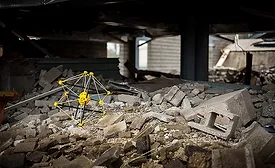
It’s a bird, it’s a plane… no, it’s a Squishy Robot, dropped from a helicopter or a drone to transmit crucial environmental data to emergency responders at disaster scenes.
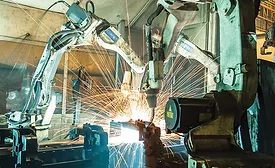
Advances in machining and robotics have increased operational efficiency in virtually all manufacturing sectors. Production and profits would plunge if operations were done by hand alone. History has shown us that the advantages of machines are undeniable.
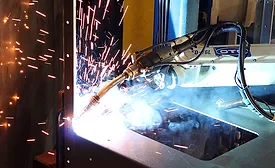
Pre-engineered robotic welding cells make automation available for a wide range of applications. Installing robots in facilities of all sizes can boost productivity by increasing weld speed, efficiency and quality. They also reduce cycle time by allowing a single operator to fixture the next piece while the robot welds.
Robotic welding provides manufacturers with several competitive advantages. Most importantly, it makes them more productive while generating more consistent, higher quality welds and reducing waste. Robots also empower manufacturers to address the current shortage of skilled welders to recruit.
New force and pressure measurement system, PROBms, guarantees the standard-compliant safety of human robot collaboration (HRC)
August 1, 2018
With the new rental-based force and pressure measurement system, PROBms, Pilz now offers a complete package for validation of human-robot collaborations (HRC) in accordance with ISO/TS 15066. So the limit values for force or pressure of the robot movement, as specified by the ISO/TS, can now be measured precisely and, therefore, validated using PROBms.
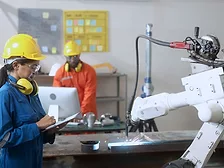
As industrial robots continue to become more advanced, more capable and more popular, the need for comprehensive robot safety standards increases. Robots can be dangerous to operate – especially when safety protocols aren’t followed.