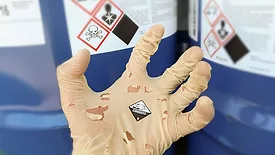
The advanced properties of the Taeki5® protective gears are allowing safety professionals to address the toughest requirements for Hand Arm Body protection and ensure a safer working environment
This week’s Top Products of the Week include head, hand and fall protection and a solution for increasing visibility in those dangerous workplace intersections:
The course is aimed at sales people working for safety distributorships and glove manufacturers.
May 15, 2013
At the International Glove Association (IGA) annual meeting held in March in Palm Coast, FL, the group announced plans for a two-day educational course in all things industrial gloves, to be held in 2014
Often, employees who are exposed to chemical hazards need to use personal protective equipment (PPE) that includes gloves and, occasionally, chemical protective suits. Chemical protective suits and gloves come in a variety of materials, and no one material protects against all chemical hazards.
Does your work involve the use of chemicals? You might think that injury to employees’ hands through exposure to chemicals is a thing of the past in workplaces. The risks are so well documented and the methods of protection so well known. But think again.
Work gloves- Leather - sparks, moderate heat, blows, chips, and rough objects; metal mesh (aluminized) – heat (require an insert of synthetic materials); canvas (aramid fiber and other synthetic materials) – heat and cold, cut and abrasion resistant.
Craig Wagner helped in development of chemical and cut resistance
May 2, 2013
Craig Wagner, President of Global Glove & Safety Mfg., Inc. was inducted recently into the prestigious International Glove Association (IGA) Hall of Fame. With more than 28 years of experience in sales, manufacturing and design, Craig Wagner has been instrumental in the evolution of hand safety PPE, from dipped products, chemical resistance, disposables and mechanics style to the latest in HDPE cut resistant yarns.
The hand is the part of the body most often injured and these injuries are sometimes difficult to heal. Hand injuries are preventable. By identifying hazards and developing safety measures, you and your employer can prevent your hands from being among the 500,000 injured in Canada every year.