If there’s a workplace fatality, or if injury/illness rates are too high, or workplace hazards and risks are perceived to be great, employers, disgruntled workers and outside interested parties, such as OSHA, often seek an EHS revolution -- rapid fundamental change.
Across America, states vary widely in how promptly, or even if, they adopt the latest edition of NFPA 70: National Electrical Code® (NEC®). Not adhering to the latest edition can lead to serious shortfalls in electrical safety for citizens and a failure to protect first responders and workers from preventable dangers.
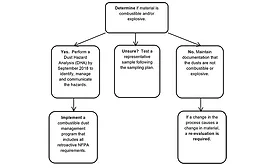
The U.S. Chemical Safety Board has long asserted that chemical dust explosions are a "serious industrial safety problem." CSB research reveals that nearly 200 dust fires and explosions have occurred in U.S. industrial facilities over the past 25 years, resulting in approximately 100 fatalities and 600 injuries.
NFPA 70E responds to the latest information about the effects of arc flash, arc blast, and direct current (dc) hazards, and recent developments in electrical design and PPE. It provides vital information that helps you comply with OSHA 1910 Subpart S and OSHA 1926 Subpart K.
According to OSHA, combustible material can burn rapidly when in a finely divided form. If such a dust is suspended in air in the right concentration, under certain conditions, it can become explosive. Even materials that do not burn in larger pieces can explode in dust form.
The final version of the 2018 edition of NFPA 70E® - Standard for Electrical Safety in the Workplace® is scheduled to be published next month (September) and will be active 15 days after publication.
NFPA states that hundreds of deaths and thousands of burn injuries occur each year due to shock, electrocution, arc flash, and arc blast — and most could be prevented through compliance with NFPA 70E: Standard for Electrical Safety in the Workplace®.
AIHce 2017 is offering TWO Professional Development Courses (PDCs) in electrical safety.
This year, participants will have the option of taking either one or both of the electrical safety courses being offered: Electrical Safety I (Basic Principles/Engineering Controls) and Electrical Safety II (Energized work practices/NFPA 70E).