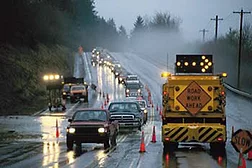
For motorists and the workers who build, repair, and maintain streets, bridges, and highways, roadway work zones can be dangerous. In these areas, a variety of complicated road signs, barrels and lane changes could increase the risk of motor vehicle crashes.
The driver of a Tesla Model 3 involved in a fatal crash in Florida in March engaged the vehicle’s Autopilot1 system about 10 seconds before it collided with a truck – but did not have his hands on the steering wheel. That puzzling finding is part of the National Transportation Safety Board’s (NTSB) investigation into the incident. So is the fact that neither the driver of the Tesla nor the Autopilot system – otherwise known as an advanced driver assistance system (ADAS) executed evasive maneuvers, according to preliminary data and videos.
On April 3, I represented the National Transportation Safety Board (NTSB) at an event kicking off Distracted Driving Awareness Month and California Teen Driver Safety Week, in Sacramento. I challenged California to lead the nation in acting on NTSB’s 2011 recommendation to ban the non-emergency driver use of portable electronic devices that do not support the driving task.
The U.S. Department of Transportation’s National Highway Traffic Safety Administration (NHTSA) and Federal Railroad Administration (FRA) are hoping that a $5.6 million public safety awareness campaign will make Americans take railroad crossing safety more seriously.
The numbers suggest that that is not currently the case. Every four hours in America, a person or vehicle is struck by a train at a rail crossing.
The National Transportation Safety Board (NTSB) has been able to re-construct the series of events involved in a January 3, 2019 multi-vehicle crash in Florida, although what set the tragedy in motion remains under investigation.
According to the NTSB, at approximately 3:40 p.m., a 2016 Freightliner truck-tractor in combination with a semitrailer was traveling north on Interstate 75 (I-75) in Gainesville, Florida, when it struck a 2016 Acura passenger car that was also traveling north.
The federal government’s 1995 decision to allow states to set speed limits higher than 65 mph caused almost 14,000 additional deaths over 25 years on interstates and freeways, according to a new study by the Insurance Institute for Highway Safety.
That average of 560 deaths a year ”is really a big deal,” said Charles Farmer, the author of the study and a vice president of the Insurance Institute.
The opioid epidemic’s toll on the U.S. workforce, retaliation against an undocumented worker leads to his arrest and federal worker safety agencies get a look at what could be their budgets next year. These were among the top stories featured on ISHN.com this week.
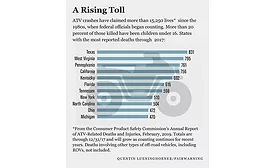
Since the early 1980s, the Consumer Product Safety Commission has conducted a grim census, tracking reports of deaths from crashes of all-terrain vehicles, or ATVs. Now the body count has risen above 15,250, according to the agency’s latest annual report, with more than one in five of the deaths suffered by children under 16.
The federal government is pondering how best to accommodate automated vehicles under standards that were developed when all cars were driven solely by humans and self-driving vehicles were not even a glimmer on the horizon.
As a part of the process, the U.S. Department of Transportation’s (USDOT) National Highway Traffic Safety Administration (NHTSA) is inviting the public to comment on a pair of petitions from Nuro and General Motors (GM) about exemptions to those standards.
The new kid on the block – Tesla – is tops when it comes to equipping its vehicles with automatic emergency braking (AEB), although several other manufacturers aren’t far behind, according to the National Highway Traffic Safety Administration (NHTSA) and the Insurance Institute for Highway Safety (IIHS).