After five years in development, a new standard that provides a framework for improving employee safety, reducing workplace risks and creating better, safer working conditions, all over the world has been approved by the International Organization for Standardization (ISO).
ISO 45001 Occupational Health and Safety Management Systems, which was developed with support from the American Society of Safety Engineers (ASSE), is a voluntary consensus standard intended to help combat the global toll of work-related fatalities, which currently number about 7,600 a year.
Tree harvesters and processor attachments equipped with hydraulic bar saws cut with great power and speed.
When a chain breaks, if a resulting whipping action projects a chain shot link, the link often has a mass, velocity and resultant energy, in some cases enough to reach an operator in a cab, which has potential to cause damage, harm or severe injury.
This may be complicated by the remote nature of forestry operations.
Experience the latest innovations in hand protection with cut-resistant gloves made with Dyneema® Diamond Technology by visiting our exhibit at the Safety Leadership Conference.
Control banding is an assessment method that can be used to manage workplace risks. It is a process that matches, for example, a control measure (e.g., ventilation, engineering controls, containment, etc.) to a range or "band" of hazards (e.g., skin/eye irritation, very toxic, carcinogenic, etc.). The control banding method also groups chemicals according to similar physical or chemical characteristics, how the chemical will be handled or processed, and what the anticipated exposure is expected to be.
Two Minnesota-based companies partner to help safety professionals predict and prevent potential workplace hazards through the sharing of real-time data, insights and safety risk concerns from workers connected to intelligent safety gear and a cutting-edge Internet of Things (IoT) platform
November 20, 2017
As employers continue to spend billions of dollars annually on worker safety programs, injury rates over the past several years have remained stagnant. That statistical plateau has leaders in the safety industry tapping into another resource to take worker safety to the next level: the workers themselves.
The hour-and-a-half long seminars held during World of Concrete are crash courses, in business, the basics of concrete (for entry level personnel) and in topics like engineering, masonry, residential construction, safety and risk management and technical updates.
Numerous techniques to assess risk are available. Most formal techniques are based on identifying the hazard (the potential for harm), and determining the amount of risk (low, medium or high) by calculating, observing or estimating.
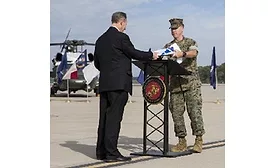
A Marine Corps Air Facility (MCAF) in Quantico, Va. has been recognized for its achievements in workplace safety and health. OSHA Regional Director Richard Mendelson presented MCAF Commanding Officer Lt. Colonel Daniel Murphy with a plaque and flag signifying the facility’s Star Status in OSHA’s Voluntary Protection Programs.
Improving the safety performance of both employees and contractors was identified as a top priority for driving organization's contractor management goals, according to a recent Contractor Management Survey by ISN, a global leader in contractor and supplier information management.
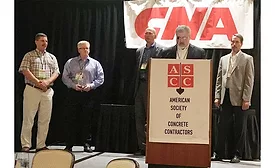
Three years of safety performance indicators and a detailed description of a company’s safety culture were just a few of the factors used to determine the winners of the annual safety awards presented by the Safety & Risk Management Council (SRMC) of the American Society of Concrete Contractors (ASCC).