Environment report
Five years after the Gulf spill: What about the birds?
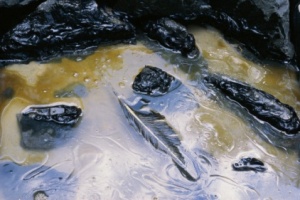 A new report from the American Bird Conservancy (ABC) offers some positive news on efforts to restore and protect some of the many wild bird species harmed by the April 20, 2010 Deepwater Horizon spill. The birds were impacted not only by the oil, but by the cleanup efforts. In some cases, clean-up crews using heavy earth-moving machinery destroyed thousands of nests and caused significant disturbance.
The Gulf-wide, multi-partner campaign “continues to gain momentum and deliver important successes,” according to the report.
2,400 acres of habitat
“2014 was by far our best year in terms of delivering bigger conservation results for beach-nesting birds,” said the ABC. We worked at 58 sites with 21 partners providing some combination of protection, monitoring, and outreach on more than 2,400 acres of coastal habitat that supported 950 nests and 1,400 breeding pairs of our target species: primarily Least Terns and Wilson’s and Snowy Plovers,” said Kacy Ray, ABC’s Gulf Conservation Program Manager.
Across the Gulf, the conservation program, which began in 2011, reached thousands of people through on-the-ground stewardship and community engagement. In 2014, more than 50 volunteers put in more than 1,000 hours educating the public about beach-nesting birds. Nest site stewardship led to outstanding results in St. Pete Beach, FL; Gulf Shores, AL; and East Beach, TX, where Black Skimmers and Snowy Plovers produced one fledging chick per breeding pair, which Ray describes as a remarkable reproductive output.
The effort includes partners from multiple conservation groups as well as local, state, and federal agencies implementing conservation activities to help impacted coastal birds recover. The project has brought expertise not only from ABC, but from partners throughout the Gulf region, including the Barataria-Terrebonne National Estuary Program; US Fish and Wildlife Service; Coastal Bend Bays and Estuaries Program; Houston Audubon; Audubon Louisiana; Grand Isle State Park; Gulf State Park; Eckerd College in Pinellas County, FL; and the Gulf Coast Bird Observatory, among many others. The project, which is primarily funded by the National Fish and Wildlife Foundation, has focused on beach-nesting bird habitat in Texas, Louisiana, Alabama, and Florida.
Crushed eggs and injured chicks
“This project will reduce impacts on key beach-nesting bird colonies, many of which are currently vulnerable to accidental disturbance by members of the public, dogs, and ATVs, which can cause adult birds to abandon a nest or lead to crushed eggs and injured chicks,” said Ray. “Nesting birds occupy a tiny portion of the region’s beaches, usually well back from the shoreline, so there doesn’t need to be a conflict with beach goers. But the areas they do use are absolutely vital to their breeding success,” she added.
“We all love the beaches of the Gulf – they are economically vital to our coastal communities – so our project goal is not to restrict public access. Instead, we hope to engage the public in helping us with beach bird recovery by sharing this beautiful shoreline during nesting season,” she said.
The trouble with beaches
“Beaches are among the most limited and threatened of all bird habitats in the U.S. They provide only a tiny sliver of nesting opportunity for birds, and are often heavily used by humans, squeezed by development, and frequented by colonies of feral cats. Consequently, birds that require this habitat face considerable survival challenges. Much of their plight is caused by anthropogenic (human-related) impacts, so it is only fitting that we take steps to fend off some of those challenges and give them a fighting chance,” said Dr. George H. Fenwick, ABC’s President.
"The best thing for beachgoers to do, especially in the spring and summer months, is to avoid getting close to areas where larger congregations of birds are gathered, and to always respect areas that are roped off or marked with signs designating an area that is used by nesting birds,” said Ray. “The habitat for these birds is diminishing every year due to beach development, erosion, and ever-increasing recreational use, so the birds can really use any break we can give them. They have no other place to go.”
When they're dive-bombing your head...
“You know you’ve entered a nesting area when large groups or individual birds vocalize loudly, dive-bomb your head, or feign injury to lead you away from their nests. If this happens, back away and share the beach so the birds can successfully rear their young,” she said.
American Bird Conservancy is committed to achieving conservation results for native birds and their habitats throughout the Americas, and takes action to halt extinctions, protect habitats, eliminate threats, and build capacity for bird conservation.
Looking for a reprint of this article?
From high-res PDFs to custom plaques, order your copy today!