ISHN logo
search
cart
facebook twitter linkedin youtube
  • Sign In
  • Create Account
  • Sign Out
  • My Account
ISHN logo
  • NEWS
    • Today's News
    • Global Safety News
    • Government Regulations
  • PRODUCTS
    • Product Innovations
    • Featured Products
  • TOPICS
    • Environmental Health and Safety
    • Facility Safety
    • Workplace Health
    • Occupational Safety
    • PPE
    • More Topics
  • CONSTRUCTION
  • TECHNOLOGY
  • COLUMNS
    • Best Practices
    • Dave Johnson: What’s going on
    • Editorial Comments
    • Leading Safety
  • MULTIMEDIA
    • ISHN Podcast
    • Videos
    • Cold Stress Education Quiz
    • Webinars
    • White Papers
  • MORE
    • Buyer's Guide
    • Newsletters
    • Convention Companion
    • Polls
    • Events
    • ISHN Store
    • Sponsor Insights
  • EMAGAZINE
    • eMagazine
    • Archived Issues
    • Contact
    • Advertise
  • JOIN TODAY!
Workplace Health

When your skin doesn’t protect…

Inhalation exposures are not the only threat
By Maureen Paraventi
Occupational skin diseases
April 1, 2016

Occupational skin diseases (OSD) are common and costly. They represent the second most common type of occupational illness and include irritant contact dermatitis, allergic contact dermatitis, skin cancers and skin infections. Just one OSD — contact dermatitis – has estimated annual costs of more than $1 billion. Plus, health problems caused by toxins absorbed through the skin can be more than skin deep; dermal exposure to hazardous agents can enter the blood stream and affect other parts of the body.1

Despite this, efforts to minimize workers’ exposure to toxins have long focused mainly on the inhalation route. Fortunately, NIOSH has developed a hierarchy of controls to reduce dermal exposure.

Who is at risk?

NIOSH estimates that more than 13 million workers in the U.S. are potentially exposed to chemicals that can be absorbed through the skin. Workers risk potentially harmful exposures of the skin in industries including food service, cosmetology, health care, agriculture, cleaning, painting, mechanics, printing/lithography and construction.

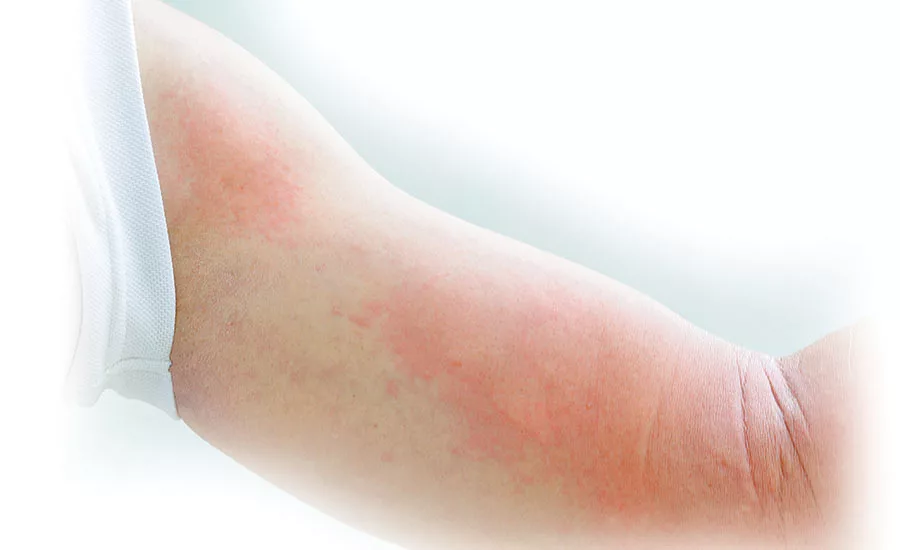
Contact dermatitis, also called eczema, is the most commonly reported form of OSD, constituting approximately 90-95 percent of all cases of OSD in the U.S. Defined as an inflammation of the skin resulting from exposure to a hazardous agent, its symptoms include itching, pain, redness, swelling, and the formation of blisters or dry, flaking scaly areas on the skin.2

How exposure occurs

Exposure can be caused by direct contact, aerosols, immersion or splashes. Dermal absorption — which can occur without the worker even noticing it — happens when a chemical travels from the outer surface of the skin both into the skin and into the body. The outer layer of the skin — called the stratum corneum (SC) – acts as a protective barrier, so the thickness and general health of the SC (whether or not it’s damaged, for instance) are important factors in whether absorption occurs and in the rate at which it occurs.1

The physical and chemical properties of the hazardous substance, the concentration of the chemical on the skin’s surface and the duration of the exposure also have a role in absorption.1

Chemical agents are the main cause of occupational skin diseases and disorders. Primary or direct irritants cause a chemical reaction directly on the skin. Others — called sensitizers — result in allergic reactions after repeated exposure.

Pesticides and organic solvents pose a special danger. They may result in systemic toxicity if they penetrate through the skin and enter the blood stream.

How to prevent exposure

When possible, you should attempt to replace the hazardous agent with a less hazardous compound. Engineering controls such as local exhaust ventilation systems and isolation booths can be used to prevent hazardous agents from contacting workers’ skin. Next in the hierarchy of controls2 are administrative controls, such as training programs that educate workers about chemical hazards and how they can protect themselves from those hazards.

Finally, NIOSH says that personal protective equipment — gloves, safety glasses, protective clothing and boots — should be worn by workers who:

  • Clean and disinfect tools, equipment and work areas
  • Come into contact with solvents, glue or epoxy resins or
  • Come into contact with preparations containing soaps, detergents and disinfectants.

1. www.cdc.gov/niosh/topics/skin/

2. www.cdc.gov/niosh/topics/skin/recommendations.html

KEYWORDS: occupational diseases

Share This Story

Looking for a reprint of this article?
From high-res PDFs to custom plaques, order your copy today!

Maureen Paraventi is Web Editor of ISHN.

Recommended Content

JOIN TODAY
to unlock your recommendations.

Already have an account? Sign In

  • forklift safety

    Exploring the latest technologies in forklift safety

    With more staff and more stock in warehousing now more...
    Facility Safety
    By: Josh Cramer
  • welding

    All about welder’s flash or arc eye

    A flash burn is a painful inflammation of the cornea,...
    Environmental Health and Safety
  • dangerous jobs

    The 10 most dangerous jobs in the U.S.

    On-the-job deaths have been rising — hitting the highest...
    Construction Industry Safety and Health
    By: Benita Mehta
Manage My Account
  • eMagazine Subscriptions
  • ISHN Newsletter & Other Newsletter Alerts
  • Online Registration
  • Manage My Preferences
  • Subscription Customer Service

More Videos

Sponsored Content

Sponsored Content is a special paid section where industry companies provide high quality, objective, non-commercial content around topics of interest to the ISHN audience. All Sponsored Content is supplied by the advertising company and any opinions expressed in this article are those of the author and not necessarily reflect the views of ISHN or its parent company, BNP Media. Interested in participating in our Sponsored Content section? Contact your local rep!

close
  • man wearing the the Sundström SR200 Full Face Mask Respirator
    Sponsored byOHD

    5 Fit Testing Mistakes That Could Cost You

  • This image shows Magid AcuSpex polarized blue mirrored safety glasses.
    Sponsored byMagid Glove and Safety

    Construction PPE Guide: What Crews Need for Each Task

  • lone worker in confined space
    Sponsored byAlphasense Ltd.

    GET THE LEAD OUT of your Safety Oxygen Sensors!

Popular Stories

SpaceX 7 launch

OSHA Investigating Fatal Fall at SpaceX Starbase

Worker Impairment

How to Tell When a Co-Worker is Impaired? A Safety Pro’s Challenge

Automated loading dock equipment

After March 2026 Rivian Death, Safety Managers Reassess Loading Dock Systems Under OSHA's Warehouse Emphasis Program

top 10 most dangerous jobs

Poll

Seasonal Readiness

With the federal heat stress prevention rule on the horizon, which area of your safety program needs the most attention?
View Results Poll Archive

Products

Surviving an OSHA Audit A Management Guide, 2nd Edition

Surviving an OSHA Audit A Management Guide, 2nd Edition

See More Products

ISHN Podcasts

Related Articles

  • Occupational skin diseases

    When your skin doesn’t protect…

    See More
  • POSITIVE CULTURES: When your boss doesn't get it

    See More
  • Under your skin

    See More

Related Products

See More Products
  • ANSI/AIHA/ASSE Z9.3-2007 Spray Finishing Operations: Safety Code for Design, Construction and Ventilation

See More Products

Events

View AllSubmit An Event
  • Gas Detectors: The most common mistakes people make when using atmospheric monitors

    Learn the most common mistakes people make when using atmospheric monitors. Join Bob Henderson from GFG Instrumentation for this educational webinar.
View AllSubmit An Event
×

Become a Leader in Safety Culture

Build your knowledge with ISHN, covering key safety, health and industrial hygiene news, products, and trends.

JOIN TODAY
  • RESOURCES
    • Advertise
    • Contact Us
    • Directories
    • Manufacturing Division
    • Store
    • Want More
  • SIGN UP TODAY
    • Create Account
    • eMagazine
    • Newsletters
    • Customer Service
    • Manage Preferences
  • SERVICES
    • Marketing Services
    • Reprints
    • Market Research
    • List Rental
    • Survey/Respondent Access
  • STAY CONNECTED
    • LinkedIn
    • Facebook
    • YouTube
    • X (Twitter)
  • PRIVACY
    • PRIVACY POLICY
    • TERMS & CONDITIONS
    • DO NOT SELL MY PERSONAL INFORMATION
    • PRIVACY REQUEST
    • ACCESSIBILITY

Copyright ©2026. All Rights Reserved BNP Media, Inc. and BNP Media II, LLC.

Design, CMS, Hosting & Web Development :: ePublishing