The key to preventing heat-related incidents
Each June as part of National Safety Month, the National Security Council encourages extra care and precaution in maintaining personal and work safety. As you can imagine, heat is one of the biggest safety concerns in the summer. While most people may think of heat stroke and heat exhaustion as being something that affects athletes and outdoor laborers, many others are exposed to high levels of heat in the workplace. Factory, warehouse, industrial employees and other indoor workers are equally susceptible to the ravages of high temperatures. In a confined space, especially with heat-generating equipment and appliances, employees can quickly become exhausted and overheated. For workers wearing protective gear, they are at an even higher risk for heat-related issues given that protective gear can trap heat next to the body.
If you are a manager or owner of a business that conducts work in a non-air-conditioned setting or an open and difficult to cool workspace, it is important to assess the risks ahead of a heat-related illness or injury.
Heat-stress and heat-related illnesses
Working in a hot environment can be more than uncomfortable, it can be a health risk and dangerous. According to the National Safety Council, 11 American workers die on the job each day. Dr. David Michaels, Assistant Secretary of Labor for Occupational Safety and Health Administration (OSHA), emphasizes the dangers of hot working conditions in his keynote speeches by highlighting that each year thousands of people become sick from heat-related illnesses. In 2014, his office noted that at least 30 workers in this country died from heat exposure.
It is important to understand how the body handles heat and hot conditions when evaluating the potential for employee heat-related illnesses. As temperatures rise, the body releases heat more slowly. As humidity increases, sweat evaporation decreases and stagnant air makes sweat evaporation even more difficult. When these three factors are combined, you have a higher potential for health and safety concerns. The chances for accidents due to sweaty hands, dizziness and decreased mental alertness go up considerably.
Productivity and the bottom line
Not only can high temperature environments increase the likelihood of injury or illness, it can contribute to a slower work pace. Studies show that worker productivity will decrease by more than 1 percent for every two degrees when temperatures rise over 77 degrees. At temperatures of 92 degrees or higher, there is a 16.6 percent decrease in productivity.
What’s more is that heat intense environments are not just physically uncomfortable – they can be truly costly to a company’s bottom-line. High temperatures can increase the likelihood of injury or illness which results in higher legal and insurance costs. OSHA offers a tool that estimates just how much an accident can cost in terms of impacting profitability: www.osha.gov/dcsp/smallbusiness/safetypays/estimator.html
Heat hazards to workers not only reduce efficiency, it can place companies in liability situations if management could have reasonably foreseen the effects of the high temperatures. OSHA requires employers provide a safe working space – and that also means limiting the exposure of employees to high temperatures and increasing the frequency of breaks in a cool environment.
Prevention – weighing cooling options
It is wise to be proactive and take steps early – not after it is too late – to guard against heat stress. According to OSHA, basic heat safety measures need to take place around 90 degrees Fahrenheit, with increased heat precautions used for temperatures at graduated intervals from there. In addition to providing hydration and scheduling breaks, securing effective, affordable cooling solutions ahead of time is the best strategy for employers. Consider your cooling options when air-conditioning is impractical or cost-prohibitive.
Oscillating and ceiling fans offer the primary benefit of creating air movement, however these methods simply blow stagnant warm air. While an industrial oscillating fan is portable, it may not be powerful enough to cover a large, open area effectively. Conversely, ceiling fans offer no portability and installation can be costly in an industrial environment.
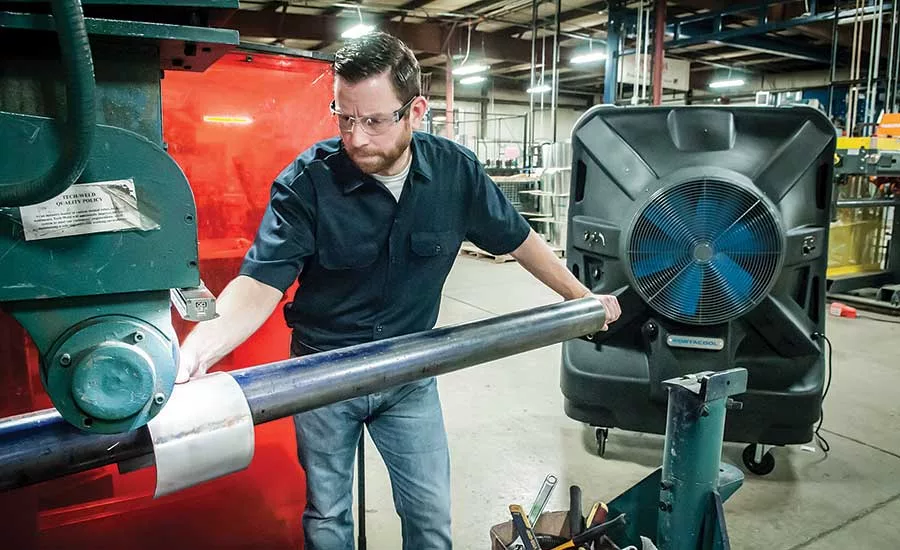
In most environments, a great cooling solution to lower ambient temperatures down to an acceptable level is a portable evaporative cooler. Evaporative coolers are designed to create a noticeable difference by lowering temperatures by as much as 30°F. These cooling products utilize the natural power of evaporation with high-quality evaporative media to provide maximum cooling efficiency.
Prevention – onsite preventative steps
After determining cooling options and placement, take care to institute daily measures to combat heat-related injuries:
- Make sure to have plenty of fluids on hand. Workers need plenty of water throughout the day (approximately every 15 minutes) in hot conditions and shouldn’t wait until they feel thirsty.
- Schedule rest breaks to help your body recover. OSHA advises workers to rest in the shade or in air-conditioning when possible to help cool down. Utilize or add cooling stations on worksites when possible with tools such as a portable evaporative cooler that work on a standard 110-V electricity supply.
- Stay aware of conditions with your phone or tablet, especially if working outdoors. Working in full sunlight can increase heat index* values by 15°F. OSHA has an app (download info here) to help calculate the heat index for the worksite and helps to identify the risk level.
- Be sure workers are informed by reviewing the heat illness signs and symptoms. Training is this area is worthwhile.
- Use a buddy system. Encourage workers to monitor each other for signs and symptoms of heat-related illness.
(For more information about safety while working in the heat, see OSHA’s heat illness webpage and online guidance page for employers that outlines how to use the heat index to protect workers.)
Looking for a reprint of this article?
From high-res PDFs to custom plaques, order your copy today!