Five ways to prepare eyewashes & showers for an emergency
All-access evaluation
Safety managers know the importance of correctly using eyewashes and safety showers to flush hazardous substances from one’s eyes, face or body. They also know the true test of any safety program hinges on the level of a facility’s preparedness before an emergency strikes and its emergency protocol immediately following the situation.
The following elements of a workplace safety program focus on improving processes before and after an injury occurs.
1) Conduct a site survey to identify risks and equipment needs
Start with a thorough site evaluation that pinpoints at-risk areas, potential hazards and emergency needs. In general, a site survey takes into account key worksite factors such as product location, water supply, water temperature, accessibility and equipment selection.
Some product manufacturers offer complimentary safety shower and eyewash system site surveys to help facilities ensure their equipment is in good working order, compliant with the ANSI/ISEA Z358.1 standard and/or meets designated corporate goals
or best safety practices.
Part of a site survey includes an activity-based evaluation. For example, if grinding, sanding or machining operations are occurring, plumbed or portable eyewash units are needed. If chemicals are being used in the facility, a worker could be splashed with a corrosive chemical or be exposed to a chemical vapor, and therefore would need quick access to a drench shower to rinse the entire body.
Begin by referencing Safety Data Sheets (SDSs), provided by chemical manufacturers, distributors, or importers for each hazardous chemical located in the facility. SDSs include information such as physical data, toxicity, health effects, first aid, reactivity, storage, disposal, protective equipment, and spill-handling procedures.
It’s also important to reference the ANSI/ISEA Z358.1–2014 American National Standard for Emergency Eyewash and Shower Equipment, which outlines specific installation, testing, performance, maintenance, training and usage requirements for emergency eyewash and drench shower equipment.
Beyond the initial site survey, it’s critical to periodically review placement, installation, standards and requirements, as well as the latest product/technology advancements to improve safety fixture performance. Also be sure to conduct site surveys in the event of expanding, relocating or modifying onsite work processes.
2) Know your emergency equipment options
As part of a site evaluation, compliance solutions and fixture recommendations will be discussed. Three primary types of emergency eyewash and shower stations include:
Emergency eyewash stations:
- Effective for spills, splashes, dust or debris likely to affect only the eyes.
- Provide a controlled flow of water to both eyes simultaneously.
- Deliver an uninterrupted, 15-minute supply of tepid water. Plumbed units can supply a greater volume of water – between 2.0 and 5.0 gallons per minute (7.5 and 19.0 liters per minute).
Emergency eye/face wash stations:
- Used when the entire face is at risk from spills, splashes, dust and debris.
- Irrigate the eyes and face simultaneously.
- Provide a large distribution pattern of water – a minimum of 3.0 gpm (11.4 lpm) – to rinse the eyes and entire face.
Emergency showers:
- Used when larger areas of the body are at risk.
- Flushe a larger portion of the body but are not appropriate for the eyes (a combination eyewash and drench shower may be used to simultaneously flush the eyes and rinse larger areas of the body).
- Deliver flushing fluid of 20 gpm (75.71 lpm).
When selecting emergency equipment, the newer the better, as product manufacturers are continuously looking for new ways to improve efficacy of eyewash stations and showers. Fluid dynamics technology is a recent advancement that has improved product performance, and raised the level of employee protection and comfort.
3) Focus on proper location and placement of fixtures
Appropriate and adequate numbers of units should be stationed close to hazards, easily seen and accessed, and be in immediate good working order. Here are some best practices for emergency fixture placement, which reflect the ANSI/ISEA Z358.1-2014 standard:
- Fixtures must be within 55 feet of a potential hazard and take no more than 10 seconds to reach. Access to the fixture must not be obstructed by debris or other hazards that could impede usage.
- Equipment must be on the same level as the hazard. If there are doors between the hazard and the fixture, they must swing in the direction of travel.
- If the worker’s ability to walk or move might be impacted by the chemical exposure, the fixture should be placed closer to the worker.
- The height of eye and eye/face washes should be between 33 and 53 inches, and measured from the floor to the water flow (not washbasin edge).
- If highly corrosive chemicals are used, the drench shower or eyewash should be placed immediately adjacent to the hazard.
- If a potential chemical spill in an area can affect multiple workers, enough fixtures should be in place for all to access.
- All equipment must be identified with highly visible signage (bright yellow is easy to spot) that is well lit; it should be able to be activated in one second or less.
4) Train employees and test equipment
Employees must be educated on the location of fixtures, how to use them effectively and how to alert emergency medical response teams during an emergency situation to ensure the best outcome. While product efficacy is important, employee awareness, education and confidence helps workers make better informed decisions – before, during and after – an emergency situation.
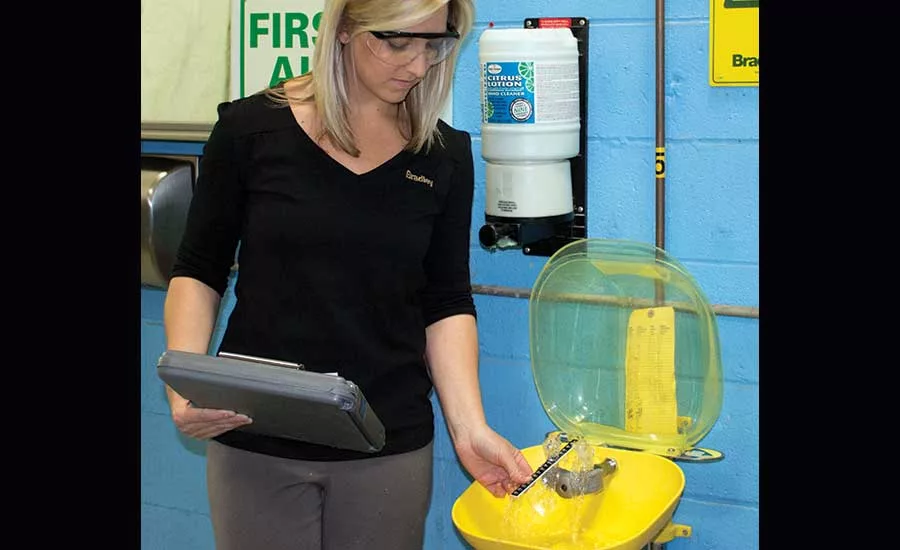
Weekly equipment inspections — and activations — should be performed and documented. Manufacturers provide materials to assist in weekly testing, such as a heavy-duty drench shower tester designed with a water-tight funnel to minimize getting wet during testing. The funnel directs water to a drain or bucket, and prevents water splashing in the surrounding area. For testing eye wash fixtures, a transparent plastic compliance gauge features clear instructions on how to test the eye or eye/face wash system according to ANSI/ISEA Z358.1-2014 testing protocols.
5) Confirm protocol for emergency response
Each employee should be trained on what action to take in assisting the affected employee(s) and how to report emergencies to emergency medical personnel. Signaling devices, which are connected to showers and eye washes, help with expediting emergency response.
Upon activation of the fixtures, the signaling devices automatically turn on a highly visible flashing light and a loud sound designed to cut through ambient noise. The signaling systems call others to help, draw attention to the precise location of need, alert management to contact first responders, and provide remote monitoring of safety equipment.
Looking for a reprint of this article?
From high-res PDFs to custom plaques, order your copy today!


