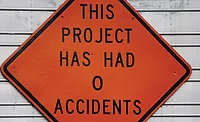
How to achieve zero: First you must believe it’s possible

Before you can begin the journey toward the goal of zero injuries and incidents, leaders must believe it’s possible. Many people argue that “zero” isn’t possible — it is a proven truth that can be seen in every area of human endeavor. The word accident connotes a sense of an event that happens by chance. Safety incidents and injuries do not happen due to an accident. This false belief leads to the acceptance that a certain number of incidents and injuries are “just part of doing business.”
Ample evidence
There is ample evidence to the contrary. According to Emmitt J. Nelson, ME, PE, NAC, ZIC, and his association, the Zero Injury Institute1, many companies have operated over one million hours without injury or incident. S&B Engineers and Constructors and Kiewit-Southwest, for instance, both have achieved over four million safe hours constructing facilities without injury. That leaves only one question unanswered: ”What must leaders do to create and sustain a safety culture capable of delivering ‘zero incidents and injuries’?”
First develop a map of the actions needed to demonstrate your commitment to safety. This “roadmap” doesn’t need to be heavily detailed to get started. Many of the actions you’ll need to take will flow from the actual work. The model in Figure1 has proven to be successful in delivering a step-change in safety performance in businesses regardless of size, location, or markets.
Figure 1: The Zero Incident Roadmap2
Beyond following rules
Getting to zero injury performance takes more than just having people “follow the rules” or making incremental improvements in the way work gets done. In fact, a culture of compliance is often the enemy of improved safety because no one stops to ask if things could be done in a less risky, safer manner. At the same time, making incremental process improvements can invoke the law of “unintended consequences” because as you make changes in a process, it’s difficult to anticipate how they could negatively impact other dependent processes.
Creating the right foundation
The first three elements of the roadmap – embedded core values, right future goals, and “felt” leadership – work as an integrated, interdependent set that help to transform an existing “compliance” culture to one that’s committed to zero incidents and zero injury performance. Put simply:
- Embedded core values spawn development of the right future goals (in this case, achieving zero incidents) regarding safety.
- Without the right future goals, you can’t make core values – the cultural underpinning of your business – actionable.
- Executives must provide “felt” leadership by “walking the talk” -- making safety real and visible at all levels.
Operationalizing safety
Standard work processes, IT-enabled knowledge management, and operating discipline also must be addressed together because they work interdependently. Specifically:
- Standard work processes allow you to make process improvements to improve safety – without triggering the law of unintended consequences.
- IT-enabled knowledge management establishes the collaboration and learning framework needed to drive efficiency, effectiveness, and safety best practices throughout the life of a project, including the operation and maintenance of the facility.
- Operating discipline locks safety improvements in place and delivers predictable and sustainable outcomes.
Continuous improvement
If you aren’t working at improving you are falling behind. A robust continuous improvement process improves the efficiency of the process and drives effectiveness in reducing injuries. It is a critical part of laying a solid foundation for sustaining performance gains.
It is really difficult to “lock” positive changes into the “way all people work.” But that’s what is needed if “zero” goals are going to be met. Think about “felt” leadership. We know all organizations will get the safety performance their management demonstrates that they expect. Some actions that demonstrate leadership commitment to “zero : include:
- Make safety a part of your routine conduct of business
- Promote leaders who are strong safety performers AND are able to deliver good product
- Don’t allow yourself to become insulated from reality
- Expect collaboration at all levels
- Formalize continuous improvement/self-assessment
- Don’t settle for being best in class -- commitment must be Zero
Testing felt leadership
What expectations are you current demonstrating? Do you regularly test to see if your leadership is being “felt” in the organization? If you are, how broad is your sample? When you do check, verify that your commitments are being clearly understood.
Do you gauge the effectiveness of your current and future states? If not here are some starter questions:
- How consistent is our safety culture?
- Have any recent events impacted our culture?
- How do you know it is consistent on all shifts? All locations?
- Are business goals competing with safety?
- Do new employees get the same training and hold the same values as longer service ones?
- Is pressure to “do more with less” competing with your safety goals?
Takeaway
If you do not like your current safety performance, leadership is needed from everyone, and in particular, from the top management. Strong safety performance is not sustainable if it is only driven from the workforce. Workers must be engaged and they must participate, but they alone cannot make safety an organizational value. That value must derive from the senior management and the board/shareholders.
Oftentimes, senior management only speaks to the workers who they perceive are in harm’s way, and they frequently ignore office personnel, who are mistakenly thought to be in a low-hazard environment. Remember, office personnel directly influence the behavior and the priorities of the operations workforce. At the end of the day, everyone must be involved. The safety performance of any unit is a reflection of the management team’s expectations.
“You will achieve the safety performance you demonstrate you expect.”
References
- Zero Injury Institute, http://www.zeroinjuryinstitute.com
- “Safety: An Investment in Business Sustainability and Effective Risk Management,” A Bentley White Paper, Jim Porter, September, 2013, page 8.
The authors would like to acknowledge and thank Bentley Systems for their agreement to excerpt portions of their 2013 White Paper, “Safety: An Investment in Business Sustainability and Effective Risk Management” by Jim Porter, President, Sustainable Operations Solutions, LLC.
Looking for a reprint of this article?
From high-res PDFs to custom plaques, order your copy today!