Follow the hazards control hierarchy to reduce welding risks
Back to basics
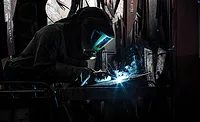
Welding is the most economical, efficient and common way to permanently join metals in industry today. When welded, two or more pieces of similar metals are fused together by the use of a filler metal, heat, pressure or both to form a strong joint. Once completed, the welded joint is as strong as or stronger than the pieces from which the joint is formed. There are more than 100 different ways to weld metals together. With so many different ways to weld, types of metals, and filler materials comes many hazards such as flying particles, harmful dust, smoke, fumes, heat and light radiation.
According to the Bureau of Labor Statistics (BLS), in 2014 there were approximately 400,000 welders in the United States with a projected growth rate of 4.4 percent for the next ten years. With that number of welders and number of hazards associated with welding, the BLS has determined the rate of injuries and illnesses is higher than the national average.
According to OSHA, the best way to reduce the risk of injury and illness in the welding profession is to enact the philosophy of the hierarchy of controls. The hierarchy of controls is a widely accepted concept promoted by numerous safety organizations, and supported by OSHA. It is a way of controlling hazards in a preferred order from most effective to least effective.
Types of welding
According to OSHA, welding is classified into two groups: fusion (heat alone) or pressure (heat and pressure) to join two pieces together. OSHA further breaks fusion welding into three types:
- Electric arc – Employs an electric arc to melt the base metals and filler metals and can be further divided into type based on amount of fumes produced (listed least to most): Flux Core Arc Welding (FCAW); Shielded Metal Arc Welding (SMAW); Gas Metal Arc Welding / Metal Inert Gas (GMAW / MIG); Gas Tungsten Arc Welding / Tungsten Inert Gas (GTAW / TIG)
- Gas – Employs a flame from burning a gas (usually acetylene) to melt the base metal at the joint to be welded.
- Thermit – Employs a chemical reaction to produce intense heat instead of using gas fuel or electric current.
Pressure welding usually involves heating the surfaces to a plastic state and then forcing the metals together.
Welding hazards
All types of welding produce hazards. The most common hazard is welding fumes. Welding fumes contain a variety of metals, including but not limited to aluminum, arsenic, beryllium, lead and manganese along with several other gases. Having an awareness of the most common welding hazards helps to target safety training to proactively avoid an injury/illness.
Electric shock – Electric shock is one of the most serious and immediate risks facing a welder. Shock occurs when arc-welders touch two metal objects that have a voltage between them (typically 20-100 volts), thereby becoming part of the circuit to ground.
Fumes and gases – Due to the high temperatures generated when welding, metal fume and gas hazards are produced that if inhaled or ingested can result in many health issues.
Fire and explosions – Welding can create heat, sparks and spatter that can serve as an ignition source of flammable and combustible materials.
Flash burn – Welding can create intense light that can cause extreme discomfort, swelling and temporary blindness if proper eye protection is not worn.
Thermal burn – The nature of welding involves extreme temperatures that require controls to be in place to prevent burns to the skin. This could be present in the form of sparks and spatter or direct contact with the welded surface.
Noise – Welding processes typically produce noise levels above 85 decibels. Additionally, welding is typically done in areas where it is not unusual for ambient noise to add to the decibel level.
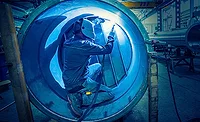
Confined spaces – When the space or area where welding is taking place is small or confining the amount of ventilation is limited. This can serve as a multiplier to fume and gas levels making them much more concentrated. Shielding gases such as argon, helium, nitrogen, or mixtures of these gases can also displace oxygen creating an asphyxiation hazard.
Compressed gases – Welding involves the use of many gases under high pressure contained in cylinders. The cylinders can be a fire hazard if not stored properly. Cylinders can also be a physical hazard if not secured properly to prevent valve damage and resulting explosive release of the gas creating a deadly projectile.
Hazard controls
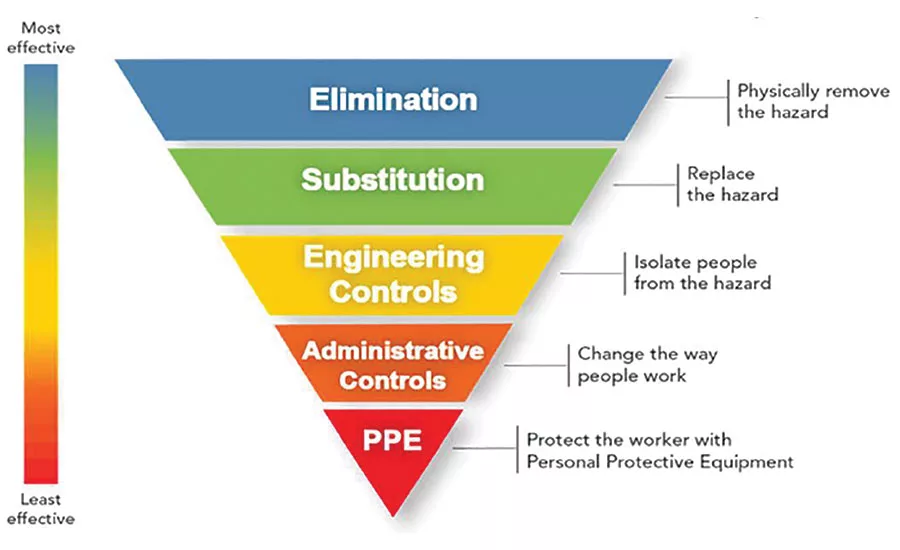
The best way to prevent injuries and illnesses posed by all workplace hazards is to follow the concept of hierarchy of controls. This order is typically depicted as an inverted pyramid, with the most effective control starting at the top.
Hierarchy of controls
Elimination is designed to completely remove the hazard from the workplace. Example would be not performing welding in a confined space or eliminate the hazards in the space before welding begins.
Substitution is designed to prevent potentially harmful exposure. Example would be switching to shielded metal arc welding (SMAW) to gas metal arc welding (GMAW) with a solid or metal coated wire, or opt to use low-manganese filler metal to reduce the amount of hazardous fumes produced.
Engineering controls involve physical changes to the workplace. These can include isolation, such as enclosing the welding process, or ventilation, which includes capturing material at the source (local exhaust ventilation), and/or ambient collection.
Administrative controls require the welder or employer to do something. This is typically accomplished through training and policies. Example would be training the welder to, position their head and body to keep their body part away from the hazard.
Personal protection equipment (PPE) is only considered if the first four controls do not lower the exposure risk to the hazard(s) to an acceptable level or were infeasible. To maximize the benefits of PPE, users must be trained on use, limitations, and care of the PPE.
Conclusion
Hazards change due to new technology involving how metals are joined. It may be a new base metal alloy, new filler metal, new process, or combination of everything. It is important welders, and safety and health professionals, continue to follow the hierarchy of controls to guard against traditional known welding hazards and also stay abreast of new and emerging welding technologies.
Looking for a reprint of this article?
From high-res PDFs to custom plaques, order your copy today!