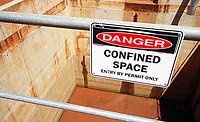
Note the differences in confined spaces to follow the right standard
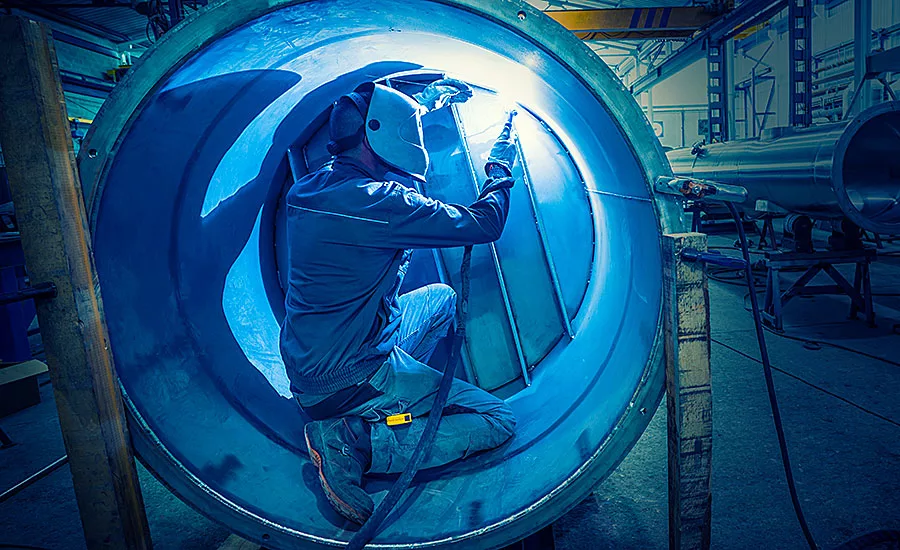
Working in a confined space can be hazardous but working in a permit-required confined space (permit space) is often downright dangerous. That’s why it’s important that employers ask the question: Is the work done in the permit space considered a maintenance or construction activity? The answer to that question will determine if OSHA’s 29 CFR 1910.146 general industry standard or the 1926 Subpart AA standard must be followed.
There are several OSHA Letters of Interpretation (LOI) that will help an employer answer the maintenance or construction question.
11/18/2003 - Clarification of maintenance vs. construction activities
This letter of interpretation states that “Construction work is not limited to new construction but can include the repair of existing facilities or the replacement of structures and their components. For example, the replacement of one utility pole with a new, identical pole would be maintenance; however, if it were replaced with an improved pole or equipment, it would be considered construction.”
02/01/1999 - The difference between maintenance and construction
This letter of interpretation defines maintenance as “… keeping equipment or a structure in proper condition through routine, scheduled or anticipated measures without having to significantly alter the structure or equipment in the process. For equipment, this generally means keeping the equipment working properly by taking steps to prevent its failure or degradation.”
02/01/1996 - Contractors and the criteria for applying the Construction Work Standard
In 1993, OSHA per 1910.12(a) required that all employers and employees engaged in construction work follow the regulations in 1926. 1910.12(b) defines construction work as “… work for construction, alteration, and/or repair, including painting and decorating.”
Know the difference
Confined spaces are different from permit-required confined spaces. A confined space is a space that:
- Is large enough and so configured that an employee can bodily enter and perform assigned work, and
- Has limited or restricted means for entry or exit, and
- Is not designed for continuous employee occupancy.
A permit-required confined space (permit space) is a confined space that has one or more of the following characteristics:
- Contains or has a potential to contain a hazardous atmosphere;
- Contains a material that has the potential for engulfing an entrant;
- Has an internal configuration such that an entrant could be trapped or asphyxiated by inwardly converging walls or by a floor which slopes downward and tapers to a smaller cross-section; or
- Contains any other recognized serious safety or health hazard, such as unguarded machinery, exposed live wires, or heat stress.
If the work employees are performing in the confined space is considered construction, then the 1926 Subpart AA standard must be followed. Subpart AA is generally considered more stringent than general industry’s 1910.146.
Test your knowledge
Let’s test your knowledge to see if you can pick out which standard applies (all scenarios apply to permit spaces and assume all hazards have been mitigated). See how you did at the end of this article.
1. An employee goes into an electrical vault to visually inspect the equipment. 1910 or 1926?
2. An employee goes into an electrical vault to replace some electrical equipment with improved equipment. 1910 or 1926?
3. Two employees enter an empty water tank to paint the inside of the tank. 1910 or 1926?
4. An employee enters a heating, ventilation, and air-conditioning (HVAC) duct to clean the duct. 1910 or 1926?
5. Two employees go into a boiler to cut into a pipe to install a new, improved valve. 1910 or 1926?
6. An employee enters a sewer to inspect the walls for deterioration. 1910 or 1926?
7. An employee of the host employer enters a new elevator pit (that was just installed in an existing facility) to inspect it for final signoff. 1910 or 1926?
General industry versus construction
If an employer has their own employees perform construction work at their facility in a permit space, or their employees will be working with a contractor to perform the work, it’s important the employer know these key differences between the general industry standard and the construction standard:
The following are the key differences where the Construction 1926 Subpart AA confined space regulation is more stringent than the General Industry 1910.146 confined space regulation:
- Requiring a competent person to evaluate the work site and identify confined spaces, including permit spaces. (1926.1203(a))
- More detailed provisions requiring coordinated activities when there are multiple employers at the worksite. This will ensure hazards are not introduced into a confined space by workers performing tasks outside the space. An example would be a generator running near the entrance of a confined space causing a buildup of carbon monoxide within the space. (1926.1203(h))
- Requiring continuous atmospheric monitoring whenever possible. (1926.1203(e)(2)(vi))
- Requiring continuous monitoring of engulfment hazards. For example, when workers are performing work in a storm sewer, a storm upstream from the workers could cause flash flooding. An electronic sensor or observer posted upstream from the work site could alert workers in the space at the first sign of the hazard, giving them time to evacuate the space safely. (1926.1204(e)(1)(iii))
- Allowing for the suspension of a permit, instead of cancellation, in the event of changes from the entry conditions listed on the permit or an unexpected event requiring evacuation of the space. The space must be returned to the entry conditions listed on the permit before reentry. (1926.1205(e)(2))
Employers need to know which OSHA confined space standard applies in order to protect their employees from the hazards they could face.
Quiz answers
1. 1910
2. 1926
3. 1926
4. 1910
5. 1926
6. 1910
7. 1910
Looking for a reprint of this article?
From high-res PDFs to custom plaques, order your copy today!