Potentially fatal fumes: Reduce airborne hazards while welding
Welding and welding safety are nothing new to us all. In fact, welding of different types has been around since the 1800s. For centuries blacksmiths have been forging metals together. While welding equipment today has dramatically improved, the fumes generated remain hazardous and are classified as a carcinogen. Has respiratory protection for welders improved to the same degree?
Welding remains a high-risk occupation with welding fumes linked with Parkinson Disease and cancer.
So now is a great time to talk about tips for welding safety equipment and, particularly, respiratory protection while welding.
General protection
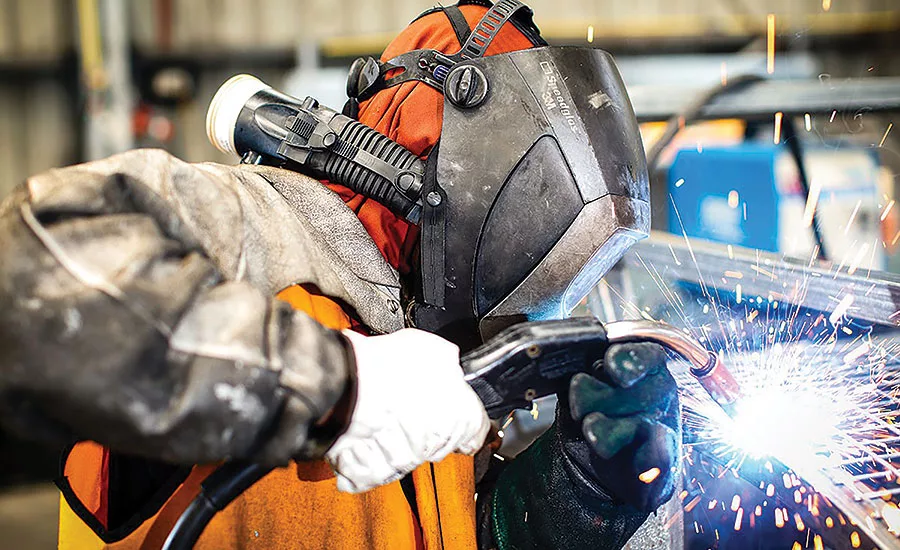
Welding eye and face protection is a cornerstone of any welder’s personal protective equipment. Helmets, hand-shields, goggles and safety glasses or combinations are, fortunately, all widely used in the welding industry. Filter lenses and plates are required to pass the test for transmission of radiant energy and comply with the ANSI/ISEA Z87.1-2015, the standard for American National Standard for Occupational and Educational Personal Eye and Face Protection Devices. Keeping workers protected from direct radiant heat and exposure is critical. According to OSHA 29 CFR 1910.252 (b)(2)(ii)(B), “Helmets and hand shields shall be arranged to protect the face, neck and ears from direct radiant heat from the arc.”
Three lines of defense
Respiratory protection while welding is critical to worker safety and has been called “the silent hazard” to workers when welding, brazing, soldering, cutting and grinding. OSHA focuses on a “three lines of defense” concept to help eliminate or reduce potential airborne exposures and hazards.
The first line of defense is engineering controls that eliminate the hazard. Such controls are ventilation and extraction systems. The second line of defense are administrative controls where work is scheduled to limit a welder’s exposure to a specific hazard. Both of these first lines of defense have major limitations and cannot always be in place to protect workers. For example, ventilation is not always possible if the welder is working on a remote contract job or required to work in tight spaces. This also applies to administrative controls, where welders may be under time pressures to complete a job to get a line back and operational.
The last line of defense, personal protective equipment (PPE), becomes the most important and certain measure to protect welders while on the job. Effective (protective and comfortable) respiratory equipment is a welder’s insurance against heavy metal inhalation, acute asthma or chronic respiratory disease.
Welding fumes
Why are welding fumes so toxic? The most toxic hazards are from filler metal, coatings, shielding gases and base metals created when heating the materials. Many welding fumes contain hexavalent chromium and zinc, which are known to cause long-term damage to the lungs and nervous system. Consider that toxic welding fumes surround the welder throughout the job and are directly in the path of the welder’s breathing. The fine fume particles are able to travel deep inside the welder’s lungs to cause irreversible cell damage reducing lung function and enter the welder’s blood system causing systemic and chronic illness.
Because of this, personal respiratory protection should be the No. 1 priority for all welders. High protection (i.e. Powered Air Purifying Respirators or PAPRs) and correctly fitted respirators will protect against the most dangerous vapors, fumes, and particulates, including silica. Regardless of ventilation systems or scheduled work tasks, welders should ensure they use their respirators as the health consequences can include:
- Irritation of the nose and throat
- Asthma
- Central nervous system damage such as Parkinson’s Disease
- Kidney and other organ damage
- Lung and other cancers
In 2017, International Agency for Research on Cancer (IARC), part of the World Health Organization, reclassified welding fumes and UV radiation from welding as known Group 1 carcinogens. As a Class 1 carcinogen, welding is now in the same category as smoking for a cancer risk. In addition, IARC stated that up to one percent of the world’s workforce may be exposed to welding fumes while on the job and it affects non-welders on or around welding activity. Their report also noted certain workers were more likely to develop cancer depending on the chemicals and fumes they were exposed to. Increased risks were observed broadly — welders working with stainless-steel, nickel, chromium iron and manganese compounds.
Respiratory manufacturers and some global companies have been fast to respond to this, recommending powered air purifying respirators for all welders. Surprisingly in the US, we have yet to see regulatory changes in line with this. Regardless of the regulatory guidelines, businesses with welding operations including welding contractors should immediately assess their controls and respiratory programs to ensure all workers are effectively protected.
Historically many welders have relied on negative pressure masks such as disposable respirators — N95 or half-masks with P100 filters. However, welders have been fast adopters of PAPRs, which provide high levels of assured protection and superior worker comfort and acceptance.
PAPRs do come with limitations. Traditional PAPRs with hip mounted heavy batteries and motors and connecting body hoses add to the weight and bulk of existing welding equipment. In addition, traditional PAPRs may not be compatible with existing PPE, forcing welders to reinvest in new welding helmets and have issues with immobility or portability, limiting welders in tight spaces or moving between equipment. New technology in PAPRs has eliminated these issues and now offer super lightweight and compact affordable options, with both high protection and fresh airflow. Now, there is no reason for employers or welders to risk their most precious asset — their health.
New technology
Welding is big business! To optimize productivity and liability, welding safely is as important as any welding equipment on site. Whether a welding professional or safety manager working in a foundry, welding shop, construction company, or a one-man-band welder, you need to conduct proper evaluation of your team’s safety precautions. New research, regulatory changes and PPE innovations could be game changers for your business. Technology innovations are happening fast so we all want to keep on the watch for new PPE, engineering controls and other innovations to keep workers safe.
We covered a lot of information in this article but far too short to cover every regulation or best practice in welding safety. For complete welding safety requirements including engineering controls, site safety, fire prevention, confined spaces etc., please see OSHA 29CRF 1910.252 and other state and local regulations and guidelines.
Looking for a reprint of this article?
From high-res PDFs to custom plaques, order your copy today!