Why risk assessments are not required by the PWFA
Bias, various interpretations create differing opinions

iStock / Getty Images Plus
In 1992, the European Union established the Pregnant Workers Directive. The Directive required EU member nations to, among other things, conduct risk assessments to improve the safety and health of pregnant workers and workers who have recently given birth or are breastfeeding. The necessity for the EU’s 1992 Pregnant Workers Directive is equivalent to the U.S.’s necessity to implement the federal Pregnant Workers Fairness Act (PWFA) now, with final rules effective June 18, 2024.
Although the main thrust of the EU’s Pregnant Workers Directive requires employers to conduct risk assessments, the U.S.’s PWFA did not follow this path. There is no requirement for U.S. employers to conduct risk assessments under the PWFA. Why does the EU’s and the U.S.’s major approach to pregnant worker safety and health concerns go in opposite directions?
Risk interpretation
How long can a pregnant worker stand, while doing work in a factory, before she risks her own health or risks the health of her future child? The initial answer comes from an interesting source: the unanimous U.S. Supreme Court 1908 decision in Muller v Oregon. Oregon established a law in 1903 that “no female shall work in any mechanical establishment, or factory, or laundry in this State more than ten hours during any one day.”
The rationale for the 10 hours limit was argued by Louis Brandeis who developed (as far as I can determine) the first occupational health meta-analysis in the U.S. Using health and social science available at the time, Brandeis was able to convince the U.S. Supreme Court that beyond 10 hours of standing, a woman’s health would be at risk; and “as healthy mothers are essential for vigorous offspring, the physical wellbeing of woman is an object of public interest.” The court determined that, “The liberty protected by the Due Process of the Fourteenth Amendment is not a bar to Oregon’s compelling interest in protecting women’s health through restricted work hours.”
Time has eroded Muller v Oregon’s legal standing. Given current political and legal leanings, however, even at the highest courts, such as rise of personhood laws, I would not be surprised if Muller’s concept is revived in the future. As it stands now with the PWFA, any pregnancy related limits or needs e.g., how long to stand, is a decision that must be made by the pregnant worker during consultation with her health care provider, that can “best serve” her needs, that now may include an industrial hygienist, as necessary.
Gender bias
Did Riley make the hockey team? If you have children, mostly ages 6-16 years old, there is a good chance that they saw this summer’s animated movie, Inside Out 2. The movie is now among the Top 10 highest-grossing movies ever.
(Spoiler alert) Riley is thirteen-year-old girl about to enter high school. Riley is given the opportunity to play in an all-girls hockey tournament. Her performance in the tournament will determine if she makes the all-girl high school hockey team as a freshman.
When I ask any girl who saw Inside Out 2, “did Riley make the team?” the answer has always been “yes.” The same question to boys finds that nearly all believe that Riley did not make the team. I am using a small sample size, admittedly, but I am confident that if you ask the same questions, you will get the responses that I am finding.
My hypothesis, therefore, is that, for whatever reason, women that judge women issues will render a fair appraisal and men who judge women’s issues will be harsher in their findings. If this hypothesis is correct, then gender bias may greatly sway results in pregnant worker risk assessments.
Study at your workplace?
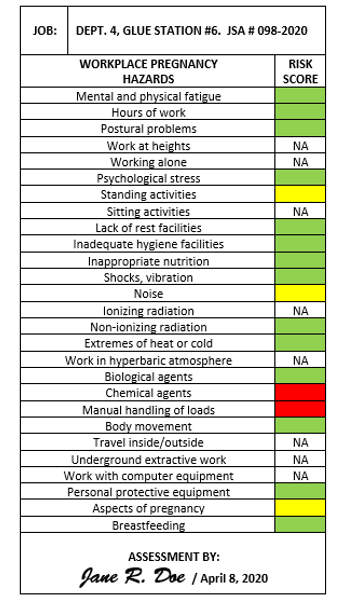 There is a way to determine if this hypothesis is correct at your workplace. Recreate the JSA above, except leave the Risk Score and top and bottom sections blank. The JSA lists the topics in order (except for breastfeeding) as they appear in the risk assessment guidance that supports the EU’s 1992 Pregnant Workers Directive. Locate the EU’s actual risk assessment guidance online, as necessary.
Next, assemble a team that includes men and women. The larger the number of people on the team the better. Each team member should have some competence to recognize and evaluate hazards, such as those that comprise a safety committee. HR, legal and other members, such as supervisors, may add a beneficial touch to this event.
Select any representative job at your workplace. Handout a blank JSA and a red, yellow and green color maker to each team member. Have them act alone, and use any resource they want, complete the Risk Scores as if a pregnant worker (and future child) were at the job. Green = No Concern. Yellow = Unlikely Concern. Red = Concern. NA = Not Applicable. Share all the results among team members when finished and discuss findings.
Make the above exercise fun. The results of the exercise should be used in your summarization of the PWFA final rule and interpretative guidance to management.
Conclusion
The information in this article demonstrates that risk assessment for pregnant worker concerns has been known globally for decades, even more than a century ago within the U.S. The push now among some OHS publications to encourage risk assessments, at this late hour, even when not required by the PWFA, is an issue that should be considered and resolved. There should not be any confusion between OSHA-fication e.g., rigid and fixed attitudes and PWFA requirements.
Although completion of the assessment as shown above may have little merit for PWFA compliance and may incur some tort liability e.g. know and failure to act, be aware that some hazards such as ionizing radiation and chemical agents have other regulatory inducements for risk assessments to help protect pregnant workers and their future children.
Looking for a reprint of this article?
From high-res PDFs to custom plaques, order your copy today!