Cal/OSHA's Indoor Heat Standard Meets Loading Dock Reality
The 87°F Threshold Most Warehouse Operators Miss
Credit: LongHa2006 / Getty Images Plus
Most warehouse operators feel confident about heat compliance. The main floor stays cool, the crew has water and shade, and the initial trigger under Cal/OSHA's indoor heat standard gets attention. But there's a higher threshold that activates costly mandatory controls, and it's being breached daily, where you may not even think to check. Loading docks can become compliance liabilities, exposing you to citations, disruptions and preventable heat injuries.
Understanding the Temperature Triggers
Cal/OSHA's Heat Illness Prevention in Indoor Places of Employment regulation took effect in July 2024. "This regulation provides protections for workers across California and helps prepare employers to deal with the challenges of rising temperatures in indoor environments," said Cal/OSHA Chief Debra Lee at the time.
The law introduces two heat thresholds that trigger progressively stricter requirements. Employers must provide basic protections at 82° Fahrenheit, including water, a cooldown area and encouraged cooldown rests. Most facility managers have addressed these initial requirements.
87° Fahrenheit: The Critical Threshold
The second threshold matters more because compliance becomes significantly more demanding. Once indoor temperatures reach 87° Fahrenheit, the following mandatory control measures activate:
- Mandatory assessment: The employer must actively measure temperature and heat index in the work area and keep detailed records.
- Engineering controls: This is the top priority. You must use engineering controls like air conditioning, fans, ventilation or shielding to reduce the temperature below the threshold.
- Administrative controls: If engineering controls prove insufficient, you must use administrative controls such as rotating employees, changing schedules to cooler times or reducing work intensity.
- Personal heat-protective equipment: As a last resort, the employer must provide and require equipment like cooling vests.
Warehouse operators may not realize they are breaching this threshold unless they understand where to look.
The Hot Zone: When Your Loading Dock Becomes a Liability
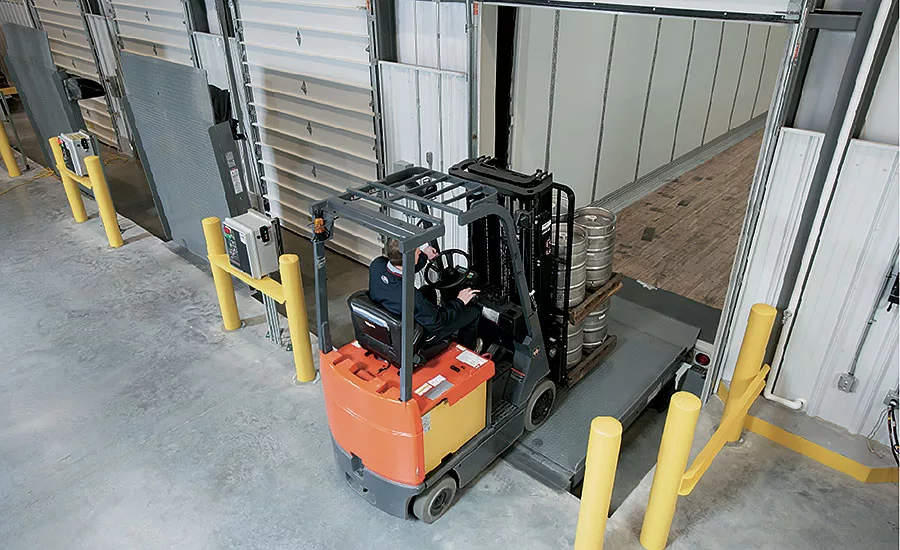
Picture a typical busy loading dock during summer, with doors constantly open, idling trucks radiating heat and hot asphalt creating a micro-climate that has nothing in common with your climate-controlled warehouse floor.
The temperature difference can be stark. Climate Rig’s Bryce Hinckley notes that "Metal-roofed warehouses in California's Central Valley, Inland Empire and Imperial Valley routinely hit 87°F+ indoors by mid-morning on summer days, particularly at upper rack levels and at loading dock zones where bay doors are open.”
Consider a distribution center in Fresno in July. While the main floor stays cool, temperature guns show the air at open Bay 4 hitting 88° Fahrenheit by 1 p.m., placing the team in violation without anyone realizing it. This scenario plays out daily across California's hottest regions.
The Loading Dock Exemption Myth
Many operators assume that brief outdoor exposure scenarios fall outside the regulation's scope, but that assumption is incorrect for loading and unloading activities. Unlike other brief exposure scenarios, these operations have no incidental exposure exemption, making this a primary compliance failure point.
Why High-Speed Doors Are the First Line of Defense in Your Loading Dock
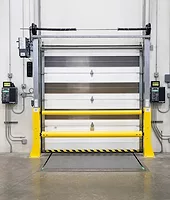
High-speed commercial doors are one of the most effective engineering controls for this compliance challenge, and the core benefit is straightforward — minimizing open-door time. When a door opens and closes in seconds rather than minutes, you dramatically reduce heat and air exchange.
That’s why high-speed doors can be a valuable tool for keeping the dock area below the mandatory action level while also improving energy and cost efficiency.
According to Kristin Slyker, Chief Executive Officer of Vortex Doors, an Anaheim-based commercial and industrial door service company with over 600 trained technicians across 50+ nationwide service centers, "A few seconds might not seem like much, but given the size of standard warehouse doors, those seconds add up. Installing a high-speed door lowers temperature exchange by a few minutes each day, significantly reducing the amount of energy your business consumes over time."
When dock temperatures approach the threshold, having access to emergency door repair in Anaheim becomes critical, as downtime directly translates into increased heat exposure. Building relationships with experienced providers for industrial door repair in CA should be part of your strategy long before an urgent need arises.
Protecting Compliance with Door Maintenance
Under Cal/OSHA regulations, engineering controls must be documented and verifiable, meaning a high-speed door qualifies as a control measure only if it's functioning as designed. A door operating at reduced speed due to worn components, or one with degraded weather sealing that allows continuous heat infiltration, fails to meet the standard's engineering control requirements.
Compliance-focused maintenance programs should include documented inspection intervals for critical components: photoeye sensors that prevent premature door cycling, spring tension systems that maintain cycle speed, and perimeter weather seals that prevent thermal bridging. According to Slyker from Vortex Doors, "The most common failure point we see is degraded weather stripping. Facilities don't realize that even small gaps create continuous heat infiltration, undermining the door's effectiveness as an engineering control. Our technicians inspect seal compression during preventative maintenance because when you're operating close to the 87-degree threshold, a door that's not properly sealed can be the difference between compliance and violation."
The compliance risk extends beyond gradual degradation. Door failures during peak heat periods create immediate regulatory exposure. Facilities should establish service agreements that guarantee response times aligned with their heat exposure profile — operations in California's Inland Empire and Central Valley during June through September face higher urgency than those in coastal zones with marine layer cooling.
The High Cost of Overlooking the Thermometer
Cal/OSHA takes heat violations seriously. Facilities that fail to meet the indoor heat standard with the help of high-speed doors or other mitigations face significant citations and fines at multiple penalty tiers:
- General and regulatory violations reach $16,285.
- Serious violations reach $25,000.
- Willful and repeated violations reach $162,851.
Example Cases
The enforcement record shows Cal/OSHA is actively citing facilities. Amazon's regional air freight hub in San Bernardino was cited three times in January 2024, resulting in collective penalties of $14,625, demonstrating how easily facilities can miss compliance requirements.
Even more illuminating is the Van Nuys landscape maintenance company that received a $276,425 willful heat violation citation in January 2025. Although not a warehouse, this case represents the first such willful citation in more than five years and signals Cal/OSHA's increasingly aggressive enforcement posture.
Operational and Human Costs
Penalties are only the most visible operational risk. Work stoppages disrupt operations, while heat-related workers' compensation claims drive up insurance costs.
However, it’s the human cost that matters most. According to the National Association of Safety Professionals, OSHA statistics show that "Nearly 40 U.S. workers die annually due to environmental heat exposure, with thousands more suffering injuries. Heat is responsible for at least 170,000 work-related injuries and as many as 2,000 fatalities each year, making it one of the top five causes of workplace injuries and deaths."
Beyond the immediate health risks, heat violations damage your reputation as a safe employer, and in competitive labor markets, word spreads quickly about facilities that don't protect their people. Among your existing staff, morale suffers when workers don’t feel protected.
The Bottom Line on Loading Dock Compliance
The 87° Fahrenheit loading dock threshold is a limit that most operators don't even know they're breaching. High-speed, well-maintained doors represent the most direct strategy to protect workers, but you need to stop guessing and start measuring. Go to your loading docks with a temperature gun during peak operations and see for yourself. The cost of compliance is far less than the financial burden of a citation and infinitely less than a preventable heat injury to someone on your team.
Looking for a reprint of this article?
From high-res PDFs to custom plaques, order your copy today!