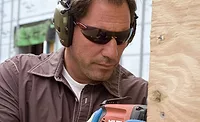
A Sound Strategy

The best way to protect your hearing from hazardous noise exposure is to consistently use hearing protectors around loud noise.â€
This may sound like a basic instruction to most people, but to an employee who has experienced hearing loss due to noise exposure, this same instruction, if given audibly, may sound like this: “Da be way oo roec your hearing rom haardu noi eboer i oo onidindly oo hearing roecer around loud noi.â€
Safety professionals know the hazards of loud noise, but how can you convey this risk awareness to workers and motivate them to take protective actions? Motivation is the keystone to preventing noise-induced hearing loss. Motivated employees take responsibility for protecting their hearing both on and off the job, rather than just viewing hearing protectors as a workplace compliance issue.
Let’s look at three ways to instill the risk awareness that can motivate workers to take action in defense of their own hearing. These strategies can help employers sustain a successful hearing conservation program.
1) Dispel their illusion of invulnerability
From the young worker with illusions of invincibility to the seasoned veteran who claims “the loud noise doesn’t bother me like it used to,†many workers don’t believe they are personally susceptible to noise damage. Comments such as, “I’m used to the noise,†or “The noise isn’t really that bad,†conflict with your sound measurements, which indicate otherwise. The brain may perceptually grow accustomed to constant noise, but anatomically, the ears can never “toughen up†against hazardous noise. Ears respond to loud noise by losing hearing.You can dispel these illusions of personal invulnerability by providing employees with the hard facts of noise and hearing loss: the audiogram and the measured noise levels. Several studies1,2,3 have found that the incidence of noise-induced hearing loss drops significantly when workers are provided a copy of their annual audiometric tests, with an explanation of the results. It is hard to argue with an objective test that historically shows the progression of hearing loss from year to year. When provided a copy of their audiogram showing a “noise notch†in their hearing, many workers are surprised; the decline in hearing was so subtle, they had no idea hearing was being measurably affected.
Publicly posting the measured noise levels also encourages protection. Some employers utilize noise thermometer posters, clearly showing specific noise levels at their facility, along with other common occupational and non-occupational noise levels. Posting the decibel rating on each piece of continuously operating equipment can also serve as a reminder to workers to wear their hearing protection. The message to a worker is clear: Noise above 85 dB can damage hearing, and your lathe machine is 94 dB — you are at risk.
In educating workers about noise damage, specific and personal data is more motivating than broad generalizations.
2) Demonstrate future risk
It is human nature to weigh our risks in terms of “here and now.†But since noise-induced hearing loss displays no visible signs of injury and typically develops over years of exposure, how can we show the worker the future risk? Many employers use audio demonstrations, or simulated hearing losses, so that the worker has a clear understanding of his future risk and the need for adequate protection today.The distorted sentence at the beginning of this article is one example of this simulation. A noise-induced hearing loss typically affects high-frequency hearing (regardless of whether the incoming noise exposure is low- or high-frequency noise). This means the affected worker will have difficulty hearing the high-frequency sounds of speech — consonant sounds like s, k, ch, f, p, th, t and sh. A simple phrase like “Tie your shoe†could sound like “_ie or _oo!†for a worker with a noise-induced hearing loss. Write out a paragraph of text, then eliminate the consonants listed above to produce an effective training script that demonstrates future risk for noise-exposed workers.
When noise damages hearing, most people notice a change not in the loudness of conversation, but in the clearness of the words — the words simply sound garbled. In safety training meetings, this can be effectively reproduced on a sound system by playing any speech sample — the announcer at a baseball game, a radio newscast or a recorded conversation — with the treble tone control turned down to minimum levels. The resulting bass-rich signal — emulating an artificially induced high-frequency hearing loss — effectively demonstrates the frustrating lack of clarity caused by noise damage.
3) Remove barriers to using protection
At the conclusion of her annual audiometric test, I asked one worker if she was consistent in wearing her hearing protectors. “Haven’t seen them for weeks,†she replied. “We ran out of them on the shop floor, and nobody has re-stocked them yet.â€Compliance in wearing hearing protection is sometimes as simple as ensuring an ongoing supply. But sometimes the barriers run deeper and begin in the selection process. A recent NIOSH study4 examined the reasons why workers do not consistently wear their hearing protectors. Though respondents came from several different countries and from many different industries, the results were quite consistent: The major obstacles to consistent hearing protector usage are interference with communication, interference with job performance, and comfort. Employers who can remove these obstacles in the selection of hearing protectors they offer to employees will effectively eliminate the major barriers to workplace protection.
Hearing protectors are now available that address workers’ concerns of overprotection and communication interference. Earplugs have different attenuation ratings (NRRs) for different noise levels; others, made of special high-tech material, conform to the shape of the wearer’s ear canal. Some earplugs and earmuffs are designed to maximize communication through uniform attenuation, allowing wearers to hear important sounds (co-workers, warning signals, radio and communication systems, machinery) more naturally while still protecting from harmful noise levels. Electronic earmuffs can also enhance communication by amplifying ambient sounds (including speech and warning signals) to a safe level, while protecting against louder, more damaging noise.
Make the investment
Noise-exposed workers have few inherent incentives for protecting themselves from loud noise. After all, unlike other occupational injuries, noise-induced hearing loss causes no pain or visible trauma, leaves no visible scars, is unnoticeable in its earliest stages, and generally takes years to diagnose. By showing these workers their susceptibility to noise damage, demonstrating the future risk, and removing the barriers to properly wearing hearing protection, an employer invests in a workforce that takes responsibility for their own hearing protection, both on and off the job.Sidebar: Ultimate motivator: A glimpse into the future
One safety manager recently reported the ultimate “hearing protection†motivator. At a company holiday party to which past and present employees were invited, a retired worker briefly addressed the audience. From the podium, he explained that during his long tenure of service at the company, he was lax about wearing hearing protection and now suffered hearing loss. He described how the enjoyments he had long been anticipating in retirement were significantly diminished by his deteriorating hearing.He ended his short homily with a personal warning to the current workforce: Wear your hearing protectors! Those who heard this message from “one of their own†were deeply struck by the personal message. They had been granted a sad but motivating fast-forward glimpse into their own futures and the need for protection today.
Looking for a reprint of this article?
From high-res PDFs to custom plaques, order your copy today!