No room for error
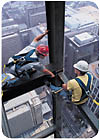
Most serious fall incidents can be traced back not to the fall protection equipment itself but, rather, to either misuse of the equipment or the use of wrong equipment — usually due to a lack of knowledge.
So, just how competent is your competent person? The training they receive and the training they provide should instill confidence in the equipment and your work procedures at heights. If OSHA is the only reason your staff is using fall protection, an alert bell should be going off. It is important to comply with standards and regulations, but the workforce must also understand that these standards and regulations exist for a reason.
Lack of understanding
There are many misconceptions about standards and safety procedures in our industry. Proper training ensures the understanding necessary to create a safety culture within the work environment. The examples below represent some of the most common issues and violations that arise simply because workers do not understand why they exist.
OSHA 1926.502(d)(6)(iii) – Unless the snaphook is a locking type and designed for the following connections, snaphooks shall not be engaged to a dee-ring to which another snaphook or other connector is attached.
Misconception – Workers commonly put more than one snaphook in a dee-ring. Depending on the type of snaphooks used, 20 percent to 30 percent of the workers will attach the snaphook to the other snaphook and not to the dee-ring. This is improper procedure and could result in a snaphook gate failure in the event of a fall.
OSHA 1926.502(d)(20) – The employer shall provide for prompt rescue of employees in the event of a fall or shall assure that employees are able to rescue themselves.
Misconception – Most companies do not have a rescue plan and rely on 911. Calling 911 should be a part of the plan, and although public safety will do the best they can, they are not required to provide these services.
The word “prompt†in this code has somewhat of a gray area as well. A letter of interpretation addressing 1910.151 medical services and first-aid states that when areas where life-threatening injury can reasonably be expected, a 3-4 minute response time is required, from time of injury to time of administering first-aid. Although this is an aggressive goal, through proper training and the use of engineered rescue systems for fall arrests, conscious employees can be alleviated from suspension trauma in less than a minute and administered appropriate medical care within 3-4 minutes. In the case of an unconscious employee, a good plan should lay out the strategy to get that person down from 50-300 feet within 15 minutes and under 50 feet within 10 minutes.
Improper procedure is another common problem with rescue plans. For example, some emergency plans call for cutting the lanyard as part of the rescue. This technique might be derived from the recreational mountaineering industry. Unlike fall protection harnesses, mountaineering harnesses aren’t designed to meet OSHA regulations, and rescue personnel are required to use extreme measures to rescue hobbyists. Fall protection harnesses, lanyards, snaphooks and carabineers are all designed and tested to strict OSHA regulations and ANSI standards. The snaphooks and carabineers are designed with an ultimate breaking strength of 5,000 pounds and each is proof-loaded or pull-tested to 3,600 pounds before they are attached to a lanyard. In a fall, these systems will see impact forces of 1,800 pounds or less.
If in the course of a rescue, a rescuer can open the snaphook, but not remove it from the victim, the system is under load. There have been documented cases where the worker fell after the lanyard was cut due to the rescue system not being deployed properly. If a rescuer cuts the lanyard in the course of a rescue and the worker falls to his death, a criminal investigation might look into whether or not the rescuer’s actions contributed to the death of the worker.
ANSI Z359.1 (7.2.2) – Snaphooks and carabineers shall not be connected to each other. Misconception – Most people are unaware of this standard. The reason is because during a fall the snaphook could engage the carabineer gate and open it. Simultaneously, gravity will pull the snaphook out of the carabineer.
ANSI Z359.1 (7.2.1) – Sliding hitch knots shall not be used in lieu of fall arresters.
ANSI Z359.1 (3.2.7.2.2) – Knots shall not be used for load-bearing end terminations.
Misconception – Sliding hitches, otherwise known as Prusik Knots or triple sliding hitches, are prevalent in the technical rescue community and also have their roots in mountaineering. They are often mistakenly used in fall protection. Sliding hitches are typically tied — the Prusik Knot uses the Double Fisherman’s Knot.
OSHA also has a non-mandatory appendix for complying with 1926.502(d)(II)(h)(8), stating sliding hitch knots should not be used for lifeline/lanyard connections except in emergency situations where no other available system is practical.
Ongoing effort
Today, workers are learning proper use of PPE and rescue methods in training facilities or participating in custom onsite training. The training should allow the worker to actually use the equipment and experience real-life application scenarios to be successful. Some safety equipment manufacturers have realized the need for world-class training that is both convenient and efficient. This can be advantageous because manufacturers not only demonstrate the product attributes, but have vast expertise in correct product selection and providing the best solution for specific jobsite challenges.Safety is an ongoing effort. Having the correct equipment is just half the battle; workers must keep the right attitude and have a complete understanding of their equipment in order to maintain a safe workplace. By moving beyond the OSHA requirement and truly understanding why we do things a certain way, jobsite superintendents can be confident of the safety of their workers and ensure they go home at the end of their shift.
Looking for a reprint of this article?
From high-res PDFs to custom plaques, order your copy today!


