ISHN logo
search
cart
facebook twitter linkedin youtube
  • Sign In
  • Create Account
  • Sign Out
  • My Account
ISHN logo
  • NEWS
    • Today's News
    • Global Safety News
    • Government Regulations
  • PRODUCTS
    • Product Innovations
    • Featured Products
  • TOPICS
    • Environmental Health and Safety
    • Facility Safety
    • Workplace Health
    • Occupational Safety
    • PPE
    • More Topics
  • CONSTRUCTION
  • TECHNOLOGY
  • COLUMNS
    • Best Practices
    • Dave Johnson: What’s going on
    • Editorial Comments
    • Leading Safety
  • MULTIMEDIA
    • ISHN Podcast
    • Videos
    • Cold Stress Education Quiz
    • Webinars
    • White Papers
  • MORE
    • Buyer's Guide
    • Newsletters
    • Convention Companion
    • Polls
    • Events
    • ISHN Store
    • Sponsor Insights
  • EMAGAZINE
    • eMagazine
    • Archived Issues
    • Contact
    • Advertise
  • JOIN TODAY!

"Cutting" costs and injuries
By John Buckner
April 8, 2006


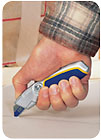
If you don’t think utility knives and blades make a major impact on your plant’s productivity and safety record, think again. According to statistics from the Consumer Product Safety Commission, 39 percent of the 330,000 medically treated injuries attributed to manual workshop tools in the United States involved knives and retractable blades. Such injuries may occur from blades that break, accidental cuts while changing blades, and the mishandling of utility knives.

Have you noticed all of the applications around your facility that require cutting with a utility knife? They may include opening boxes or wrap, trimming wire, cutting production material, fixtured cutting in the assembly process and general maintenance cutting. Almost all workers have something to cut. Utility knives are never farther away than their pocket or tool belt.

Unfortunately, this most common of tools can also be one of the most dangerous. And, since not much has changed over the years, we often take these tools for granted. The good news is that newer, innovative blades are rapidly changing the way managers perceive the importance of these hand tools.

Lost productivity & high risk

Expectations are low for traditional carbon steel utility blades. Frustrated employees must stop working to turn them around, change them out and then go retrieve more. Blade changes can be a tedious process, lasting anywhere from 30 seconds for a simple turn-around, to more than two minutes for a full blade substitution. That’s 335 hours for a facility that uses 10,000 blades a year.

Another problem with traditional utility blades is that cutting can be a dangerous operation. As carbon steel blades dull, workers press harder, exposing them to a potential injury from their cutting hand slipping off the work-piece, or more seriously, the blade shattering. The risk of getting cut is never higher than during blade changes, when workers directly handle blades. As a result, cuts top the list of workplace injuries recorded in plants and facilities today. You pay the price in terms of lost time, insurance fees and other liabilities. By changing the tools you use and employing safe cutting practices, you can reduce the risk of injury. (See “Safe cutting practices” sidebar.)

Cutting-edge solution

Utility blades have improved with the introduction of bi-metal technology, a process that fuses two metals together through electro-beam welding. One of the metals is high-speed steel, which yields sharpness; the other is a flexible spring steel that flexes but does not break. These bi-metal utility blades have a significantly longer life, translating to a sharper edge for your workers and fewer blade changes.

Linda Hobbs, purchasing supervisor at Vantage Industries (a division of Leggett & Platt), has seen strong productivity increases in her facility. “We converted to bi-metal utility blades from carbon steel blades,” says Hobbs. “The bi-metal blades were unbreakable and lasted six times longer than carbon steel counterparts in our manufacturing application, where we use the utility blades to remove baked-on residue from rollers.” Since bi-metal utility blades are unbreakable, they are safer for workers. “We are constantly looking for tools to maximize employee safety,” said Rachel Champion, safety manager at Yamaha, North America. “Shattered utility blades can lodge chards of steel in the skin or the eyes. Unbreakable bi-metal blades reduce our risks of catastrophic injuries.”

With bi-metal blades offering the potential to dramatically reduce the total costs in the area of cutting and to decrease liability, production and safety managers are increasingly taking a sharp look at utility knives and blades. Improving your safety program may be as easy as upgrading these everyday tools.

SIDEBAR: Safe cutting practices

1. Always wear safety glasses.
2. Wear protective gloves, especially on the hand that holds the work-piece to be cut.
3. Always use a sharp blade.
4. Make sure footing is secure and stable.
5. Pull the knife toward you when cutting on a flat surface.
6. Keep your free hand (non-cutting) away from the line of cut.
7. When using a straight edge to cut, clamp it securely.
8. Never make a blind cut. Always check the length of the cut to ensure a clear path.
9. Change your blade whenever it starts to tear the work piece.
10. Pure carbon steel blades are brittle and shatter easily. Don’t bend them or apply side loads to them by using them to pry objects loose.

Share This Story

Looking for a reprint of this article?
From high-res PDFs to custom plaques, order your copy today!

John Buckner heads up the utility knives and blades category for IRWIN Industrial Tools. Prior to joining IRWIN, he worked for Ingersoll-Rand Company for eight years, mainly with air compressors, tools and components. He can be reached at John.Buckner@Irwin.com.

Recommended Content

JOIN TODAY
to unlock your recommendations.

Already have an account? Sign In

  • forklift safety

    Exploring the latest technologies in forklift safety

    With more staff and more stock in warehousing now more...
    Workplace Training Strategies
    By: Josh Cramer
  • welding

    All about welder’s flash or arc eye

    A flash burn is a painful inflammation of the cornea,...
    Environmental Health and Safety
  • dangerous jobs

    The 10 most dangerous jobs in the U.S.

    On-the-job deaths have been rising — hitting the highest...
    Occupational Safety
    By: Benita Mehta
Manage My Account
  • eMagazine Subscriptions
  • ISHN Newsletter & Other Newsletter Alerts
  • Online Registration
  • Manage My Preferences
  • Subscription Customer Service

More Videos

Sponsored Content

Sponsored Content is a special paid section where industry companies provide high quality, objective, non-commercial content around topics of interest to the ISHN audience. All Sponsored Content is supplied by the advertising company and any opinions expressed in this article are those of the author and not necessarily reflect the views of ISHN or its parent company, BNP Media. Interested in participating in our Sponsored Content section? Contact your local rep!

close
  • man wearing the the Sundström SR200 Full Face Mask Respirator
    Sponsored byOHD

    5 Fit Testing Mistakes That Could Cost You

  • This image shows Magid AcuSpex polarized blue mirrored safety glasses.
    Sponsored byMagid Glove and Safety

    Construction PPE Guide: What Crews Need for Each Task

  • lone worker in confined space
    Sponsored byAlphasense Ltd.

    GET THE LEAD OUT of your Safety Oxygen Sensors!

Popular Stories

SpaceX 7 launch

OSHA Investigating Fatal Fall at SpaceX Starbase

Worker Impairment

How to Tell When a Co-Worker is Impaired? A Safety Pro’s Challenge

Automated loading dock equipment

After March 2026 Rivian Death, Safety Managers Reassess Loading Dock Systems Under OSHA's Warehouse Emphasis Program

top 10 most dangerous jobs

Poll

Seasonal Readiness

With the federal heat stress prevention rule on the horizon, which area of your safety program needs the most attention?
View Results Poll Archive

Products

Surviving an OSHA Audit A Management Guide, 2nd Edition

Surviving an OSHA Audit A Management Guide, 2nd Edition

See More Products

ISHN Podcasts

Related Articles

  • Reducing cuts, cutting costs

    See More
  • ISHN0717_F2_pic.jpg

    Avoid the heavy costs of burn injuries

    See More
  • Counting the costs of occupational injuries

    See More

Related Products

See More Products
  • occup safety.jpg

    Occupational Safety and Health: Fundamental Principles and Philosophies

See More Products

Related Directories

  • ESAB Welding & Cutting

    At ESAB, we exist to shape the future of welding and cutting. We connect fabricators with the widest range of products and PPE under our industry-leading brand portfolio with the latest technologies to solve virtually any industry challenge — then we back it up with our knowledge, experience and passion to help them be more productive than ever before. To learn more, visit esab.com or call 1-800-ESAB-123.
  • Broner Glove & Safety Co.

    For over 90 years, Broner Glove and Safety has been dedicated to 'Making a Difference' in safety programs. As proud members of AD-SafetyNetwork, we provide comprehensive safety solutions, including personalized service, top-tier PPE, and cutting-edge plant and site safety equipment, ensuring the well-being of your workforce and industry excellence.
×

Become a Leader in Safety Culture

Build your knowledge with ISHN, covering key safety, health and industrial hygiene news, products, and trends.

JOIN TODAY
  • RESOURCES
    • Advertise
    • Contact Us
    • Directories
    • Manufacturing Division
    • Store
    • Want More
  • SIGN UP TODAY
    • Create Account
    • eMagazine
    • Newsletters
    • Customer Service
    • Manage Preferences
  • SERVICES
    • Marketing Services
    • Reprints
    • Market Research
    • List Rental
    • Survey/Respondent Access
  • STAY CONNECTED
    • LinkedIn
    • Facebook
    • YouTube
    • X (Twitter)
  • PRIVACY
    • PRIVACY POLICY
    • TERMS & CONDITIONS
    • DO NOT SELL MY PERSONAL INFORMATION
    • PRIVACY REQUEST
    • ACCESSIBILITY

Copyright ©2026. All Rights Reserved BNP Media, Inc. and BNP Media II, LLC.

Design, CMS, Hosting & Web Development :: ePublishing