ISHN logo
search
cart
facebook twitter linkedin youtube
  • Sign In
  • Create Account
  • Sign Out
  • My Account
ISHN logo
  • NEWS
    • Today's News
    • Global Safety News
    • Government Regulations
  • PRODUCTS
    • Product Innovations
    • Featured Products
  • TOPICS
    • Environmental Health and Safety
    • Facility Safety
    • Workplace Health
    • Occupational Safety
    • PPE
    • More Topics
  • CONSTRUCTION
  • TECHNOLOGY
  • COLUMNS
    • Best Practices
    • Dave Johnson: What’s going on
    • Editorial Comments
    • Leading Safety
  • MULTIMEDIA
    • ISHN Podcast
    • Videos
    • Cold Stress Education Quiz
    • Webinars
    • White Papers
  • MORE
    • Buyer's Guide
    • Newsletters
    • Convention Companion
    • Polls
    • Events
    • ISHN Store
    • Sponsor Insights
  • EMAGAZINE
    • eMagazine
    • Archived Issues
    • Contact
    • Advertise
  • JOIN TODAY!
Columns

MANAGING BEST PRACTICES: Check your chemical inventory

By Dan Markiewicz MS, CIH, CSP, RMP
September 2, 2008


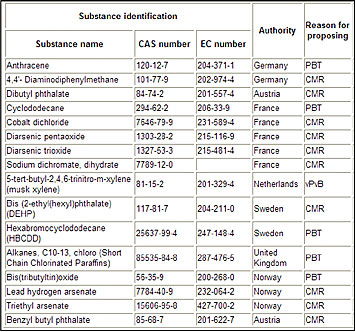
Table I: European Chemicals Agency July 2008 Candidate List of Substances of Very High Concern
Table source: http://echa.europa.eu/consultations/authorisation/svhc/svhc_cons_en.asp

Last month’s article gave examples of why a restricted chemicals policy is needed. The momentum to restrict certain toxic chemicals is pushing EHS pros to develop and update a restricted chemical policy and program for their worksite(s). This article briefly describes how you may develop a policy and procedure to address this issue.

In the past two decades there was a focus to restrict chemicals that posed special environmental risks, such as those that could deplete the ozone or harm wildlife (e.g. DDT). The trend now is to focus on chemicals that pose special human health risks.

Table I (below) provides an example of this trend. The chemicals listed are the first candidates for “substances of very high concern” (SVHC) under authority of the new EU REACH legislation. The majority of the chemicals on the current list are CMRs (carcinogen, mutagen or toxic to reproduction).

Some chemicals on the list already are being restricted.

About 30,000 chemicals are expected to be registered under REACH in the next several years. Since more than one-half of the budgets for chemical toxicity studies under REACH are for reproductive tests, CMRs (primarily “R”) should continue to outpace PBT (Persistent, Bioaccumulative and Toxic chemicals) and vPvB (very Persistent, very Bioaccumulative) as SVHC (just more acronyms to become familiar with).

Get management support

You will get management support when you effectively explain why certain chemicals should be restricted at the worksite. The need to restrict chemicals will vary depending upon industry sector. Management in the electronic sector, for example, probably is aware and may be eager to become RoHS-compliant (EU Restriction of Hazardous Substances Directive that took effect in July 2006). In this situation, management may appreciate why lead, mercury, cadmium, Cr+6, PBB and PBDE should be restricted for use at work. Focus “why” explanations based upon those chemicals that should be restricted within an industry sector.

Establish policy & procedure

A policy may be viewed as a statement of destination. A procedure may be viewed as the roadmap to reach the destination. A policy and procedure should be written, dated and signed by the most senior manager responsible for the operation of the worksite. The procedure should include accountabilities and a schedule for periodic review. This is necessary to avoid any confusion on the topic and keep it up to date.

If your company has no restricted chemicals policy, review those that have been developed for companies with ISO 14001 registrations within your industry and tailor them to meet local needs. It is unlikely that many of these policies at present specifically address new issues such as SVHC. Given the significance and global impact of SVHC, your policy should include a statement such as: “Our Company will restrict the purchase, use or disposal of all chemicals declared under EU REACH to be a substance of very high concern.” The policy should refer to a procedure that will carry out the details of the policy. The procedure should address contractors to ensure they do not use restricted chemicals during their activities at the worksite.

Plan for the “R”

The R (reproduction) part of CMRs may be especially troublesome in the U.S. For example, each of the phthalates along with lead hydrogen arsenate in Table I contain the risk phrase R61 “May cause harm to the unborn child.” U.S. limits such as PEL, REL and TLV generally do not address limits for the unborn child (i.e. pregnant worker). For example, the PEL and TLV for dibutyl phthalate do not account for effects upon the unborn child and their limits are both at 5 mg/m3. When effects upon the unborn child are considered, an Occupational Reproductive Guideline at 0.72 mg/m3 is suggested.1

Address “low dose”

As scientific capabilities expand, finding chemicals in very low amounts becomes more practical. Finding a chemical at one part per billion is equivalent to a measurement of one second in 32 years. An acceptable threshold should be stated for a restricted chemical even if you couch it with the phrase “at the limit of analytical detection by approved scientific methods.” Avoid the use of “no” when referring to a chemical amount.

Expert help

Given the complexity of this issue, you may need to seek expert help in building an effective procedure. To name just a few, specialists such as www.chemadvisor.com, consultants with expertise in the topic such as www.bureauveritas.com, or software companies (with restricted chemical lists) such as http://www.micromedex.com/products/ehs/ may be very helpful.


Reference
1. Reproductive Hazards of the Workplace, Frazier et al, John Wiley & Sons, Inc., 1998

Share This Story

Looking for a reprint of this article?
From high-res PDFs to custom plaques, order your copy today!

Dan Markiewicz, MS, CIH, CSP, RMP, is an independent environmental health and safety consultant and a long-time columnist. He can be reached at (419) 356-3768 or by email at dan.markiewicz@gmail.com.

Recommended Content

JOIN TODAY
to unlock your recommendations.

Already have an account? Sign In

  • forklift safety

    Exploring the latest technologies in forklift safety

    With more staff and more stock in warehousing now more...
    Workplace Training Strategies
    By: Josh Cramer
  • welding

    All about welder’s flash or arc eye

    A flash burn is a painful inflammation of the cornea,...
    Environmental Health and Safety
  • dangerous jobs

    The 10 most dangerous jobs in the U.S.

    On-the-job deaths have been rising — hitting the highest...
    Transportation Safety
    By: Benita Mehta
Manage My Account
  • eMagazine Subscriptions
  • ISHN Newsletter & Other Newsletter Alerts
  • Online Registration
  • Manage My Preferences
  • Subscription Customer Service

More Videos

Sponsored Content

Sponsored Content is a special paid section where industry companies provide high quality, objective, non-commercial content around topics of interest to the ISHN audience. All Sponsored Content is supplied by the advertising company and any opinions expressed in this article are those of the author and not necessarily reflect the views of ISHN or its parent company, BNP Media. Interested in participating in our Sponsored Content section? Contact your local rep!

close
  • man wearing the the Sundström SR200 Full Face Mask Respirator
    Sponsored byOHD

    5 Fit Testing Mistakes That Could Cost You

  • This image shows Magid AcuSpex polarized blue mirrored safety glasses.
    Sponsored byMagid Glove and Safety

    Construction PPE Guide: What Crews Need for Each Task

  • lone worker in confined space
    Sponsored byAlphasense Ltd.

    GET THE LEAD OUT of your Safety Oxygen Sensors!

Popular Stories

SpaceX 7 launch

OSHA Investigating Fatal Fall at SpaceX Starbase

dust explosion

Tennessee OSHA Issues Record $3.1M Fine After Deadly Explosion at Munitions Plant

Worker Impairment

How to Tell When a Co-Worker is Impaired? A Safety Pro’s Challenge

top 10 most dangerous jobs

Poll

Seasonal Readiness

With the federal heat stress prevention rule on the horizon, which area of your safety program needs the most attention?
View Results Poll Archive

Products

Surviving an OSHA Audit A Management Guide, 2nd Edition

Surviving an OSHA Audit A Management Guide, 2nd Edition

See More Products

ISHN Podcasts

Related Articles

  • MANAGING BEST PRACTICES: Checked your chemical inventory lately?

    See More
  • MANAGING BEST PRACTICES: How to implement best practices

    See More
  • MANAGING BEST PRACTICES: Display your competencies

    See More

Related Products

See More Products
  • 1119906652.webp

    Alive and Well at the End of the Day: The Supervisor's Guide to Managing Safety in Operations, 2E

  • Optimizing Social Media from a B2B Perspective

  • 9781482217148.jpg

    Fall Prevention and Protection: Principles, Guidelines, and Practices

See More Products

Related Directories

  • ImageWave Corp.

    EHS & SDS writing software including GHS Label Printing, SDS Management, Chemical Inventory Tracking, Environmental Reporting & Database Management.
  • Safe Site Check In LLC

    Make Jobsite Management Easy(™). Safe Site Check In saves jobsite safety, super, project, and cost managers hours a day including: Digital badging, onboarding & training, Safety screening, Daily log creation Safety JSA, EAP, SDS Project management integration, Subcontractor management, Remote site monitoring, Worker profiles, Incident investigations.
×

Become a Leader in Safety Culture

Build your knowledge with ISHN, covering key safety, health and industrial hygiene news, products, and trends.

JOIN TODAY
  • RESOURCES
    • Advertise
    • Contact Us
    • Directories
    • Manufacturing Division
    • Store
    • Want More
  • SIGN UP TODAY
    • Create Account
    • eMagazine
    • Newsletters
    • Customer Service
    • Manage Preferences
  • SERVICES
    • Marketing Services
    • Reprints
    • Market Research
    • List Rental
    • Survey/Respondent Access
  • STAY CONNECTED
    • LinkedIn
    • Facebook
    • YouTube
    • X (Twitter)
  • PRIVACY
    • PRIVACY POLICY
    • TERMS & CONDITIONS
    • DO NOT SELL MY PERSONAL INFORMATION
    • PRIVACY REQUEST
    • ACCESSIBILITY

Copyright ©2026. All Rights Reserved BNP Media, Inc. and BNP Media II, LLC.

Design, CMS, Hosting & Web Development :: ePublishing