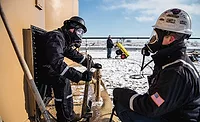
A respirator potpourri
I’m often asked what’s new in the world of respiratory protection. With so many changes, it’s difficult to offer a concise answer. Innovations run the gamut from new technologies to improved comfort, to changing government regulations, to pandemic preparedness, and more. So this article will be, not a thorough analysis, but rather a respirator potpourri.
Innovative technology
Blink and you’ll miss another change in respirator technology. In APRs we’ve seen recent improvements such as pancake filters and twist-adjustable masks. In PAPRs we’ve seen battery technology progress from NiCd to NiMH to Li Ion and Li Polymer.
Materials technology is improving to make virtually all classes of respirators lighter, more durable and more comfortable. In addition, manufacturers are listening to their customers and integrating several types of PPE into the same product, such as respiratory protection with head, face and/or fall protection. Welders can now combine auto darkening helmets with their choice of APR, PAPR or SAR, and cleanroom workers can get Tychem respiratory hoods that are gamma irradiated for sterile manufacturing applications.
Improved comfort
One of the primary reasons workers fail to wear PPE is discomfort. Employers are realizing that not only can compliance be improved, but productivity can increase when workers don’t feel as encumbered by their PPE. Respiratory protection is now being designed with ergonomics and comfort in mind. Supplied air respirators (SAR) can be configured with devices to cool the air to the worker by as much as 30 degrees and/or be combined with an air-fed vest for torso cooling. PAPRs are being designed lighter, with better weight distribution and ergonomic belts.
Changing regulations
Respiratory protection violations are consistently in the top five of OSHA’s most cited, so it pays to be educated in the latest regulations. Some PELs such as that for hexavalent chromium have been lowered. CBRN standards for APRs and PAPRs have been passed, while APFs have been updated. Proposals are being considered for an industrial PAPR standard, and preliminary discussions have been initiated for NIOSH oversight of breathing air sources.
In the healthcare industry, the Wicker amendment has expired and now OSHA has the freedom to enforce fit testing in hospitals. Finally, OSHA has proposed a rule that may expose employers to liability on a per-employee basis when it comes to PPE and training compliance. This means that, for example, instead of a single citation for violation of respiratory fit testing, a business would receive citations for each individual employee who is not properly fit tested.
Pandemic preparedness
Many experts agree that a pandemic is inevitable and that the nation is ill-prepared. In response to this, the government has created a one-stop Web site (www.panflu.gov), dedicated millions of dollars of grant money and published guidance documents on steps both businesses and individuals can take to be prepared.
The bottom line
Maybe it’s been a while since you’ve investigated respiratory protection, or maybe you’re in a new role where you have a responsibility for your company’s respiratory protection program. Either way, you might be asking how you can become current on what is out there. Here are four easy steps:
Visit an industry trade show. AIHCE, NSC and ASSE are very large national shows that offer seminars packed with in-depth information on a plethora of subjects. An added bonus of attending is that you get first-hand exposure to all the latest products. In addition, each of these organizations has local chapters that offer classes, seminars and trainings.
Subscribe to industry trade magazines. These magazines often spotlight respiratory protection in several issues per year and typically have new product features where you can see a picture, read a brief description and request more information.
Visit manufacturers’ Web sites. This is a quick and easy way to get the information you need. Today every company has a Web site, so take advantage of information that’s only a mouse click away.
Finally, request a visit from your local safety distributor. These individuals are typically trained by all the leading manufacturers and can give hands-on demonstrations and training.
Keep in mind, as a safety professional, you have a responsibility to stay educated about the latest safety trends. And who knows — staying up-to-date might even be fun.
Innovative technology
Blink and you’ll miss another change in respirator technology. In APRs we’ve seen recent improvements such as pancake filters and twist-adjustable masks. In PAPRs we’ve seen battery technology progress from NiCd to NiMH to Li Ion and Li Polymer.
Materials technology is improving to make virtually all classes of respirators lighter, more durable and more comfortable. In addition, manufacturers are listening to their customers and integrating several types of PPE into the same product, such as respiratory protection with head, face and/or fall protection. Welders can now combine auto darkening helmets with their choice of APR, PAPR or SAR, and cleanroom workers can get Tychem respiratory hoods that are gamma irradiated for sterile manufacturing applications.
Improved comfort
One of the primary reasons workers fail to wear PPE is discomfort. Employers are realizing that not only can compliance be improved, but productivity can increase when workers don’t feel as encumbered by their PPE. Respiratory protection is now being designed with ergonomics and comfort in mind. Supplied air respirators (SAR) can be configured with devices to cool the air to the worker by as much as 30 degrees and/or be combined with an air-fed vest for torso cooling. PAPRs are being designed lighter, with better weight distribution and ergonomic belts.
Changing regulations
Respiratory protection violations are consistently in the top five of OSHA’s most cited, so it pays to be educated in the latest regulations. Some PELs such as that for hexavalent chromium have been lowered. CBRN standards for APRs and PAPRs have been passed, while APFs have been updated. Proposals are being considered for an industrial PAPR standard, and preliminary discussions have been initiated for NIOSH oversight of breathing air sources.
In the healthcare industry, the Wicker amendment has expired and now OSHA has the freedom to enforce fit testing in hospitals. Finally, OSHA has proposed a rule that may expose employers to liability on a per-employee basis when it comes to PPE and training compliance. This means that, for example, instead of a single citation for violation of respiratory fit testing, a business would receive citations for each individual employee who is not properly fit tested.
Pandemic preparedness
Many experts agree that a pandemic is inevitable and that the nation is ill-prepared. In response to this, the government has created a one-stop Web site (www.panflu.gov), dedicated millions of dollars of grant money and published guidance documents on steps both businesses and individuals can take to be prepared.
The bottom line
Maybe it’s been a while since you’ve investigated respiratory protection, or maybe you’re in a new role where you have a responsibility for your company’s respiratory protection program. Either way, you might be asking how you can become current on what is out there. Here are four easy steps:
Visit an industry trade show. AIHCE, NSC and ASSE are very large national shows that offer seminars packed with in-depth information on a plethora of subjects. An added bonus of attending is that you get first-hand exposure to all the latest products. In addition, each of these organizations has local chapters that offer classes, seminars and trainings.
Subscribe to industry trade magazines. These magazines often spotlight respiratory protection in several issues per year and typically have new product features where you can see a picture, read a brief description and request more information.
Visit manufacturers’ Web sites. This is a quick and easy way to get the information you need. Today every company has a Web site, so take advantage of information that’s only a mouse click away.
Finally, request a visit from your local safety distributor. These individuals are typically trained by all the leading manufacturers and can give hands-on demonstrations and training.
Keep in mind, as a safety professional, you have a responsibility to stay educated about the latest safety trends. And who knows — staying up-to-date might even be fun.
Looking for a reprint of this article?
From high-res PDFs to custom plaques, order your copy today!