ISHN logo
search
cart
facebook twitter linkedin youtube
  • Sign In
  • Create Account
  • Sign Out
  • My Account
ISHN logo
  • NEWS
    • Today's News
    • Global Safety News
    • Government Regulations
  • PRODUCTS
    • Product Innovations
    • Featured Products
  • TOPICS
    • Environmental Health and Safety
    • Facility Safety
    • Workplace Health
    • Occupational Safety
    • PPE
    • More Topics
  • CONSTRUCTION
  • TECHNOLOGY
  • COLUMNS
    • Best Practices
    • Dave Johnson: What’s going on
    • Editorial Comments
    • Leading Safety
  • MULTIMEDIA
    • ISHN Podcast
    • Videos
    • Cold Stress Education Quiz
    • Webinars
    • White Papers
  • MORE
    • Buyer's Guide
    • Newsletters
    • Convention Companion
    • Polls
    • Events
    • ISHN Store
    • Sponsor Insights
  • EMAGAZINE
    • eMagazine
    • Archived Issues
    • Contact
    • Advertise
  • JOIN TODAY!

Passing a respirator fit test
By Vicken Sarkissian, Stacy Turner
May 8, 2009


OSHA regulations (Standard 29 CFR part 1910.134) require employers to provide appropriate respiratory protection equipment when engineering control measures are not feasible or do not completely control the identified hazards. How can you be sure your company’s respirators are offering adequate protection against inhalation hazards such as toxic vapors, gases and airborne particulate substances?

Select the right respirator
Respirators are categorized into two types: tight-fitting and loose-fitting.

Tight-fitting respirators are made from many different materials including elastomeric materials that are considered reusable. They also incorporate a variety of design elements to address varying face shapes and sizes. Tight-fitting half masks cover the mouth and nose; full facepiece masks cover the entire face from hairline to below the chin. Some tight-fitting respirators are air-purifying filtering facepiece respirators (FFR), also known as disposable particulate respirators.

Regardless of the type of tight-fitting respirator, a wearer must be certain of a proper fit and face seal prior to use. A tight-fitting respirator will only protect the user if a proper fit is obtained.

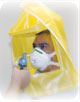
On the other hand, loose-fitting facepieces, such as hoods or helmets, cover the head completely. They do not require fit testing because the air is supplied under positive pressure.

OSHA fit-test standards
OSHA standards mandate that a respirator used for an occupational purpose must be NIOSH 42.CFR 84-approved. OSHA also provides requirements and procedures for fit testing as well as standards for a respirator-protection program.

To ensure a proper fit, a series of respirator-selection and fit-testing protocols are required. Per OSHA, “The test subject shall be allowed to pick the most acceptable respirator from a sufficient number of respirator models and sizes so that the respirator is acceptable to, and correctly fits, the user.”

There are a variety of design elements to consider when offering an employee a respirator. These features include multi-flange face seals, the respirator shape, the different materials used in manufacturing the respirator (filtering facepiece, silicone, elastomeric, etc.), the types of head suspensions and cradles, and multiple adjustment points. These attributes are all factors in assuring a comfortable yet functional fit.

Fit testing is required prior to initial use and at least annually for all employees who are required to wear respirators with a tight-fitting facepiece. OSHA also has some substance-specific standards that require fit testing more frequently. This applies to air-purifying respirators, powered air-purifying respirators and atmosphere-supplying respirators. Users with facial hair must use a loose-fitting respirator.

Passing a fit test does not guarantee that every time a wearer dons a facepiece, an adequate fit will be achieved. It merely confirms that a particular facepiece has the potential to provide a sufficient fit. The wearer must always fit the mask correctly and perform the appropriate fit-check procedures provided in the manufacturer’s user instructions prior to each donning. Dental or face altering procedures, weight changes and changes in facial hair make it necessary for a new fit test be performed.

Quantitative and qualitative fit testing
Per OSHA 29 CFR 1910, there are two methods of fit testing: quantitative and qualitative.

Quantitative fit testing (QNFT) provides a numeric measure of facepiece leakage using two types of systems: ambient aerosol systems and controlled negative pressure (CNP) systems. Ambient aerosol systems calculate a respirator fit factor by measuring ambient air particles inside and outside the facepiece. CNP systems determine the leakage of a face seal under negative pressure.

Qualitative fit testing (QLFT) is based on an individual’s sensitivity to taste, smell, or irritation. The test agents allowed by OSHA include Bitrex®, isoamyl acetate (banana oil), saccharin, and stannic chloride (irritant smoke). The tests involve introducing a test agent to the user while he or she is wearing a tight-fitting facepiece respirator. A non-numeric pass or fail result is given at the conclusion of the test.

Keep your workforce informed
There are many fit-testing tools available on the market today. Multi-lingual fit-test videos are available for training purposes. Donning and fit-check posters should be posted throughout the work area to be used in conjunction with the manufacture’s instructions.

Share This Story

Looking for a reprint of this article?
From high-res PDFs to custom plaques, order your copy today!

Vicken is senior product manager, APR with Sperian Respiratory Protection USA (www.sperianprotection.com). They manage the APR respiratory product lines at Sperian Respiratory Protection.
Stacy is product manager, APR with Sperian Respiratory Protection USA (www.sperianprotection.com). They manage the APR respiratory product lines at Sperian Respiratory Protection.

Recommended Content

JOIN TODAY
to unlock your recommendations.

Already have an account? Sign In

  • forklift safety

    Exploring the latest technologies in forklift safety

    With more staff and more stock in warehousing now more...
    Workplace Training Strategies
    By: Josh Cramer
  • welding

    All about welder’s flash or arc eye

    A flash burn is a painful inflammation of the cornea,...
    Environmental Health and Safety
  • dangerous jobs

    The 10 most dangerous jobs in the U.S.

    On-the-job deaths have been rising — hitting the highest...
    Occupational Safety
    By: Benita Mehta
Manage My Account
  • eMagazine Subscriptions
  • ISHN Newsletter & Other Newsletter Alerts
  • Online Registration
  • Manage My Preferences
  • Subscription Customer Service

More Videos

Sponsored Content

Sponsored Content is a special paid section where industry companies provide high quality, objective, non-commercial content around topics of interest to the ISHN audience. All Sponsored Content is supplied by the advertising company and any opinions expressed in this article are those of the author and not necessarily reflect the views of ISHN or its parent company, BNP Media. Interested in participating in our Sponsored Content section? Contact your local rep!

close
  • man wearing the the Sundström SR200 Full Face Mask Respirator
    Sponsored byOHD

    5 Fit Testing Mistakes That Could Cost You

  • This image shows Magid AcuSpex polarized blue mirrored safety glasses.
    Sponsored byMagid Glove and Safety

    Construction PPE Guide: What Crews Need for Each Task

  • lone worker in confined space
    Sponsored byAlphasense Ltd.

    GET THE LEAD OUT of your Safety Oxygen Sensors!

Popular Stories

SpaceX 7 launch

OSHA Investigating Fatal Fall at SpaceX Starbase

Worker Impairment

How to Tell When a Co-Worker is Impaired? A Safety Pro’s Challenge

Automated loading dock equipment

After March 2026 Rivian Death, Safety Managers Reassess Loading Dock Systems Under OSHA's Warehouse Emphasis Program

top 10 most dangerous jobs

Poll

Seasonal Readiness

With the federal heat stress prevention rule on the horizon, which area of your safety program needs the most attention?
View Results Poll Archive

Products

Surviving an OSHA Audit A Management Guide, 2nd Edition

Surviving an OSHA Audit A Management Guide, 2nd Edition

See More Products

ISHN Podcasts

Related Articles

  • OSHA proposes revised respirator fit test procedures (1/22)

    See More
  • TSI introduces FitPro+ Fit Test Software

    See More
  • Examinetics becomes 3M Preferred Fit Test Service Provider in the United States

    See More

Related Directories

  • Mystic Air Quality Consultants Inc.

    Certified safety and health consulting, gas free testing, respirator fit testing, indoor air quality and mold surveys and asbestos training classes.
×

Become a Leader in Safety Culture

Build your knowledge with ISHN, covering key safety, health and industrial hygiene news, products, and trends.

JOIN TODAY
  • RESOURCES
    • Advertise
    • Contact Us
    • Directories
    • Manufacturing Division
    • Store
    • Want More
  • SIGN UP TODAY
    • Create Account
    • eMagazine
    • Newsletters
    • Customer Service
    • Manage Preferences
  • SERVICES
    • Marketing Services
    • Reprints
    • Market Research
    • List Rental
    • Survey/Respondent Access
  • STAY CONNECTED
    • LinkedIn
    • Facebook
    • YouTube
    • X (Twitter)
  • PRIVACY
    • PRIVACY POLICY
    • TERMS & CONDITIONS
    • DO NOT SELL MY PERSONAL INFORMATION
    • PRIVACY REQUEST
    • ACCESSIBILITY

Copyright ©2026. All Rights Reserved BNP Media, Inc. and BNP Media II, LLC.

Design, CMS, Hosting & Web Development :: ePublishing