TRAINING STRATEGIES: Confined space learning objectives

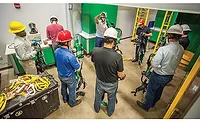
OSHA defines a confined space as a location large enough and configured in a way that an employee can bodily enter and perform assigned work, has limited or restricted means for entry or exit, and is not designed for continuous employee occupancy. Confined space training should fit your needs. Your instructor should come up with specific learning objectives (six are provided here) for your course and create a customized lesson plan that focuses on your needs.
1 Vertical or horizontal confined space entry
The risk of workers approaching and falling into an unprotected hole is eliminated when entries are horizontal, so fall protection becomes a secondary topic. For vertical entries, fall protection topics take on a primary focus.
One of the biggest mistakes people make when working around a confined space is not protecting workers when they are performing air monitoring. When a hatch or cover is removed, an unprotected opening presents a fall hazard made all the more dangerous by the fact that the opening could be releasing methane gas. If a confined space contains methane, the gas would be released as the cover is removed. This may cause the worker monitoring the space to feel dizzy or lose consciousness. In this situation, the worker could potentially fall into the hole.
2 Permit-required or non–permit-required confined space
Determine whether your jobsite has a permitrequired confined space; only permit-required confined spaces are regulated by OSHA 1910.146. To be defined as a permit-required confined space, a space must have one or more of the following characteristics: contains or has a potential to contain a hazardous atmosphere; contains a material that has the potential for engulfing an entrant; has an internal configuration such that an entrant could be trapped or asphyxiated by inwardly converging walls or by a floor that slopes downward and tapers to a smaller cross-section; or contains any other recognized serious safety or health hazard.
3 Attendant responsibilities
Every confined space entry must have an entry attendant who is trained in his role and responsibilities.
Key responsibilities of an entry attendant are communication, notification of an emergency and non-entry rescue. Entry attendants cannot perform entry rescue, even if they are on the entry rescue team. If they are members of the entry rescue team, they can enter the confined space only after they have been relieved of their attendant duties.
4 Entrant responsibilities
When entering a confined space, the entrant must have a clear understanding of what he is responsible for. His key responsibilities include knowing the hazards that may be faced, maintaining a line of communication with the entry attendant and alerting him or her whenever any sign or symptom of a dangerous situation or prohibited condition arises. Then he must exit the space quickly and safely. Entrants shall be provided with the opportunity to observe any monitoring or testing of permit spaces.
5 Rescue plan
When the jobsite requires confined space entry, a nonentry rescue plan must be in place. An on-site entry rescue team may also be needed. But having an entry rescue team does not mean that a non-entry rescue plan is unnecessary. A non-entry rescue plan can be eliminated only if using it would cause a greater hazard. To prove that, a feasibility study would have to be conducted to show that performing non-entry rescue puts employees in greater danger. When the non-entry rescue plan is eliminated, an entry rescue team becomes mandatory.
Non-entry rescues happen on a daily basis. You must expect to perform a confined space rescue. It often has little to do with the hazards in the hole or the atmosphere; most confined space rescues involve medical emergencies. According to OSHA 1910.146, a mechanical device shall be available to retrieve personnel from vertical type permit spaces more than five feet deep.
If a mechanically-aided system is used to get workers into the confined space, the workers also need to be outfitted with fall protection equipment. They need a primary system to hold their weight and a secondary system to be used as the fall protection system.
6 Air monitoring guidelines
Whenever an employee is entering a permitrequired confined space, air monitoring is essential. People need to understand the reasoning behind OSHA standards to know what their monitors are detecting. If the monitor goes off, it does not necessarily mean that the monitored space is explosive. For example, if the lower explosive limit (LEL) is set for methane, the sensor will go off at 10 percent of the LEL. The employee needs to get out of the confined space and re-establish proper ventilation.
Along with atmospheric testing and ventilation systems, training should include information on the upper explosive limits (UEL). This is important when an enriched environment with explosive gases is ventilated, creating a hazard that puts the area in danger. If the concentration is above the UEL, the gases are too rich and cannot accommodate combustion or explosion, but once it is ventilated, the concentration may reach a UEL level that is explosive.
Along with appropriate LEL and UEL levels for each hazard, your training courses should include what the permissible exposure limit (PEL) is for each of these agents or hazards. The PEL is based on parts per million of how much particulate can be in the air for an eight-hour day and a 40-hour workweek.
Typically, workers use a four-sensor unit to monitor for oxygen deficiencies and enrichment, carbon dioxide, hydrogen sulfide and the LEL. If there are any other hazards or gases present in the confined space, make sure workers are monitoring for those as well and have the proper monitoring equipment to do it.
Looking for a reprint of this article?
From high-res PDFs to custom plaques, order your copy today!