ISHN logo
search
cart
facebook twitter linkedin youtube
  • Sign In
  • Create Account
  • Sign Out
  • My Account
ISHN logo
  • NEWS
    • Today's News
    • Global Safety News
    • Government Regulations
  • PRODUCTS
    • Product Innovations
    • Featured Products
  • TOPICS
    • Environmental Health and Safety
    • Facility Safety
    • Workplace Health
    • Occupational Safety
    • PPE
    • More Topics
  • CONSTRUCTION
  • TECHNOLOGY
  • COLUMNS
    • Best Practices
    • Dave Johnson: What’s going on
    • Editorial Comments
    • Leading Safety
  • MULTIMEDIA
    • ISHN Podcast
    • Videos
    • Cold Stress Education Quiz
    • Webinars
    • White Papers
  • MORE
    • Buyer's Guide
    • Newsletters
    • Convention Companion
    • Polls
    • Events
    • ISHN Store
    • Sponsor Insights
  • EMAGAZINE
    • eMagazine
    • Archived Issues
    • Contact
    • Advertise
  • JOIN TODAY!
Today's Safety NewsTransportation Safety

Ford develops digital "child" for crash testing
November 18, 2011

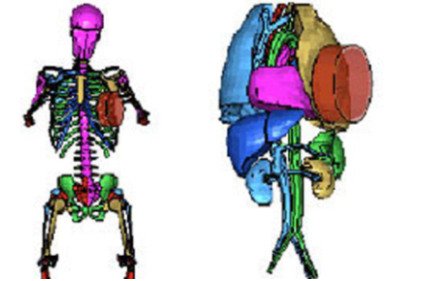
diagram of digital "child"The Ford Motor Co. is developing digital human children with lifelike skeletal structures, internal organs and brains for use in virtual crash testing.

The company says that traffic crashes are the leading cause of death for people from age 4 to 34. “A child’s body is very different from an adult’s,” said Dr. Stephen Rouhana, senior technical leader for safety, Ford Research and Advanced Engineering. “We want to better understand how injuries to younger occupants may be different.”

Digital models are used in research, not in vehicle development. They don’t take the place of crash dummies, which measure the effect of forces on the body. Instead, they are used to improve restraint system effectiveness through better understanding of injury mechanisms.

The digital model is constructed component by component – brain, skull, neck, ribcage, upper and lower extremities, etc. – with data gathered from MRI CT scans.

“Building the model of a person is just like building a model of a car,” said Rouhana. “You start with your surface geometry for each component and any subcomponent it contains – in this case the geometry of the human body and its internal organs.”

The components are then joined into a virtual human body. Using mathematical and analytical tools combined with available data on the properties of human tissues from the medical and engineering literature, researchers are able to determine the effects of a crash – and the pressure of a restraint system – on the body.

The world’s first crash test dummy was conceived in 1949 for the U.S. Airforce. Codenamed Sierra Sam, it was designed to test jet fighter ejector seats.

Ford has been using conventional crash test dummies for the past seven decades. The current Hybrid III model has a spine made out of metal discs, a movable neck, a steel ribcage, vinyl skin, and knees that are designed to respond to impact like the human counterpart.

Ford also uses specially developed dummies for side-impact crashes. The WorldSID and EuroSID 2 models contain more than 220 different sensors to record crash injuries and impact forces. 

KEYWORDS: crashes engineering

Share This Story

Looking for a reprint of this article?
From high-res PDFs to custom plaques, order your copy today!

Recommended Content

JOIN TODAY
to unlock your recommendations.

Already have an account? Sign In

  • forklift safety

    Exploring the latest technologies in forklift safety

    With more staff and more stock in warehousing now more...
    Workplace Training Strategies
    By: Josh Cramer
  • welding

    All about welder’s flash or arc eye

    A flash burn is a painful inflammation of the cornea,...
    Environmental Health and Safety
  • dangerous jobs

    The 10 most dangerous jobs in the U.S.

    On-the-job deaths have been rising — hitting the highest...
    Government Safety Regulations
    By: Benita Mehta
Manage My Account
  • eMagazine Subscriptions
  • ISHN Newsletter & Other Newsletter Alerts
  • Online Registration
  • Manage My Preferences
  • Subscription Customer Service

More Videos

Sponsored Content

Sponsored Content is a special paid section where industry companies provide high quality, objective, non-commercial content around topics of interest to the ISHN audience. All Sponsored Content is supplied by the advertising company and any opinions expressed in this article are those of the author and not necessarily reflect the views of ISHN or its parent company, BNP Media. Interested in participating in our Sponsored Content section? Contact your local rep!

close
  • man wearing the the Sundström SR200 Full Face Mask Respirator
    Sponsored byOHD

    5 Fit Testing Mistakes That Could Cost You

  • This image shows Magid AcuSpex polarized blue mirrored safety glasses.
    Sponsored byMagid Glove and Safety

    Construction PPE Guide: What Crews Need for Each Task

  • lone worker in confined space
    Sponsored byAlphasense Ltd.

    GET THE LEAD OUT of your Safety Oxygen Sensors!

Popular Stories

SpaceX 7 launch

OSHA Investigating Fatal Fall at SpaceX Starbase

Worker Impairment

How to Tell When a Co-Worker is Impaired? A Safety Pro’s Challenge

Automated loading dock equipment

After March 2026 Rivian Death, Safety Managers Reassess Loading Dock Systems Under OSHA's Warehouse Emphasis Program

top 10 most dangerous jobs

Poll

Seasonal Readiness

With the federal heat stress prevention rule on the horizon, which area of your safety program needs the most attention?
View Results Poll Archive

Products

Surviving an OSHA Audit A Management Guide, 2nd Edition

Surviving an OSHA Audit A Management Guide, 2nd Edition

See More Products

ISHN Podcasts

Related Articles

  • Tesla

    NTSB opens public docket for 2 Tesla crash investigations

    See More
  • NHTSA unveils new "10-year-old child" crash test dummy

    See More
  • Honeywell Users Group 2023 .jpg

    Honeywell introduces cloud-based digital twin for efficient and secure up-to-date testing

    See More

Events

View AllSubmit An Event
  • December 10, 2014

    Proof Of Performance Testing For Industrial Ventilation Systems webinar

    This webinar will teach methods for testing IVSs as they pertain to the original design parameters. Topics include: indentifying published standards, selecting measuring equipment, identifying test locations, identifying proper techniques for airflow measurement, correcting field measurements for local conditions, interpreting field data compared to design data, and introduction to system balance techniques.
View AllSubmit An Event
×

Become a Leader in Safety Culture

Build your knowledge with ISHN, covering key safety, health and industrial hygiene news, products, and trends.

JOIN TODAY
  • RESOURCES
    • Advertise
    • Contact Us
    • Directories
    • Manufacturing Division
    • Store
    • Want More
  • SIGN UP TODAY
    • Create Account
    • eMagazine
    • Newsletters
    • Customer Service
    • Manage Preferences
  • SERVICES
    • Marketing Services
    • Reprints
    • Market Research
    • List Rental
    • Survey/Respondent Access
  • STAY CONNECTED
    • LinkedIn
    • Facebook
    • YouTube
    • X (Twitter)
  • PRIVACY
    • PRIVACY POLICY
    • TERMS & CONDITIONS
    • DO NOT SELL MY PERSONAL INFORMATION
    • PRIVACY REQUEST
    • ACCESSIBILITY

Copyright ©2026. All Rights Reserved BNP Media, Inc. and BNP Media II, LLC.

Design, CMS, Hosting & Web Development :: ePublishing