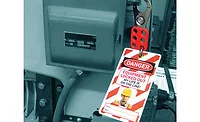
Lockout/Tagout
7 steps to protect your people
Do you need a lockout/tagout program at your company? Last year, a lumber mill had $1.6 million worth of reasons to say “yes.”
After an employee suffered a partial finger amputation while clearing a machine that hadn’t been locked out, and another suffered a severe hand injury while working on an unguarded machine, OSHA issued 24 willful violations at a maximum of $70,000 each to the company, including failure to properly shut down and lock out 23 pieces of machinery before employees were required to clean them.The company had repeatedly ignored OSHA citations for serious safety violations. Employees, according to OSHA, were exposed to amputation hazards while maintaining, cleaning and clearing jams on machinery that didn’t have their energy sources locked out.
While this may be an extreme example of what can happen if you don’t have a comprehensive lockout/tagout program at your company, it does illustrate the potential dangers to your employees as well as the possible economic impact.
Steps to safety
Ensuring employee safety is more than just shutting off, unplugging or disconnecting equipment. Procedures, devices and personnel must be set in place to prevent a serious injury when a worker thinks a machine is safely off.
Following is a seven-step guideline to an effective lockout/tagout program. Additional helpful information is available on the OSHA website or through your local safety equipment or industrial solutions provider.
1. Be aware of lockout regulations: Become familiar with the federal regulations known as The Control of Hazardous Energy (Lockout/Tagout).
Here are some of the most significant OSHA requirements for a lockout/tagout program:
Only authorized workers may lock out or tag out machines or equipment in order to perform servicing or maintenance.
Lockout devices (locks) and tagout devices cannot be used for any other purposes and must be used only for controlling energy.
Lockout and tagout devices (locks and tags) must identify the name of the worker applying the device.
All energy sources to equipment must be identified and isolated.
After the energy is isolated from the machine or equipment, the isolating device(s) must be locked out or tagged out in safe or off position only by the authorized employees.
Following the application of the lockout or tagout devices to the energy isolating devices, the stored or residual energy must be safely discharged or relieved.
Prior to starting work on the equipment, the authorized employee must verify that the equipment is isolated from the energy source, for example, by operating the on/off switch on the machine or equipment.
Locks and tags must remain on the machine until the work is completed.
Only the authorized employee who placed the locks and tags may remove his/her lock or tag, unless the employer has a specific procedure as outlined in OSHA's Lockout/Tagout standard.
2. Develop list of machinery & equipment: Survey your facility for all machinery and equipment that could potentially require lockout.
Listed machinery should include: Any automated machines, boilers, chillers, compressors, conveyors, generators, product equipment and pumps. Even in a medium-sized building, this list could include several hundred pieces of equipment. Create a separate lockout/tagout procedure for each machine, detailing the specific steps for shutting down and securing it with special emphasis on safe release of any hazardous energy.
3. Identify & mark energy sources & lockout points:
Locate and document startup areas of energy sources, such as: electrical, hydraulic, mechanical, pressure, process control, stored energy (gravity, springs) and thermal. Post signs, apply labels and tags to warn and identify energy source areas and points requiring shut down and lockout/tagout procedures. Use graphics, including photographs and diagrams to clearly illustrate where the energy sources and lockout points are on each machine.
4. Determine the lockout controls:
Identify and document the necessary devices that isolate and lock out energy sources and secure them for on-site use. Standardize the devices for various functions for proper identification.
For example, develop different color locks for each shift at your plant and for supervisors. Be sure that everyone working on a machine understands that all locks for each shift must be removed only by the person responsible for each lock before the machine is safe to operate.
5. Set up lockout training & procedure program:
Develop, standardize and document the lockout process — for each energy source. Identify employees’ level of involvement in the program. OSHA breaks them into three groups — those who are made aware of, those who are affected by and those who perform the lockout procedures. Accomplish this through comprehensive training programs and certifications.
Employee training, according to OSHA, must cover at least three areas:
Aspects of the employer’s energy control program
Elements of the energy control procedure relevant to the employee’s duties or assignment
The various requirements of OSHA standards related to lockout/tagout.
6. Implement the lockout program:
Initiate and enact the lockout/tagout program that follows the training procedures. Post reminders and have the necessary lockout/tagout devices readily available.
When completed, your lockout/tagout program must have a written procedure for the safe shutdown and startup of each machine in your company. You should have written and photographic documentation of what device is being used at each lockout point and the names of the people authorized to remove each lockout device.
Finally, identify and document changes to existing lockout procedures and new energy sources that require lockout. Make corrections, changes and additions to the program. Conduct periodic review of lockout procedures (required at least annually) to ensure they are up to date and requirements are being met.
At this point, your company should have marked all energy control points with permanent labels or tags. Each piece of equipment should have a posted step-by-step energy control procedure that will prevent unexpected startup and injury to employees.
Creating an effective lockout/tagout program is a complicated procedure, but the benefits are numerous. Good lockout/tagout programs save lives and prevent injuries, which in turn, saves money lost to employee recuperation time and workers’ compensation costs. Productivity also is improved due to minimal equipment downtime.
Looking for a reprint of this article?
From high-res PDFs to custom plaques, order your copy today!