Identify your top hand & arm hazards
By properly identifying and assessing workplace hazards, injury to hands can be minimized or avoided
|
| Click to enlarge |
Types of hazards in the workplace
As part of its monthly safety awareness program, one of our customers developed a top 10 list of hand hazards. They had identified that these 10 were responsible for a majority of hand injuries in their workplace and developed a great employee safety awareness program around them.
1. Caught between pinch points
2. Sharp object hazards
3. Slip, trip and fall hazards
4. Repetitive stress (ergonomic) hazards
5. Line-of-fire hazards
6. Defective equipment hazards
7. Rotating/moving equipment hazards
8. Thermal hazards
9. Chemical, electrical and pressure hazards
10. Inattention hazards
On any given day, employees exposed to these hazards may have an injury ranging from a minor cut to amputation.
According to the Bureau of Labor Statistics, about 250,000 serious injuries to fingers, hands and wrists occur every year in private industry alone, with around 8,000 of those being amputations.
Hand injuries account for a third of all injuries at work, another third of chronic injuries, 25 percent of lost working time, and 20 percent of permanent disability. This varies from activity to activity and with the material element involved but, on average, 22 working days are lost.
Injury occurrence by hazard type
Some of the biggest industrial workplace hazards are:
Mechanical hazards from tools, equipment, machines, structures and vehicles often can be the most obvious: chains, gears, rollers, wheels and transmission belts; spiked or jagged tools; edges that catch and tear; cutting, chopping and grinding mechanisms; cutting tools such as knives and presses; falling objects, etc. Injuries can include cuts, lacerations, abrasions, punctures, crushing, fractures and amputations.
Burns to the hands can be caused by exhaust pipes, sparks, steam, hot pipes, hot liquids and welding and molten metals. Even extreme cold can cause burns. Your hands and fingers turn numb at minus 59˚F, which can increase the risk of accidents. Temperature-related injuries can be very serious.
Chemical substances may irritate the skin, causing redness, itching, eczema, inflammation, dryness and serious burns. Some chemical products are doubly dangerous: in addition to being irritants, they are toxic when absorbed by the body through the skin. Degreasers, metals, plant and animal oils, dyes, inks, cleaning solutions and many other chemical products can damage the skin and subcutaneous tissues of your hands.
Protecting working hands
With its 27 bones (including eight wrist bones), complex network of nerves, muscles and tendons, and an outer skin layer that is only three blood cells thick, hands can pinch, grasp, twist, lift, hold and manipulate while doing a variety of other specific tasks. It’s hard to do most jobs without the full use of hands, which is why it is so important to protect them.
A strong workplace safety program starts with an assessment of the hazards and risks involved. This is not just an OSHA requirement; it’s good business practice.
The assessment will identify dangers that cause hand injuries and will help to determine what steps can be taken to eliminate, control or protect against them.
The first two lines of defense for minimizing workplace hazards are engineering the process to eliminate them or to control them. If process changes are not feasible or can’t fully eliminate the potential hazards, then we must protect the worker.
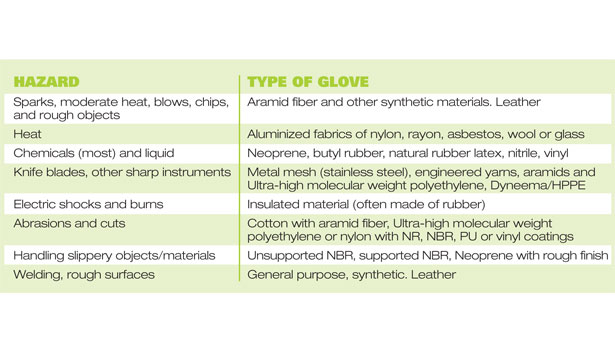
The most common personal protection equipment (PPE) for hands is a glove. There are many different types of gloves of various materials, sizes and lengths for a wide variety of uses and levels of protection. Because there is no single glove that provides protection from all types of hand injuries, selection is based on performance characteristics of the gloves in relation to the hazard present in the environment and task being performed.
The chart above provides some general guidelines on the thousands of gloves in the marketplace.
Glove manufacturers are here to help guide employers and safety officers to the most common and appropriate gloves for protection in various situations. They work with gloves every day and have staff members who can provide guidance, not only on the proper gloves to reduce hand injuries but also into cost savings.
With new advances in technology that provide protection for virtually every hazard and task, it’s nice to know you don’t have to figure this out on your own. The manufacturers’ safety data sheets also have specific information on individual gloves, and you can look online for search tools that consolidate glove information into one convenient and easy-to-use source.
Importance of training in compliance
As with all PPE, the employer must train each user to know at least when and what type of glove is necessary. It’s been said that the most important criteria in glove selection is compliance. Establishing a work environment where gloves stay on whenever the task calls for hand protection is critical. Wearing any glove can reduce the risk of hand injury by 27 percent.
Our customer with the top 10 list made safety awareness fun and enjoyable and has made great strides in their goal of ZERO injuries. This is another area where the glove manufacturer can help. Most glove manufacturers have staff members who can help with training and often provide visual tools to help keep glove-wearing top of mind.
Looking for a reprint of this article?
From high-res PDFs to custom plaques, order your copy today!