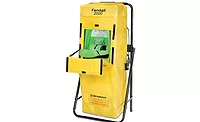
Fast flushing fluids: Outfit any location with emergency eyewash delivery systems
Despite existing safety standards, it is estimated that approximately half of all U.S. workplaces are in noncompliance with eyewash requirements. Hurdles to compliance include lack of plumbing, lack of standards awareness, space constraints, cost and more.
The good news is, there are more eyewash delivery options to choose from than ever before, and recent innovations make it easy to comply with eyewash standards and to protect your workforce. This article looks at a variety of applications where eyewash is required and the different types of delivery systems best suited for them.
Chemical storage and mixing rooms
Individuals working in a facility’s chemical storage room are likely to spend an entire shift working among pallets or shelves filled with containers of various chemicals, moving and otherwise handling hazardous materials. Likewise, those working in nearby chemical mixing rooms are typically responsible for opening chemical containers and removing, measuring and mixing hazardous materials. Anyone entering a chemical storage or chemical mixing room is at risk of accidental exposure. For this reason, everyone in such a space typically wears an array of personal protective equipment ranging from protective clothing, boots and gloves, to primary eye protection in the form of safety spectacles, goggles or sealed eyewear.
Wherever hazardous chemicals are present, employers should follow the guidelines set forth in American National Standards Institute standard Z358.1-2009 for “Emergency Eyewash and Shower Equipment.” The standard calls for primary eyewash stations to be located within an unobstructed, 10-second walk of caustics, acids, solvents and other hazardous materials. In the case of strong caustics and strong acids, the station should be located immediately adjacent to the hazard. An injured individual should flush both eyes for a full 15 minutes and seek follow-up care if needed.
While both plumbed and portable stations are viable options for chemical storage or mixing rooms, portable stations are easy to move and locate close to hazards. They are capable of delivering sterile flushing fluid, require less maintenance and are better suited to deliver fluid at a tepid temperature than plumbed stations.
Janitorial closets
The janitorial closet is another location filled with hazardous chemicals. From household to industrial-grade cleaning agents, these closets typically contain a variety of corrosive chemicals, concentrated chemical solutions that are diluted or mixed prior to use, and flammable or combustible liquids. These hazards pose risks to the eyes through chemical splash, spills and harmful vapors. Surprisingly, noncompliance in such closets remains high.
Be sure to review manufacturers’ safety data sheets (SDS or MSDS) for each chemical present to determine the appropriate level of first aid. While a primary eyewash unit located inside the closet is typically recommended, space constraints sometimes prove prohibitive. When there isn’t enough room for a primary station to be installed inside the closet, secondary stations may be used as long as a primary unit is placed immediately outside the door.
Secondary, or supplemental, eyewash stations are smaller than primary stations and deliver less fluid. According to ANSI, supplemental eyewash “supports primary plumbed units, self-contained units or both by delivering immediate flushing fluid.” New models of secondary eyewash stations entering the market offer extreme ease of use with features such as single-action activation and hands-free operation; low-profile, lightweight design; universal mounting brackets; disposable or recyclable materials; and fully integrated waste containment. By selecting stations with such benefits, employers can practically eliminate the barriers to installation, use and maintenance of eyewash stations — even in confined spaces such as janitorial closets.
Fleets and field locations
Fleets and field locations are other environments where mounting primary stations may prove challenging for a variety of reasons. In vehicles, it is often difficult to install eyewash due to size and weight constraints, and accidental activation during transit is common. Plus, the potential for splashing fluids onto expensive tools and electrical equipment acts as a deterrent. In the field, installing a primary eyewash unit at the site of every hazard in every location can prove cost prohibitive, and a lack of access to plumbing may also prove problematic.
When facing hurdles such as these, secondary eyewash stations or personal eyewash bottles are effective solutions. For fleets, look for new models of secondary stations that mount easily in vehicles, are specially designed to prohibit accidental activation and are self-contained to eliminate splashing. In the field, secondary stations are a cost-effective and highly portable solution, oftentimes offering comparable convenience of a primary eyewash station with the added benefits of compact design and — in the case of new disposable units — zero maintenance.
If the hazards in the fleet or field location are limited to nuisance particles such as pollen, dust, sawdust and smoke, ANSI deems the use of personal eyewash bottles as sufficient. Available in a variety of sizes, these highly portable bottles can even be carried on an individual to be readily available at the site of any hazard. Personal bottles are also vital for delivering first aid while assisting individuals to a primary eyewash unit and when transporting them to a medical facility for follow-up care.
Compliance is easier than ever
Employers who provide the appropriate eyewash delivery systems wherever they are needed can greatly reduce the severity and related costs of eye injuries. Recent innovations make it easier than ever to outfit any location with the proper eyewash to meet safety requirements. By keeping informed of safety standards and new solutions alike, employers can achieve eyewash compliance while also maximizing workforce safety and productivity.
Looking for a reprint of this article?
From high-res PDFs to custom plaques, order your copy today!