Could your workers be suffering from obstructive sleep apnea?
What is obstructive sleep apnea?
OSA is a sleep disorder characterized by pauses in breathing (apneas) or instances of shallow breathing (hypopneas). Each pause in breathing can last from at least ten seconds to several minutes, and may occur five to 30 times or more an hour. Snoring is a common symptom of OSA but certainly everyone who snores does not necessarily have OSA and some individuals with OSA do not snore.
OSA can be thought of as a medical problem due to abnormal anatomy.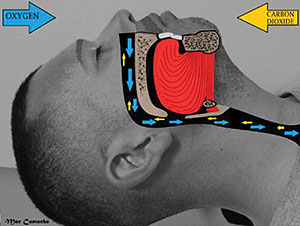
The photo at left shows an individual with normal anatomy (no airway obstruction). Oxygen and carbon dioxide can easily flow into and out of the airways to the lungs.
When individuals with OSA lie down to sleep, the soft, movable tissues (palate, tongue [shown in red] and epiglottis) fall backward and create an obstruction to the free-flow of oxygen and carbon dioxide. The brain senses the fall in oxygen and the rise of carbon dioxide. The brain protects itself by waking up the individual so he or she can change positions and resume the normal flow of air. These abrupt awakenings can occur many times per hour; they disrupt the architecture of sleep so the individual does not experience a restful, restorative night’s sleep. As a result, OSA sufferers often complain of fatigue and excessive sleepiness during their waking period.
Untreated or inadequately treated OSA does much more than just make people feel tired. Rather, OSA has been associated with such serious health conditions as heart disease, stroke, high blood pressure and diabetes.
Screening for obstructive sleep apnea
Following are risk factors for OSA:
- Male gender;
- Obesity (body mass index 33 and above);
- Age over 40;
- Large neck size (17 inches or greater in men and 16 inches or greater in women);
- Having large tonsils, a large tongue, or a small jaw bone;
- Positive family history of sleep apnea;
- Gastroesophageal reflux (heartburn);
- Nasal obstruction due to a deviated septum, allergies or sinus problems;
- Excessive daytime sleepiness (often measured by a standardized test such as the Epworth Sleepiness Scale).
Individuals with multiple risk factors should undergo a sleep study (polysomnogram) to screen for the presence of OSA. The polysomnogram records several bodily functions during sleep and may be performed in home or at a sleep center.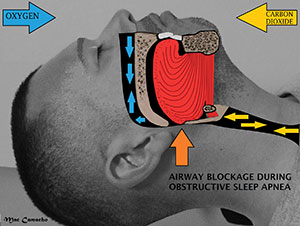
Treatment of obstructive sleep apnea
The most popular treatment for OSA is continuous positive airway pressure, also known as CPAP. A CPAP machine increases air pressure in one’s throat so that the soft tissues of the airways do not collapse when one breathes in. Many OSA sufferers describe their CPAP machines as a miracle treatment, and they would not think about going to sleep without wearing the devices.
For those intolerant of CPAP, weight loss is frequently an option. Excessive weight in the upper body places undue strain on the soft tissues of the head and neck. However, employing weight loss as the treatment of choice is a slow, difficult process, and there is no guarantee of success.
What is an employer to do?
A sleepy employee working with or around dangerous machinery is an accident waiting to happen. If the employee requires a DOT card to perform his or her job, the employer should rely on the DOT examiner to screen the driver for OSA. For a driver with an established history of OSA, the DOT examiner will verify that the treatment is adequate.
Some employment situations may involve individuals who work with hazardous materials and require respirator clearance. These individuals may fall under one or more of the various OSHA standards, for example, the OSHA Respiratory Standard (29 CFR 1910.134), the OSHA HAZWOPER Standard (29 CFR 1910.120), and the OSHA Asbestos Standard (29 CFR 1910.1001). For details, go to www.osha.gov. OSHA Standards generally require baseline examinations and some sort of follow-up medical surveillance. It behooves the employer to develop a good working relationship with the medical examiner(s) who will be performing these OSHA-mandated exams. With active dialogue, the employer may alert the medical examiner(s) to specific as well as general concerns regarding OSA.
In the absence of Federal Motor Carrier Safety Administration Regulations and in the absence of federal and state regulations regarding working with specific hazardous materials, the employer is still subject to the OSHA General Duty Clause (29 USC 654). Under the General Duty Clause, the employer must provide a safe working environment for all employees. As the General Duty Clause relates to OSA, the employer should be on the lookout for employees who may be impaired by fatigue while on the job. If an employee’s excessive sleepiness appears to present a safety hazard, it is reasonable for the employer to order drug and alcohol testing. If the drug and alcohol testing is negative, the employer should require that the employee undergo a medical evaluation, including screening for the presence of OSA.
It is interesting to note an emerging trend: some employers are taking a proactive approach and are now screening employees for OSA. These programs come in different forms. For example, some programs screen all employees while others screen only high-risk employees. Some programs are optional while others are mandatory. The commonality is that the employer pays for the screening and usually the treatment.
At first glance, this may seem like a costly endeavor. However, several employers have estimated that the costs will be more than outweighed by the benefits. In 2011, a large Florida corporation screened 608 high-risk employees for OSA. Out of this group, 319 were diagnosed and treated for OSA. The cost of the screening and treatment was estimated to be $7.2 million over a ten-year period. In terms of lost productivity alone, it was estimated that the corporation would net a savings of $136 million over that same ten-year period.
Screening makes sense
Undiagnosed and inadequately treated OSA poses a health risk to the employee as well as a safety risk when that employee reports to work. Screening for OSA is not only good for the employee, but it is also good for business.
References
1. http://www.webmd.com/sleep-disorders/sleep-studies
2. http://www.personalhealthinsurance.com/does-health-insurance-cover-sleep-studies
3. http://www.howmuchisit.org/sleep-study-cost
4. http://www.webmd.com/sleep-disorders/sleep-apnea/continuous-positive-airway-pressure-cpap-for-obstructive-sleep-apnea
5. Employer-mandated sleep apnea screening and diagnosis in commercial drivers. J Occup Environ Med. 2012 August ; 54(8): 1017–1025
6. Cost of decreased cognitive function in a large corporation in Florida: benefits of obstructive sleep apnea screening and treatment for high-risk professionals. http://www.aasmnet.org/articles.aspx?id=2309
7. http://en.wikipedia.org/wiki/Sleep_surgery
Looking for a reprint of this article?
From high-res PDFs to custom plaques, order your copy today!


