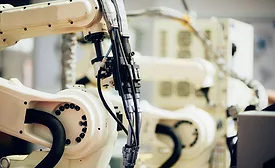
More and more Chinese factories are using robots to make up for the shortage of labor in the country.
"There are more companies recruiting than people applying for jobs," said Liu Jihong, vice general manager of a Zhejiang-based company that produces seats for engineering machinery as well as for commercial and passenger vehicles.
Manufacturers will significantly accelerate their use of robots in U.S. factories over the next decade as they become cheaper and perform more tasks, constraining payroll growth, according to a study out Tuesday.
Arc welding utilizes an electric arc between an electrode and a metal base using either consumable or non-consumable electrodes. An arc welding robot uses a process which applies intense heat to metal at a joint, causing the metal to melt and intermix.
Ten trends, including a "hallowing out" of the middle class
July 1, 2016
The Fourth Industrial Revolution is knocking on our door. It is going to radically change employment and the nature of work in the coming years. Our economies must prepare for a storm of unprecedented technical and socio-economic changes that will affect labour markets and will radically transform our relationship with work.
Robots are everywhere these days – from tackling robots on football practice fields to assembly lines to warehouse retrieval systems to surgical operations. At this year’s American Industrial Hygiene Conference & Expo, which kicked off officially Monday in sunny Baltimore, ISHN talked to one expo vendor, RoboVent, about the invasion of robots into the welding field.
Early in the science fiction thriller Ex Machina, Nathan Bateman, the brilliant and unnerving CEO of a successful software company, says to his star programmer, “Over the next few days, you're going to be the human component in a Turing test.” Despite the ominous sound of Bateman’s statement, intensified by his underground laboratory’s location on a remote mountain, the Turing test is relatively simple.
Robots are used in increasing numbers in the workplace and in society in general. As their numbers and capabilities increase, observers have urged that scientists, engineers, and policymakers explore the implications of robotics for society, to ensure that the rise of robots will not spell “doom for humanity” as some critics have warned [1].
The digital workplace has introduced both exciting new possibilities and an unwelcome new dimension to the problem of work-related stress, according to Andrea Maria Nahles, Germany’s Federal Minister of Labour and Social Affairs. The key to dealing with both, she says, is flexibility.