ISHN logo
search
cart
facebook twitter linkedin youtube
  • Sign In
  • Create Account
  • Sign Out
  • My Account
ISHN logo
  • NEWS
    • Today's News
    • Global Safety News
    • Government Regulations
  • PRODUCTS
    • Product Innovations
    • Featured Products
  • TOPICS
    • Environmental Health and Safety
    • Facility Safety
    • Workplace Health
    • Occupational Safety
    • PPE
    • More Topics
  • CONSTRUCTION
  • TECHNOLOGY
  • COLUMNS
    • Best Practices
    • Dave Johnson: What’s going on
    • Editorial Comments
    • Leading Safety
  • MULTIMEDIA
    • ISHN Podcast
    • Videos
    • Cold Stress Education Quiz
    • Webinars
    • White Papers
  • MORE
    • Buyer's Guide
    • Newsletters
    • Convention Companion
    • Polls
    • Events
    • ISHN Store
    • Sponsor Insights
  • EMAGAZINE
    • eMagazine
    • Archived Issues
    • Contact
    • Advertise
  • JOIN TODAY!
PPE

Hearing protection: Don’t rely solely on Noise Reduction Ratings for protection

By Theresa Y. Schulz, Lt. Col. U.S. Air Force (retired) Ph.D.
April 1, 2015

Noise control is difficult in refining and chemical plant environments. To mitigate hazardous noise, personal protective equipment (PPE), i.e. hearing protection, is often required.

A common misconception is that OSHA Noise regulations do not apply to the oil and gas industry. The exemption in CFR 1910.95, “Occupational noise exposure,” states, “Paragraphs (c) through (n) of this section shall not apply to employers engaged in oil and gas well drilling and servicing operations.” Of course, other parts of the oil and gas industry (i.e. hydrocarbon processing) do fall under “General Industry” and are subject to the full regulation.

The exemption only applies to drilling and servicing operations. The exempted part of the OSHA regulation describes the need for a continuing, effective Hearing Conservation Program.

For every part of the oil and gas industry, the bottom line is this: if administrative and engineering control efforts have been made, but the noise remains at a hazardous level, managers must explore PPE options. The choice of which PPE to use depends on the site’s noise level, environment, and communication needs, as well as the individual worker’s preferences. However, the choice of which hearing protector to use is often made solely or at least primarily on the Noise Reduction Rating (NRR) of the product.

Some factors to consider in hearing protection selection include:

• Capability of the protector (measured by NRR)

• Ability to fit the protector (measured by PAR)

• Comfort (measure by individual assessment)

• Ease of fit (measured by individual assessment)

• Compatibility with other PPE

To understand why we shouldn’t depend exclusively on the NRR to let us know if our employees are protected, we must understand how the NRR is determined and its purpose.

Laboratory testing

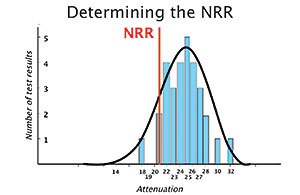
The result is the Noise Reduction Rating (NRR). Figure 1 shows a sample distribution of attenuation test results.
ISHN0415_F9_graph.jpg

Capability of the protector (measured by NRR)

The Noise Reduction Rating is a laboratory estimate of the amount of attenuation achievable by 98 percent of users when properly fit. It is a population-based rating; some test subjects achieved more attenuation, a few got slightly less. While it is true that the higher the NRR number associated with a hearing protector, the greater the potential for noise reduction, the key word is “potential.” By definition, the purpose of the NRR is to distinguish the capability of the hearing protector and not to predict the protection for any given user.

What we know from the NRR is the general capability of a hearing protector; now we need to consider the user’s ability to fit that protector.

Ability to fit the protector
(measured by PAR)

Monitoring the ability of exposed workers to fit their hearing protection helps ensure proper use of PPE to bring noise exposures below the permissible exposure limit of 90 dB. It is relatively easy to check the fit of earmuffs visually. A seal must be maintained between the wearer’s head and the cushions of the earmuff. However, the seal for an earplug is inside the ear canal and is not visible. Earplug fit-testing allows an individual to measure the attenuation he or she personally achieves with a given earplug. This measure is called a Personal Attenuation Rating or PAR.

New fit testing systems now make it easy to get a real-world, personalized picture of an employee’s ability to use his or her earplugs. There are 3 methods to individually fit-test earplugs.

The first fit-testing method is called Real Ear Attenuation at Threshold (REAT). This is the same method as described above to determine the NRR; however, since this measure is applied only to this individual, no adjustments are needed for standard deviations, etc.

A second fit-testing method, called Loudness Balance, involves the individual matching the loudness of sounds in the left and right ears. This task is done with and without earplugs.

Both the REAT and Loudness Balance methods can test any earplug.

A third method, called Field Microphone in Real Ear (F-MIRE), involves measuring the difference in sound level outside and inside of a surrogate earplug. “Compensation factors” are applied to this objective measure of noise reduction to account for human response and the differences between the surrogate earplug and the real earplug. Those compensation factors are determined much like the NRR method described above.

Any of the fit-testing methods can help to determine whether an employee is receiving optimal protection, requires additional training on how to fit earplugs, or needs to try a different model.

Comfort, ease of fit and compatibility with other PPE

The ease of use of hearing protection must be addressed at an individual level. Listen to workers and work with safety professionals to truly to protect workers’ hearing. The best hearing protection is the one that is worn.

KEYWORDS: hearing protection noise oil and gas safety

Share This Story

Looking for a reprint of this article?
From high-res PDFs to custom plaques, order your copy today!

Dr. Theresa Y. Schulz is the hearing conservation manager for Honeywell Safety Products, manufacturer of Howard Leight® hearing protection products (www.howardleight.com, www.hearforever.org). She is a past president and has been an active member of the National Hearing Conservation Association [NHCA] for 30 years. Dr. Schulz served in the U.S. Air Force for over 20 years as an audiologist.

Recommended Content

JOIN TODAY
to unlock your recommendations.

Already have an account? Sign In

  • forklift safety

    Exploring the latest technologies in forklift safety

    With more staff and more stock in warehousing now more...
    Workplace Training Strategies
    By: Josh Cramer
  • welding

    All about welder’s flash or arc eye

    A flash burn is a painful inflammation of the cornea,...
    Environmental Health and Safety
  • dangerous jobs

    The 10 most dangerous jobs in the U.S.

    On-the-job deaths have been rising — hitting the highest...
    Government Safety Regulations
    By: Benita Mehta
Manage My Account
  • eMagazine Subscriptions
  • ISHN Newsletter & Other Newsletter Alerts
  • Online Registration
  • Manage My Preferences
  • Subscription Customer Service

More Videos

Sponsored Content

Sponsored Content is a special paid section where industry companies provide high quality, objective, non-commercial content around topics of interest to the ISHN audience. All Sponsored Content is supplied by the advertising company and any opinions expressed in this article are those of the author and not necessarily reflect the views of ISHN or its parent company, BNP Media. Interested in participating in our Sponsored Content section? Contact your local rep!

close
  • man wearing the the Sundström SR200 Full Face Mask Respirator
    Sponsored byOHD

    5 Fit Testing Mistakes That Could Cost You

  • This image shows Magid AcuSpex polarized blue mirrored safety glasses.
    Sponsored byMagid Glove and Safety

    Construction PPE Guide: What Crews Need for Each Task

  • lone worker in confined space
    Sponsored byAlphasense Ltd.

    GET THE LEAD OUT of your Safety Oxygen Sensors!

Popular Stories

SpaceX 7 launch

OSHA Investigating Fatal Fall at SpaceX Starbase

Worker Impairment

How to Tell When a Co-Worker is Impaired? A Safety Pro’s Challenge

Automated loading dock equipment

After March 2026 Rivian Death, Safety Managers Reassess Loading Dock Systems Under OSHA's Warehouse Emphasis Program

top 10 most dangerous jobs

Poll

Seasonal Readiness

With the federal heat stress prevention rule on the horizon, which area of your safety program needs the most attention?
View Results Poll Archive

Products

Surviving an OSHA Audit A Management Guide, 2nd Edition

Surviving an OSHA Audit A Management Guide, 2nd Edition

See More Products

ISHN Podcasts

Related Articles

  • Noise Reduction Ratings

    Calculating Noise Reduction Ratings

    See More
  • What hearing protection regulations are on the horizon?

    See More
  • ISOtunes

    ISOtunes raises the bar for hearing protection with Bluetooth earplugs

    See More

Events

View AllSubmit An Event
  • September 22, 2016

    Bang! Damage from impulse noise and the effectiveness of hearing protection

    Some of the most hazardous sounds we hear are brief sounds – noises from impacts and impulses. These arise from sources like household tools, construction, industrial noise, firecrackers, guns, and even automotive airbags.
View AllSubmit An Event
×

Become a Leader in Safety Culture

Build your knowledge with ISHN, covering key safety, health and industrial hygiene news, products, and trends.

JOIN TODAY
  • RESOURCES
    • Advertise
    • Contact Us
    • Directories
    • Manufacturing Division
    • Store
    • Want More
  • SIGN UP TODAY
    • Create Account
    • eMagazine
    • Newsletters
    • Customer Service
    • Manage Preferences
  • SERVICES
    • Marketing Services
    • Reprints
    • Market Research
    • List Rental
    • Survey/Respondent Access
  • STAY CONNECTED
    • LinkedIn
    • Facebook
    • YouTube
    • X (Twitter)
  • PRIVACY
    • PRIVACY POLICY
    • TERMS & CONDITIONS
    • DO NOT SELL MY PERSONAL INFORMATION
    • PRIVACY REQUEST
    • ACCESSIBILITY

Copyright ©2026. All Rights Reserved BNP Media, Inc. and BNP Media II, LLC.

Design, CMS, Hosting & Web Development :: ePublishing