Business models change with the times
And so does the role of safety and health professionals
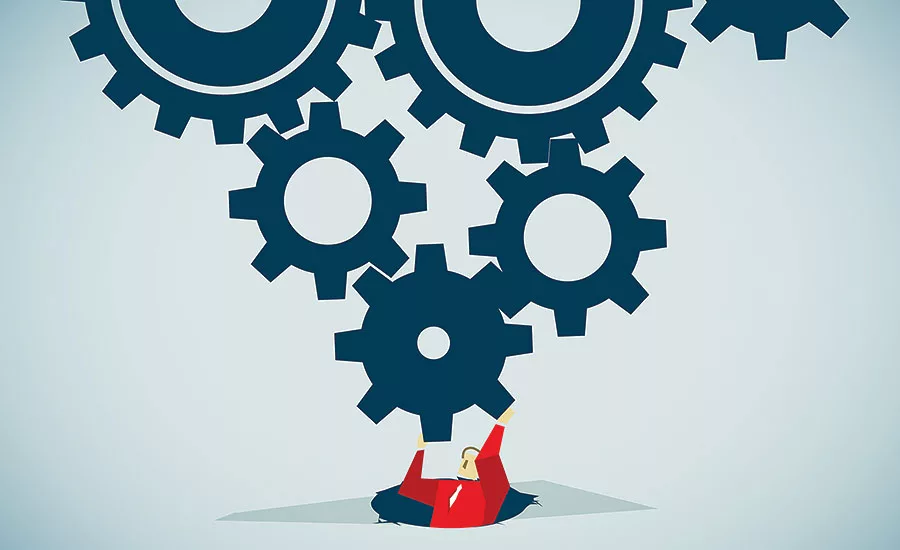
Henry Ford helped establish the proposition that organizations were like a giant clock. Expert engineers took complex production processes and broke them out into simple steps. Groups of workers, each contributing only a small and simple part of the overall process, could ultimately produce the finished product. Thus was conceived the assembly-line way of doing business. The plant would run “like clockwork,” and produce a high volume of finished goods.
The assembly- line concept was hardly limited to smokestack industries. The narrow-repetitive-job, multiple-handoff approach at the heart of the assembly line model became the predominant general model for business. Banks, hospitals, airlines, utilities, government agencies, insurance firms, and many other types of organizations operated and grew with the mechanical model as the framework for their businesses.
Whither the human factor?
The assembly-line model has two critical limitations, one of which was obvious as early as the 1920s, and the other of which became sharply visible and problematic in the 1960s and 1970s.
Limitation #1 – taking the craftsmanship out of the worker makes for pretty boring work. Years of research on so-called “job enrichment” identified five key characteristics of jobs that generally make work satisfying and fulfilling:
1) Skill Variety – the opportunity to learn, develop, use, and expand a wide range of job skills.
2) Task Identity – the sense of completing a whole piece of work.
3) Task Significance – the overall importance or value of the work.
4) Autonomy – the individual’s ability to make decisions and use his/her own judgment in doing the work.
5) Feedback – whether intrinsic to the work itself, or provided by others, or both, some knowledge of how one is doing.
Assembly-line jobs score consistently low on each of those key characteristics. This general point was made by researchers studying factory work as early as the 1920s. Indeed the whole “Human Relations” movement in psychology and sociology stemmed fairly directly from such early studies of the “boredom of the factory” and the need to humanize work that was previously engineered without much consideration for the human factor.
Resistant to change
Limitation #2 – the assembly-line model works, provided it is well-designed, and conditions in the broader environment are stable. If the market wants a limited selection of products, and the well-designed “machine” can pump out a high volume of those few products at a reasonable level of quality, all is well. But the assembly line is unsuited to a business environment of variety and change. If customers want “28 flavors” instead of just vanilla, or if there are changes in technology or the economy as a whole that require drastic shifts in business strategy and tactics, the assembly-line model is too rigid, too clumsy and too inflexible to adapt.
The organization comes alive
Comparing the 1950s or 1960s to today, the extent of the shift from the assembly line to the high performance organization is enormous. Many streams of thought have contributed to the shift away from viewing the organization as a mechanical thing, and toward viewing it as a living, animate, open system. Gradually, researchers and practitioners began to see the organization not as its machines, with the worker as a limited-span controller and extension of those machines, but rather as a complex social and technical system that exists in an environment of customers, competitors, technology, regulators, etc. It was recognized that the environment was not stable, but was undergoing change, and change was increasing at an accelerating rate.
Success goes to the nimble and adaptive
In a complex and unstable environment, the challenges that businesses face are not the challenges of making minor internal tweaks to a mechanical production process; they are the challenges of continually scanning the environment, avoiding threats and looking for opportunities.
In these conditions, an assembly-line business cannot statically run its machines and pump out its product and expect enduring success. Changing environments favor nimble, flexible, adaptive organizations. Such high performance organizations are built around interdependent teams, not narrowly focused “one-job” workers.
Workers in modern businesses do their best when they are multi-skilled, with high autonomy to “run it themselves.” Teams rather than “one-man/one-job” workers are the rule, because teams of knowledgeable “experts” simply do better work, in terms of every business metric.
The new era supervisor
In the old assembly-line model, it was enough for supervisors to “plan, organize, direct, and control” work (and workers). Good research suggests that even when the job description only required such one-way top-down direction, the very best supervisors always exceeded those bare-bones requirements. Today, as the model of business has moved away from the machine to the animate, living system, the job of the supervisor has broadened and enriched. What used to be the province of the few very best supervisors is today the expectation for all.
Refusing the safety cop role
The same is true of safety pros. Regardless of the way the role was defined in the past, the very best safety folks have always informed and engaged others, worked with them collaboratively, and refused to be put in the “safety cop” role. Just like the very best supervisors, the very best safety folks have implemented their role in the same high-involvement way, even when their organizations have not explicitly required it.
The contemporary high performance organization is not a big clock, to be wound up and left to run by disengaged workers with narrowly defined jobs. It is a flexible, open system, continually scanning its environment and adapting to changing conditions, and drawing on the competence of multi-skilled and business-knowledgeable associates.
Looking for a reprint of this article?
From high-res PDFs to custom plaques, order your copy today!