ISHN logo
search
cart
facebook twitter linkedin youtube
  • Sign In
  • Create Account
  • Sign Out
  • My Account
ISHN logo
  • NEWS
    • Today's News
    • Global Safety News
    • Government Regulations
  • PRODUCTS
    • Product Innovations
    • Featured Products
  • TOPICS
    • Environmental Health and Safety
    • Facility Safety
    • Workplace Health
    • Occupational Safety
    • PPE
    • More Topics
  • CONSTRUCTION
  • TECHNOLOGY
  • COLUMNS
    • Best Practices
    • Dave Johnson: What’s going on
    • Editorial Comments
    • Leading Safety
  • MULTIMEDIA
    • ISHN Podcast
    • Videos
    • Cold Stress Education Quiz
    • Webinars
    • White Papers
  • MORE
    • Buyer's Guide
    • Newsletters
    • Convention Companion
    • Polls
    • Events
    • ISHN Store
    • Sponsor Insights
  • EMAGAZINE
    • eMagazine
    • Archived Issues
    • Contact
    • Advertise
  • JOIN TODAY!
Environmental Health and Safety

Dust dangers: New compact devices immediately identify exposures
By Peter Briscoe
occupational dust monitoring
September 1, 2017

A new approach to dust monitoring is starting to spread throughout the industrial hygiene field. It is the use of a device that simultaneously does real-time direct reading combined with standard method in a compact wearable product. The beauty of this type of device is three-fold.

First, there is only a single compact device that the worker has to wear to do both methods of monitoring.

Second, since all monitoring is done in one pass you do not have to send out someone with a portable meter to do the real-time monitoring.

Third, the dust is being sampled from the breathing zone is simultaneously used for both the real-time and the standard method which means 100 percent correlation of results is guaranteed because it is the same dust.

Last, the real-time results can be instantaneously used to identify and pinpoint sources of concern for the workers. I have even seen people use a camera on the workers to get visual correlation with the real-time dust monitoring data.

Real-life example

Our example is a glass-making operation that uses raw silica that comes in bags and then makes specialty glass products. For workplace assessment purposes the worker in the silica bagging area and the worker in the glass manufacturing area have on the wearable device for their full eight-hour shift.

At the start of the day, the industrial hygienist prepares for testing by connecting the two devices to be used to a PC and setting up the test parameters for the day. The IH also purges and zeros the unit with a HEPA filter before putting in the pre-weighed cassette with the sample filter in it.

Then the IH puts the units on the belt of the worker and runs the tube to the breathing zone and clips it within eight inches of the worker’s mouth. The worker goes to the shift work and the IH goes back to the PC and starts the test and checks to see that the data is coming from the unit.

Throughout the day, the worker will hear or see an alarm if a dangerous condition occurs or if the device has any issues. The IH will also see the alarm on the screen. A real-time graph on the IH’s PC shows the progress of the testing and allows the IH to take action if dangerous situations occur and to anticipate danger is the trend on the graph is moving in that direction.

At the end of the shift the test automatically shuts off and the IH can get the units from the workers, shut them off, and then close off the test. The IH removes the sample cassette and bags it to send it to the lab for gravimetric, XRD, or IR testing. Note that once correlation between the direct-reading results and the post-sample gravimetric analysis has been done the lab testing is no longer necessary and the real-time meter results can be used directly at the end of the shift.

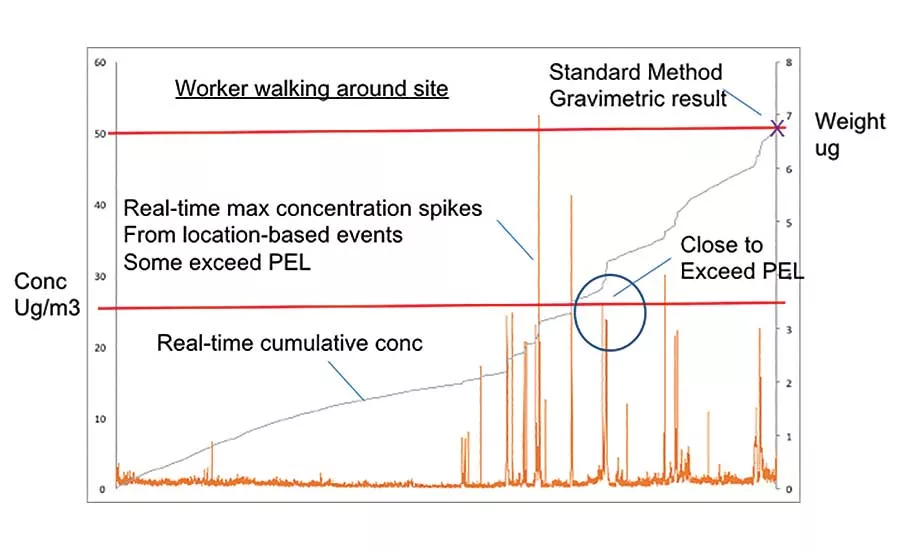
In the glass factory, the worker is moving around and encountering various danger zones. This can be seen on the graph pictured as spikes in the dust concentration at certain times of the day. These have been correlated to specific areas in the manufacturing plant, and now that the level and location is known suitable containment can be designed.

On the graph, the average concentration is seen to be building throughout the shift and at the end of the shift it has reached a level that is lower than the new PEL for silica. With the digital data it is possible to look at specific instances and investigate them closer.

Gravimetric analysis

The next step in the process is to send out the sample for Gravimetric analysis (NIOSH 0600). Gravimetric analysis is necessary to test for standard method to officially verify if the permissible exposure limit has been exceeded on the shift or not. Whenever this is done the results should be compared with the direct-reading result to ensure that the dust monitor direct-reading results are correlated with the standard method. The results of the comparison can be fed back into the device to adjust the mass concentration reading to increase the accuracy of the device.

The next step is to use XRD (NIOSH 7500) or IR Absorption (NIOSH 7603) to determine the percentage of the dust to be measured in the sample and adjust the direct-reading device to make it more accurate.  For example, if the sample contains 56 percent crystalline silica, then the device can be adjusted to show only 56 percent of the dust found.

The silica bagging operation results show that bagging is done near the end of the shift to prepare for next days operation. Two spikes from silica pours show up in the afternoon.

This part of the operation is considered high danger and workers must wear suitable protection the whole time they are in the bagging rooms. The results from this worker show the high level of silica dust ambient in the room and even higher level.

There is one additional benefit of the real-time direct-reading devices. When training workers it is very powerful to let them see the spikes on the graph, in real time, when they enter dangerous areas. That provides a lasting impression that helps teach them to be careful.

Finally, the moist important aspect of using the direct-reading devices along with the standard method is now the IH manager has lots of data to be able to use when demonstrating dangers in the operation and getting focus on solving any issues.

KEYWORDS: dust protection monitoring equipment

Share This Story

Looking for a reprint of this article?
From high-res PDFs to custom plaques, order your copy today!

Peter Briscoe is CEO of Nanozen Industries Inc. Nanozen pioneers innovative approaches to aerosol exposure analysis for industrial workplace environments. Nanozen’s mission is to manufacture and market leading edge technologies that will help drive new, emerging standards for workplace analysis, worker protection, and timely corrective action in the Occupational Health and Safety industry.

Recommended Content

JOIN TODAY
to unlock your recommendations.

Already have an account? Sign In

  • forklift safety

    Exploring the latest technologies in forklift safety

    With more staff and more stock in warehousing now more...
    Facility Safety
    By: Josh Cramer
  • welding

    All about welder’s flash or arc eye

    A flash burn is a painful inflammation of the cornea,...
    Environmental Health and Safety
  • dangerous jobs

    The 10 most dangerous jobs in the U.S.

    On-the-job deaths have been rising — hitting the highest...
    Transportation Safety
    By: Benita Mehta
Manage My Account
  • eMagazine Subscriptions
  • ISHN Newsletter & Other Newsletter Alerts
  • Online Registration
  • Manage My Preferences
  • Subscription Customer Service

More Videos

Sponsored Content

Sponsored Content is a special paid section where industry companies provide high quality, objective, non-commercial content around topics of interest to the ISHN audience. All Sponsored Content is supplied by the advertising company and any opinions expressed in this article are those of the author and not necessarily reflect the views of ISHN or its parent company, BNP Media. Interested in participating in our Sponsored Content section? Contact your local rep!

close
  • man wearing the the Sundström SR200 Full Face Mask Respirator
    Sponsored byOHD

    5 Fit Testing Mistakes That Could Cost You

  • This image shows Magid AcuSpex polarized blue mirrored safety glasses.
    Sponsored byMagid Glove and Safety

    Construction PPE Guide: What Crews Need for Each Task

  • lone worker in confined space
    Sponsored byAlphasense Ltd.

    GET THE LEAD OUT of your Safety Oxygen Sensors!

Popular Stories

SpaceX 7 launch

OSHA Investigating Fatal Fall at SpaceX Starbase

Worker Impairment

How to Tell When a Co-Worker is Impaired? A Safety Pro’s Challenge

Automated loading dock equipment

After March 2026 Rivian Death, Safety Managers Reassess Loading Dock Systems Under OSHA's Warehouse Emphasis Program

top 10 most dangerous jobs

Poll

Seasonal Readiness

With the federal heat stress prevention rule on the horizon, which area of your safety program needs the most attention?
View Results Poll Archive

Products

Surviving an OSHA Audit A Management Guide, 2nd Edition

Surviving an OSHA Audit A Management Guide, 2nd Edition

See More Products

ISHN Podcasts

Related Articles

  • Identify & mitigate combustible dust dangers

    Identify & mitigate combustible dust dangers

    See More
  • Donaldson compact dust collector.png

    Donaldson Launches 3 New Compact Dust Collectors

    See More
  • Healh experts worry that flu research will unleash new dangers

    See More

Related Products

See More Products
  • 1119010160.jpg

    Guidelines for Combustible Dust Hazard Analysis

See More Products

Events

View AllSubmit An Event
  • June 26, 2025

    NFPA 660: How to Use the New Consolidated Combustible Dust Standard

    ON DEMAND: Combustible dust and particulate solids can pose a serious hazard in many industries. Over the last 100 years, the National Fire Protection Association (NFPA) committees created many industry- and commodity-specific standards to mitigate those hazards.
View AllSubmit An Event

Related Directories

  • Scientific Dust Collectors

    Scientific Dust Collectors (SDC) began in 1981 when our first patent for improving filter cleaning was issued. Our patented UniFlow Supersonic Nozzle -based cleaning system is where it all starts. Combined with our High Side Inlets, Wide Filter Spacing, and Inlet Baffling, we are able to guarantee performance, efficiency, and filter life. ASHRAE 199 Test Lab on site.
×

Become a Leader in Safety Culture

Build your knowledge with ISHN, covering key safety, health and industrial hygiene news, products, and trends.

JOIN TODAY
  • RESOURCES
    • Advertise
    • Contact Us
    • Directories
    • Manufacturing Division
    • Store
    • Want More
  • SIGN UP TODAY
    • Create Account
    • eMagazine
    • Newsletters
    • Customer Service
    • Manage Preferences
  • SERVICES
    • Marketing Services
    • Reprints
    • Market Research
    • List Rental
    • Survey/Respondent Access
  • STAY CONNECTED
    • LinkedIn
    • Facebook
    • YouTube
    • X (Twitter)
  • PRIVACY
    • PRIVACY POLICY
    • TERMS & CONDITIONS
    • DO NOT SELL MY PERSONAL INFORMATION
    • PRIVACY REQUEST
    • ACCESSIBILITY

Copyright ©2026. All Rights Reserved BNP Media, Inc. and BNP Media II, LLC.

Design, CMS, Hosting & Web Development :: ePublishing