ISHN logo
search
cart
facebook twitter linkedin youtube
  • Sign In
  • Create Account
  • Sign Out
  • My Account
ISHN logo
  • NEWS
    • Today's News
    • Global Safety News
    • Government Regulations
  • PRODUCTS
    • Product Innovations
    • Featured Products
  • TOPICS
    • Environmental Health and Safety
    • Facility Safety
    • Workplace Health
    • Occupational Safety
    • PPE
    • More Topics
  • CONSTRUCTION
  • TECHNOLOGY
  • COLUMNS
    • Best Practices
    • Dave Johnson: What’s going on
    • Editorial Comments
    • Leading Safety
  • MULTIMEDIA
    • ISHN Podcast
    • Videos
    • Cold Stress Education Quiz
    • Webinars
    • White Papers
  • MORE
    • Buyer's Guide
    • Newsletters
    • Convention Companion
    • Polls
    • Events
    • ISHN Store
    • Sponsor Insights
  • EMAGAZINE
    • eMagazine
    • Archived Issues
    • Contact
    • Advertise
  • JOIN TODAY!
Today's Safety NewsTransportation Safety

Defect caused engine failure, emergency evacuation
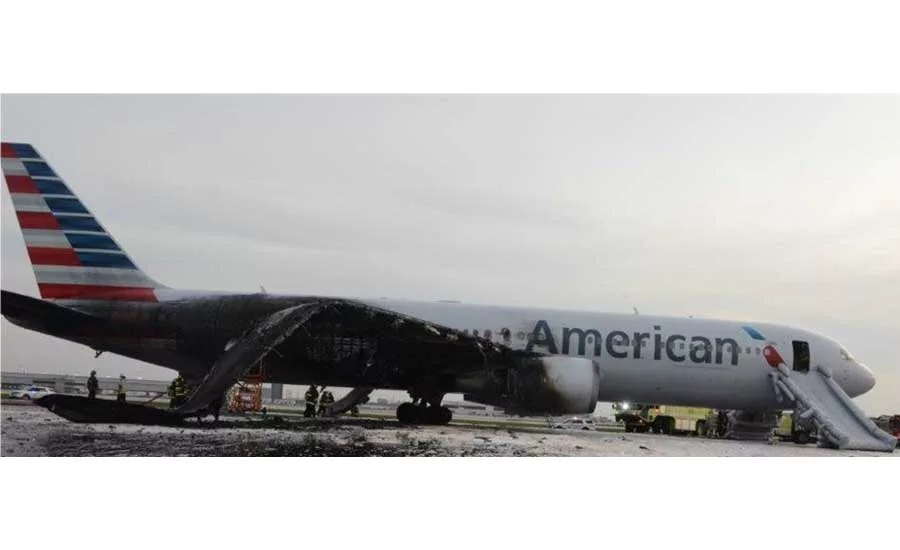
NTSB
January 31, 2018

An internal defect in a commercial airliner engine caused an uncontained engine failure resulting in a fire and the emergency evacuation of all aboard, the National Transportation Safety Board (NTSB) said yesterday.

American Airlines flight 383, a Boeing 767 bound for Miami, was on its takeoff roll at Chicago O’Hare International Airport Oct. 28, 2016, when a turbine disk in the right engine failed, sending metal fragments through a fuel tank and wing structure. The flight crew rejected the takeoff just as the jetliner approached takeoff speed and stopped the airplane on the runway. All 161 passengers and 9 crewmembers evacuated as emergency responders battled the fuel-fed fire. The airplane was damaged beyond repair. One passenger was seriously injured. (NTSB photo above is by Ed Malinowski)

The failed turbine disk was recovered in four pieces, one of which weighed 57 pounds and was found more than a half mile from the airplane. Through extensive examination of the disk fragments at the NTSB lab in Washington investigators determined there was a subsurface defect in the disk at the time of manufacture. Because of the nature of the defect and the limits of inspection methods, the NTSB concluded the defect was likely undetectable when the disk was produced in 1997.

Investigators further determined the defect had been propagating microscopic cracks in the disk for as many as 5,700 flight cycles – one takeoff and one landing – prior to the accident. Although the disk had been inspected in January 2011, the NTSB said the internal cracks were also most likely undetectable at that time because the current required inspection methods are unable to identify all subsurface defects.

“Even though there have been significant advances in the safety performance of passenger airplanes over the last few decades, this accident shows that there’s still improvements that can be made,” said NTSB Chairman Robert L. Sumwalt. “Current inspection methods – those that can fail to uncover a defect in a safety critical component of an airliner – need a closer look.”

The NTSB determined the pilots made the appropriate decision to abort the takeoff and shut down the damaged engine. Because the pilots were working with a checklist that didn’t differentiate between an engine fire in the air from one on the ground, the undamaged engine was not immediately shut down. The passenger who was seriously injured sustained those injuries as a result of evacuating the airplane, as directed by a flight attendant, and encountering jet blast from the engine that was still running.

The NTSB’s report, approved Tuesday, details numerous problems with the evacuation, including a lack of communication between the flight deck and cabin crew, deviation by a flight attendant from emergency evacuation procedures, and the crew’s lack of coordination following the evacuation.

The NTSB also noted the flight attendants, who had difficulty using the aircraft interphones to communicate with the cockpit and passengers, were inadequately trained by American Airlines on the different interphone systems installed in its planes.

Video of the evacuation as well as accounts by flight attendants revealed many passengers disregarded pre-flight safety instructions to leave personal belongings behind and instead exited the burning airplane with carry-on luggage.

“Things can be replaced; people can’t,” said Sumwalt. “We know from many investigations of emergency evacuations that every second counts, and passengers need to follow the instructions of the crewmembers who are trying to get them out of harm’s way.”  

The NTSB made one recommendation to American Airlines, one to Boeing, seven new recommendations to the Federal Aviation Administration. The NTSB also reiterated two recommendations to the FAA on emergency evacuations because that agency has yet to be favorably act upon them.

The complete accident report will be available in several weeks. The findings, probable cause and safety recommendations as well as Chairman Sumwalt’s prepared remarks and the PowerPoint presentations given today are all available at https://go.usa.gov/xn7xF.

Additional information related to this investigation, including news releases and a link to the accident docket containing more than 600 pages of supporting factual material, is available on the AA 383 accident investigation page at https://go.usa.gov/xn7xf.

KEYWORDS: accident investigation airlines aviation safety

Share This Story

Looking for a reprint of this article?
From high-res PDFs to custom plaques, order your copy today!

Recommended Content

JOIN TODAY
to unlock your recommendations.

Already have an account? Sign In

  • forklift safety

    Exploring the latest technologies in forklift safety

    With more staff and more stock in warehousing now more...
    Facility Safety
    By: Josh Cramer
  • welding

    All about welder’s flash or arc eye

    A flash burn is a painful inflammation of the cornea,...
    Environmental Health and Safety
  • dangerous jobs

    The 10 most dangerous jobs in the U.S.

    On-the-job deaths have been rising — hitting the highest...
    Government Safety Regulations
    By: Benita Mehta
Manage My Account
  • eMagazine Subscriptions
  • ISHN Newsletter & Other Newsletter Alerts
  • Online Registration
  • Manage My Preferences
  • Subscription Customer Service

More Videos

Sponsored Content

Sponsored Content is a special paid section where industry companies provide high quality, objective, non-commercial content around topics of interest to the ISHN audience. All Sponsored Content is supplied by the advertising company and any opinions expressed in this article are those of the author and not necessarily reflect the views of ISHN or its parent company, BNP Media. Interested in participating in our Sponsored Content section? Contact your local rep!

close
  • man wearing the the Sundström SR200 Full Face Mask Respirator
    Sponsored byOHD

    5 Fit Testing Mistakes That Could Cost You

  • This image shows Magid AcuSpex polarized blue mirrored safety glasses.
    Sponsored byMagid Glove and Safety

    Construction PPE Guide: What Crews Need for Each Task

  • lone worker in confined space
    Sponsored byAlphasense Ltd.

    GET THE LEAD OUT of your Safety Oxygen Sensors!

Popular Stories

SpaceX 7 launch

OSHA Investigating Fatal Fall at SpaceX Starbase

Worker Impairment

How to Tell When a Co-Worker is Impaired? A Safety Pro’s Challenge

Automated loading dock equipment

After March 2026 Rivian Death, Safety Managers Reassess Loading Dock Systems Under OSHA's Warehouse Emphasis Program

top 10 most dangerous jobs

Poll

Seasonal Readiness

With the federal heat stress prevention rule on the horizon, which area of your safety program needs the most attention?
View Results Poll Archive

Products

Surviving an OSHA Audit A Management Guide, 2nd Edition

Surviving an OSHA Audit A Management Guide, 2nd Edition

See More Products

ISHN Podcasts

Related Articles

  • What caused engine failure, fire in commercial aircraft?

    See More
  • Emergency evacuation

    See More
  • NTSB photo

    NTSB looks into fiery American Airlines engine failure

    See More
×

Become a Leader in Safety Culture

Build your knowledge with ISHN, covering key safety, health and industrial hygiene news, products, and trends.

JOIN TODAY
  • RESOURCES
    • Advertise
    • Contact Us
    • Directories
    • Manufacturing Division
    • Store
    • Want More
  • SIGN UP TODAY
    • Create Account
    • eMagazine
    • Newsletters
    • Customer Service
    • Manage Preferences
  • SERVICES
    • Marketing Services
    • Reprints
    • Market Research
    • List Rental
    • Survey/Respondent Access
  • STAY CONNECTED
    • LinkedIn
    • Facebook
    • YouTube
    • X (Twitter)
  • PRIVACY
    • PRIVACY POLICY
    • TERMS & CONDITIONS
    • DO NOT SELL MY PERSONAL INFORMATION
    • PRIVACY REQUEST
    • ACCESSIBILITY

Copyright ©2026. All Rights Reserved BNP Media, Inc. and BNP Media II, LLC.

Design, CMS, Hosting & Web Development :: ePublishing