Facility safety inspections
Valve safety trains require regular inspections, maintenance and training. Tremendous explosive forces can be unleashed if best practices are not followed.
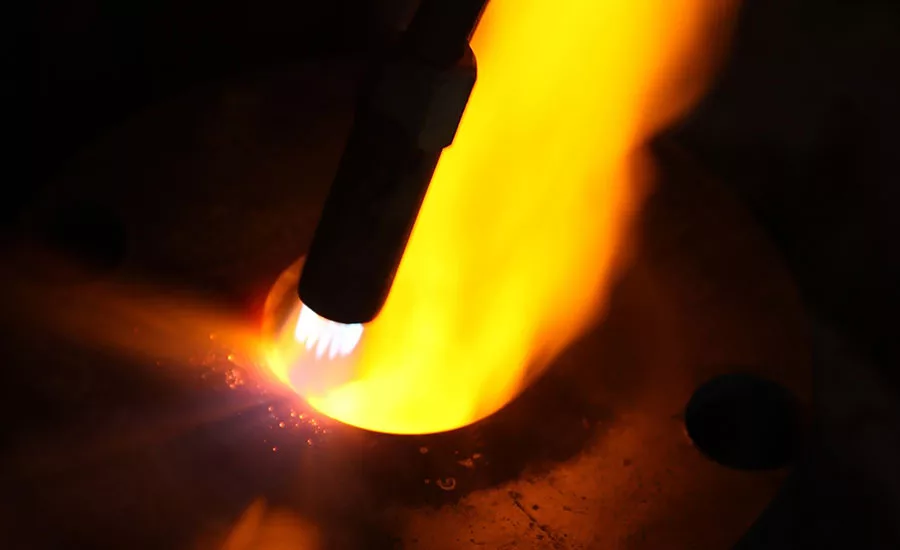
Thermal processes are used to alter the physical, and sometimes chemical, properties of a material or coating. Two common examples of thermal processing would be high-temperature operations such as heat treating, and low-temperature operations, for instance drying or baking.
Heat treating involves the use of heating or chilling, normally to extreme temperatures, to modify a material’s physical properties — making it harder or softer, for example.
Many industries use baking, drying or other lower temperature heating processes to modify aspects of a material or coating. Additionally, facilities may have incinerators for oxidizing pollutants, or air heaters for tempering climate air.
Applications for thermal processing are virtually endless. At the heart of all thermal processes is a valve safety train. These fuel-delivery devices maintain consistent conditions of gasses into furnaces, ovens, dryers and boilers, among others, making them crucial in assuring safe ignition, operation and shutdown. Equally important, they keep gas out of the system whenever equipment is cycled or shut off.
Safety valve train components
A valve safety train isn’t a single piece of equipment. Instead, it has many components including regulators, in-line strainers (“sediment traps”), safety shut-off valves (SSOV), manual valves (MV), pressure switches, and test fittings logically linked to a burner management system. Flame-sensing components make sure that flames are present when they are supposed to be, and not at a wrong time. Other components may consist of leak-test systems, gauges and pilot gas controls. At a minimum there are two crucial gas pressure switches in a valve safety train, one for low pressure and one for high pressure.
Low & high pressure gas switches
The low gas pressure switch ensures the minimum gas pressure necessary to operate is present. As you would assume, it will shut off fuel to the burner if the gas pressure is below the setpoint.
The high gas pressure switch ensures an excessive pressure is not present. It too will shut off fuel if the gas pressure is too high. Both switches must be proven safe to permit operation.
Additionally, there will be an air pressure switch to ensure sufficient airflow is present to support burner operation. Some systems have supplementary pressure switches, such as a valve proving pressure switch. Switches such as these are typically used to enhance safety or provide other safety aspects specific to that application’s needs. A multitude of sensors within the valve safety train -- pressure switches, flame detectors, position indicators -- and isolation and relief valves work together in concert to prevent accidents.
Valve safety trains must be compliant with all applicable local and national codes, standards, and insurance requirements. The most common of these for North America are NFPA, NEMA, CSA, UL, FM. Annual testing and preventive maintenance are not only an NPFA requirement, but also oftentimes required by insurance agencies, equipment manufacturers, and national standards, including ANSI, ASME, and NEC.
Set your trap
The primary function of a valve safety train is to reliably isolate the inlet fuel from the appliance. Safety shut-off valves are purposely selected to do this. To protect these valves, the initial section of a safety train is used to condition the fuel and remove debris that could potentially damage or hinder all downstream safety components.
The first conditioning step is a sediment trap (a.k.a. dirt leg, drip leg). This trap captures large debris, pipe scale, and provides a collection well for pipe condensates. The proper orientation of a sediment trap is at the bottom of a vertical feed. This downwards flow arrangement promotes the capture of debris and condensate into the trap. A horizontal feed across a sediment trap is an improper application.
The second conditioning step is a flow strainer or filter element. These devices are fine particulate sieves. The removal of fine particulates from the fuel stream further protect the downstream safety devices from particulate erosion and abrasion.
Taken together these conditioning steps remove particulates and condensates that might block, hinder, erode, or otherwise compromise the safety features of the downstream devices.
The explosive force of a bomb
Owing to the presence of hazardous vapors and gases, a poorly designed or inadequately maintained safety train can lead to catastrophic accidents, ranging from explosions and fires to employee injuries and death. When this explosive force is unleashed, the shock wave carries equipment, debris, materials, pipes, and burning temperatures in all directions with tremendous force.
Two risks: valves and vents
Valves are mechanical devices that rely upon seats and seals to create mechanical barriers to control flow. Over time, these barriers wear out for a variety of reasons, whether it is age, abrasion, erosion, chemical attack, fatigue or temperature. Increased wear contributes to leaks, and leaks lead to failures and hazards. Defective valves can allow gas to leak into a boiler even when the boiler is not in operation. Then, when the boiler is later turned on, a destructive explosion could occur.
Testing a valve’s integrity is an evaluation of current barrier conditions, and may be used to identify a valve that is wearing out prior to failure. As such, annual valve leakage tests are an important aspect of a safety valve train inspection program. Along with annual testing, valves should be examined during the initial startup of the burner system, or whenever the valve maintenance is performed. Only trained, experienced combustion technicians should conduct these tests.
Improper venting is another danger. Here is the problem: Numerous components in a valve safety train require an atmospheric reference for accurate operation. Many of these devices, however, can fail in modes that permit fuel to escape from these same atmospheric points. Unless these components are listed as “ventless,” vent lines are necessary. Vent lines must be correctly engineered, installed, and routed to appropriate and approved locations. In addition, building penetrations must be sealed, pipes must be supported, and the vent terminations must be protected from the elements and insects. In short, vent lines are another point of potential failure for the system.
Even when vent lines are properly installed, building pressures can vary sufficiently enough that they prevent optimal burner performance. Building pressures often vary with seasonal, daily weather, and manufacturing needs, further complicating matters. Condensate in vent lines can collect and drain to low points or into the devices themselves. Heating, cooling and building exhausters are known to influence building pressures and device responses, but so can opening and closing of delivery doors for shipping and receiving. Hence a burner once tuned for optimal operation might not be appropriately tuned for the opposite season’s operation.
The smart alternative to traditional vented valve trains is a ventless system that will improve factory safety and enhance burner operation. Ventless systems reference and experience the same room conditions where the burners are located, resulting in more stable year-round operating conditions.
Final thoughts
Valve safety trains are critical to the operation of combustion systems. Despite being used daily in thousands of industrial facilities, awareness on their purpose and function may be dangerously absent because on-site training is minimal or informal. To many employees on the plant floor this series of valves, piping, wires and switches is simply too complex to take the time to understand. What is known can be dangerously misunderstood.
Understanding of fuel-fired equipment, especially the valve safety train, is necessary to prevent explosions, injuries and property damage. The truth is, although valve safety trains are required to be check regularly, they rarely are, especially when maintenance budgets are cut. And while codes require training\, they offer very little in terms of specific directions.
As a safety professional, the onus is on you. You and your staff must have a core level of knowledge regarding safe practices of valve safety trains, even if a contractor will be doing the preventive maintenance work. Accidents and explosions can be due to human error and a lack of training when an unknowing employee, for example, attempts to bypass a safety control. Preventive maintenance is essential to counter equipment deterioration, as is the documentation of annual inspection, recording switch set points, maintaining panel drawings and verifying purge times. Accidents happen when this type of documentation is not available. Finally, don’t wait for a near-miss or accident to upgrade your valve safety train. Upgrade it for safety’s sake not simply because it will increase throughput.
Looking for a reprint of this article?
From high-res PDFs to custom plaques, order your copy today!