ISHN logo
search
cart
facebook twitter linkedin youtube
  • Sign In
  • Create Account
  • Sign Out
  • My Account
ISHN logo
  • NEWS
    • Today's News
    • Global Safety News
    • Government Regulations
  • PRODUCTS
    • Product Innovations
    • Featured Products
  • TOPICS
    • Environmental Health and Safety
    • Facility Safety
    • Workplace Health
    • Occupational Safety
    • PPE
    • More Topics
  • CONSTRUCTION
  • TECHNOLOGY
  • COLUMNS
    • Best Practices
    • Dave Johnson: What’s going on
    • Editorial Comments
    • Leading Safety
  • MULTIMEDIA
    • ISHN Podcast
    • Videos
    • Cold Stress Education Quiz
    • Webinars
    • White Papers
  • MORE
    • Buyer's Guide
    • Newsletters
    • Convention Companion
    • Polls
    • Events
    • ISHN Store
    • Sponsor Insights
  • EMAGAZINE
    • eMagazine
    • Archived Issues
    • Contact
    • Advertise
  • JOIN TODAY!
Today's Safety NewsTransportation Safety

NTSB report on deadly automated vehicle crash slams Uber for safety lack
Uber
November 20, 2019

There was plenty of blame to go around in the report released yesterday by the National Transportation Safety Board (NTSB) into its investigation of an automated test vehicle crash last year, but most of it was assigned to Uber, the company conducting the test.

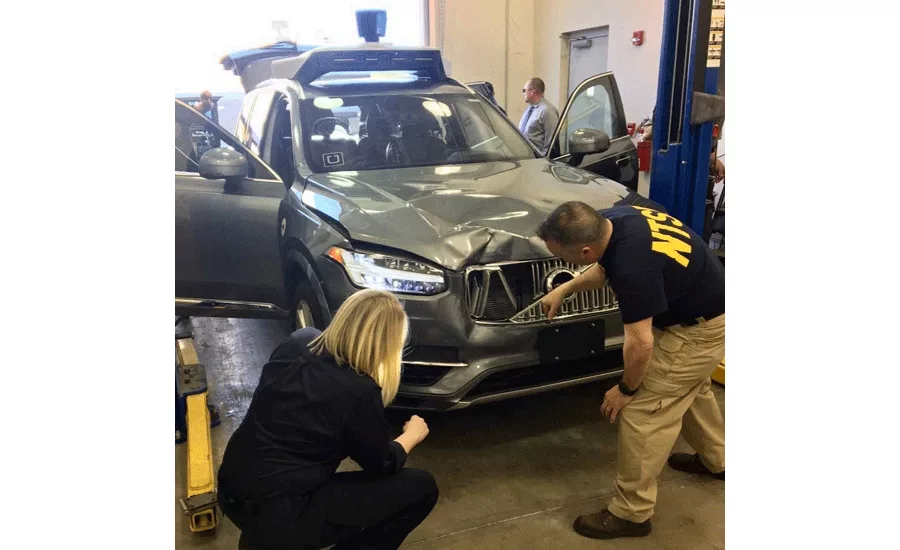
Shown above: NTSB investigators on-scene in Tempe, Arizona, examining the Uber automated test vehicle involved in the collision. (NTSB photo)

Automatic brakes were deactivated

A pedestrian was killed in the March 18 collision in Tempe, Arizona involving an Uber Advanced Technologies Group (ATG) vehicle - a 2017 Volvo XC90, modified with a proprietary developmental automated driving system. The vehicle’s factory-installed forward collision warning and automatic emergency braking systems were deactivated during the operation of the automated system.

An Uber ATG operator was in the driver’s seat, but the automated system was controlling the vehicle when it struck the pedestrian at 39 mph.

Distraction played a role; at the time of the crash, the vehicle operator, Rafaela Vasquez, was found to have been watching NBC’s “The Voice” on her cell phone – although Vasquez denied using her cell phone during her interview with NTSB investigators. Also contributing to the tragedy: the pedestrian’s impairment at the time of the crash, coupled with her crossing outside a crosswalk at night. Additionally, the Arizona Department of Transportation exercised insufficient oversight of automated vehicle testing, the NTSB found.

But it was Uber Technologies Inc. division’s “inadequate safety culture” that was identified as the major culprit in the fatality.

"The last link of a long chain"

“Safety starts at the top,” said NTSB Chairman Robert L. Sumwalt. “The collision was the last link of a long chain of actions and decisions made by an organization that unfortunately did not make safety the top priority.”

The NTSB determined that the immediate cause of the collision was the failure of the Uber ATG operator to closely monitor the road and the operation of the automated driving system because the operator was visually distracted throughout the trip. Contributing to the crash was Uber ATG’s inadequate safety risk assessment procedures, ineffective oversight of the vehicle operators and a lack of adequate mechanisms for addressing operators’ automation complacency.

Among the investigation’s findings:

  • The Uber ATG automated driving system detected the pedestrian 5.6 seconds before impact. Although the system continued to track the pedestrian until the crash, it never accurately identified the object crossing the road as a pedestrian -- or predicted its path.
  • Had the vehicle operator been attentive, the operator would likely have had enough time to detect and react to the crossing pedestrian to avoid the crash or mitigate the impact.
  • While Uber ATG managers had the ability to retroactively monitor the behavior of vehicle operators, they rarely did so. The company’s ineffective oversight was exacerbated by its decision to remove a second operator from the vehicle during testing of the automated driving system.
  • Uber ATG made several changes to address the deficiencies identified, including implementation of a safety management system.

Before allowing test vehicles on public roads...

The NTSB is calling upon federal regulators to create a review process before allowing automated test vehicles to operate on public roads.

The NTSB issued a total of six recommendations to the National Highway Traffic Safety Administration, the state of Arizona, the American Association of Motor Vehicle Administrators and Uber ATG.

The NTSB recommended that NHTSA require entities wishing to test a developmental automated driving system on public roads to submit safety self-assessment plans before being allowed to begin or continue testing and that NHTSA should review the plans to ensure they include appropriate safeguards.

A link to the executive summary, findings, probable cause and recommendations is available online at https://go.usa.gov/xp9Eu . The full report is expected to be released within the next few weeks.


KEYWORDS: accident prevention autonomous vehicles motor vehicle accidents pedestrian safety public safety

Share This Story

Looking for a reprint of this article?
From high-res PDFs to custom plaques, order your copy today!

Recommended Content

JOIN TODAY
to unlock your recommendations.

Already have an account? Sign In

  • forklift safety

    Exploring the latest technologies in forklift safety

    With more staff and more stock in warehousing now more...
    Workplace Training Strategies
    By: Josh Cramer
  • welding

    All about welder’s flash or arc eye

    A flash burn is a painful inflammation of the cornea,...
    Environmental Health and Safety
  • dangerous jobs

    The 10 most dangerous jobs in the U.S.

    On-the-job deaths have been rising — hitting the highest...
    Transportation Safety
    By: Benita Mehta
Manage My Account
  • eMagazine Subscriptions
  • ISHN Newsletter & Other Newsletter Alerts
  • Online Registration
  • Manage My Preferences
  • Subscription Customer Service

More Videos

Sponsored Content

Sponsored Content is a special paid section where industry companies provide high quality, objective, non-commercial content around topics of interest to the ISHN audience. All Sponsored Content is supplied by the advertising company and any opinions expressed in this article are those of the author and not necessarily reflect the views of ISHN or its parent company, BNP Media. Interested in participating in our Sponsored Content section? Contact your local rep!

close
  • man wearing the the Sundström SR200 Full Face Mask Respirator
    Sponsored byOHD

    5 Fit Testing Mistakes That Could Cost You

  • This image shows Magid AcuSpex polarized blue mirrored safety glasses.
    Sponsored byMagid Glove and Safety

    Construction PPE Guide: What Crews Need for Each Task

  • lone worker in confined space
    Sponsored byAlphasense Ltd.

    GET THE LEAD OUT of your Safety Oxygen Sensors!

Popular Stories

SpaceX 7 launch

OSHA Investigating Fatal Fall at SpaceX Starbase

dust explosion

Tennessee OSHA Issues Record $3.1M Fine After Deadly Explosion at Munitions Plant

roofing dangerous jobs Getty.jpg

OSHA Finds Florida Roofing Company Willfully Exposed Workers to Safety Hazards After Worker’s Fatal Fall

top 10 most dangerous jobs

Poll

Seasonal Readiness

With the federal heat stress prevention rule on the horizon, which area of your safety program needs the most attention?
View Results Poll Archive

Products

Surviving an OSHA Audit A Management Guide, 2nd Edition

Surviving an OSHA Audit A Management Guide, 2nd Edition

See More Products

ISHN Podcasts

Related Articles

  • NTSB issues report on deadly Amtrak passenger train derailment

    See More
  • Oil industry responds to NTSB report on Michigan crude oil spill

    See More
  • NTSB Pa. Turnpike

    NTSB pieces together fatal multi-vehicle crash on Pa. turnpike

    See More

Related Products

See More Products
  • human resources.jpg

    Human Resources and Change Management for Safety Professionals

See More Products

Events

View AllSubmit An Event
  • March 26, 2026

    Electrical Safety Essentials: A Practical Guide for Safety Professionals

    ON DEMAND: This one-hour webinar provides general safety professionals with a practical, non-technical overview of electrical hazards, injury mechanisms, and prevention strategies aligned with OSHA 29 CFR 1910 Subpart S and related standards.
  • June 27, 2018

    Signage for Safety & OSHA Compliance

    Invest in safety through clear and consistent signage, with guidance from this free webinar.
View AllSubmit An Event
×

Become a Leader in Safety Culture

Build your knowledge with ISHN, covering key safety, health and industrial hygiene news, products, and trends.

JOIN TODAY
  • RESOURCES
    • Advertise
    • Contact Us
    • Directories
    • Manufacturing Division
    • Store
    • Want More
  • SIGN UP TODAY
    • Create Account
    • eMagazine
    • Newsletters
    • Customer Service
    • Manage Preferences
  • SERVICES
    • Marketing Services
    • Reprints
    • Market Research
    • List Rental
    • Survey/Respondent Access
  • STAY CONNECTED
    • LinkedIn
    • Facebook
    • YouTube
    • X (Twitter)
  • PRIVACY
    • PRIVACY POLICY
    • TERMS & CONDITIONS
    • DO NOT SELL MY PERSONAL INFORMATION
    • PRIVACY REQUEST
    • ACCESSIBILITY

Copyright ©2026. All Rights Reserved BNP Media, Inc. and BNP Media II, LLC.

Design, CMS, Hosting & Web Development :: ePublishing