Assess & control fall risks
Eliminating hazards is the first line of defense
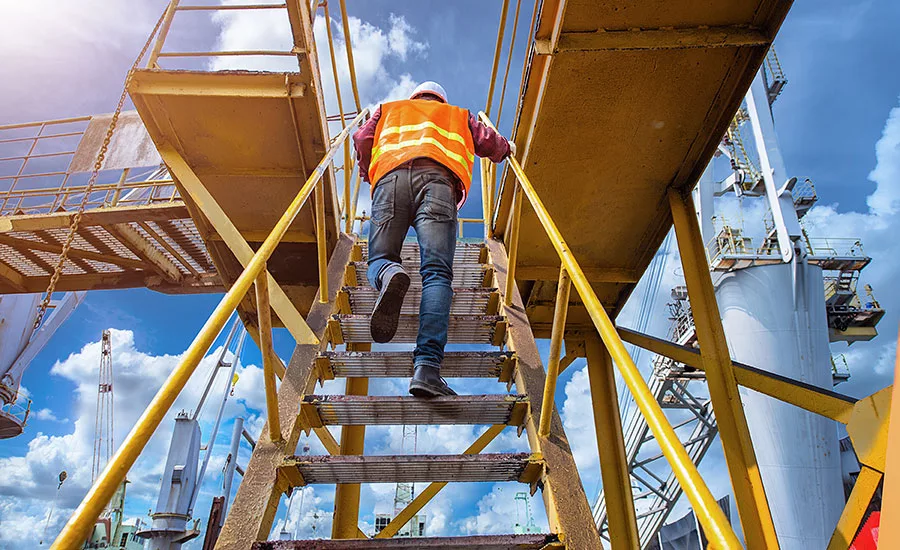
Fall protection has been the number one most frequently cited OSHA violation for several years now, which means, worksites simply are not understanding the need to keep employees upright. Employers continue to take significant unnecessary “risk” when it comes to workplace slips, trips and falls by not taking the appropriate measures in evaluating their worksites.
Remember that the definition of “risk” in the safety world is evaluating the probability of something happening versus the severity of the consequence if it does happen. The higher the probability or severity of someone falling in that area, the more protection should be focused in that area.
Keep your workplace safe and prevent employees from sustaining a serious or even deadly injury
from a fall to a lower level by following these
recommendations.
Know the requirements and meet them
In the last few years, OSHA has worked to align general industry standards with those already established for construction, though some differences remain. Specifically, the general industry is required to use fall protection measures for unprotected edges of fall hazards of four feet or more, while in construction, the requirement is for six feet or more. Both the general industry and construction rules require fall prevention measures in:
- Hoist areas
- Runways
- Areas above dangerous equipment
- Wall openings
- Repair pits
- Stairways
- Scaffolds
Recent OSHA regulatory updates have allowed protection options previously only permitted in construction, such as personal fall protection systems (PFAS) for general industry as well. In addition to the federal regulations, 28 states have their own regulatory frameworks for fall prevention that must meet or exceed federal standards.
Eliminate fall risks first
The first line of defense against falls isn’t a regulation or restraint system — it’s identification and elimination. Appoint a competent member of your staff to regularly assess your facility for fall hazards and be sure this person has the authority to take prompt corrective measures to remove or mitigate hazards.
All of your employees should understand their roles in maintaining a safe and healthy workplace via required safety and health compliance training. It is critical to make “good housekeeping” a universal responsibility and keep it as a regular discussion topic at monthly meetings for everyone. Encourage every worker to be vigilant for fall risks in the workplace and create an environment where your team feels comfortable to report these risks for mitigation or correction.
A good practice is a daily walkthrough of a specific department, completed by an employee from a different department. For example, using a shipping department employee to inspect the maintenance department will allow for a new set of eyes looking for hazards who doesn’t see that department daily.
Passive engineering controls & fall restraint systems
Be proactive when a fall risk can’t be eliminated by making sure warning signage and planned passive engineering controls such as guardrails are at the ready wherever they are needed. While some passive protections, like guardrails, can be expensive to install, they are known to be lifesavers.
When work must be done near an unprotected edge or side, consider a fall restraint system. A worker can’t fall to a lower level if a restraint system keeps them from reaching that unprotected edge and tumbling over. Fall restraint systems take many forms; however, every system requires a body harness and lanyard attached to an anchor point. When a work area is clearly defined, a fixed single point anchor is appropriate. For applications where personnel need to roam freely on a rooftop, for example, a horizontal lifeline can be more appropriate.
Last line of defense: Fall arrest
If a fall threat can’t be prevented through elimination, mitigation or restraint, a fall arrest system may be the thing that saves a worker’s life. The equipment is designed to withstand the force of a fall by controlling it and preventing the worker from striking the surface below.
By law, PFAS must use an anchor point able to withstand a downward force of 5,000 lbs. or the system must be supervised by a “qualified person” who has designed the system’s ability to arrest a fall’s downward force by a safety factor of two. The PFAS must limit maximum arrest force—the most force that the person attached to the system will experience — to 1,800 lbs. The “qualified person” designation is one of the highest debatable definitions and one of the most overlooked requirements of the regulation, but should be a professional engineer with experience in designing PFASs.
You should never assume anchor points are capable of arresting a fall. For example, if an I-beam is capable of supporting a top load max capacity of 5,000 lbs, that doesn’t mean it is automatically capable of also supporting 5,000 lbs of downward force on it. When unsuitable anchor points are used there is a greater possibility of the system failing, leading to a preventable tragedy.
Like restraint systems, employees must be trained to understand the requirements and proper safety compliance before using PFAS. They must inspect both the full-body harness AND the fall restraining hardware before each use. It is crucial that the employer and employees follow the instructions of the design.
PFAS is the last line of defense and should be used only in situations where a worker’s job assignment makes it impossible to avoid an unprotected edge. If your worksite requires a PFAS to mitigate the fall hazard, then make sure to have the system including anchor points designed by a “qualified person.”
Understanding your responsibilities under the code of federal regulations and enacting policies to maintain the OSHA safety standards is a crucial step, however, the single most important step you can take as an employer is to actively identify, prevent, and mitigate fall hazards.
Looking for a reprint of this article?
From high-res PDFs to custom plaques, order your copy today!