ISHN logo
search
cart
facebook twitter linkedin youtube
  • Sign In
  • Create Account
  • Sign Out
  • My Account
ISHN logo
  • NEWS
    • Today's News
    • Global Safety News
    • Government Regulations
  • PRODUCTS
    • Product Innovations
    • Featured Products
  • TOPICS
    • Environmental Health and Safety
    • Facility Safety
    • Workplace Health
    • Occupational Safety
    • PPE
    • More Topics
  • CONSTRUCTION
  • TECHNOLOGY
  • COLUMNS
    • Best Practices
    • Dave Johnson: What’s going on
    • Editorial Comments
    • Leading Safety
  • MULTIMEDIA
    • ISHN Podcast
    • Videos
    • Cold Stress Education Quiz
    • Webinars
    • White Papers
  • MORE
    • Buyer's Guide
    • Newsletters
    • Convention Companion
    • Polls
    • Events
    • ISHN Store
    • Sponsor Insights
  • EMAGAZINE
    • eMagazine
    • Archived Issues
    • Contact
    • Advertise
  • JOIN TODAY!
Today's Safety NewsWorkplace HealthWorkplace Training Strategies

Protecting your workers in hot environments

By Mark Saner
May 9, 2013
Working in hot and humid environments can not only be uncomfortable, but it can also cause serious health issues due to the potential of heat stress. Heat stress is a very dangerous condition particularly prevalent during physical activity in hot and humid working conditions during the summer months. It is detrimental to health, productivity and work quality.
Tips to avoid heat stress

Learn the signs and symptoms 

Acclimatization 

Rest 

Hydration 

Shade 

Type of garment/fabric 

Avoid caffeine and alcohol

Heat stress can manifest itself in many ways including heat rashes, heat cramps, heat exhaustion and, ultimately, heat stroke.

Know the typical warning signs

Identifying heat stress warning signs allows workers to take the appropriate steps to get the situation under control. Watch for headaches, lightheadedness, dizziness, unusual fatigue, irritability, confusion, nausea/vomiting, cramping and diarrhea.

This illustration below shows the temperature and humidity levels in which heat stroke becomes dangerous.

How the body cools itself

The body continually generates heat that must be released in order to maintain the proper core temperature of 98.6°F. The body responds to the increased temperature by circulating more blood to the skin, which allows the body to radiate more heat into the air. If heat loss from increased blood circulation is not adequate, the brain signals the sweat glands in the skin to release sweat. As the sweat evaporates, it draws the energy to vaporize from the rest of the sweat on the skin, leaving cooler moisture on the skin, which helps reduce the overall core temperature. This is called evaporative cooling.

There are four basic mechanisms to cooling the body.
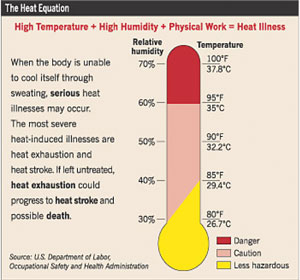
heat stress figure

Radiation – Almost 65 percent of all body heat is lost through radiation. This occurs when the heat from the skin is absorbed by the surrounding cooler air.

Convection – Approximately 10 percent of body cooling comes from heat transfer due to moving cool air (breeze, fan) across the skin to encourage evaporation and heat loss.

Conduction – Approximately 2 percent of body heat is pulled away by direct contact with a cooler object. The heat on the skin is transferred to the cooler object in contact with the skin.

Evaporation Cooling – Normally 23 percent occurs when moisture on the skin’s surface (sweat) evaporates, taking heat away and leaving cooler moisture and skin.

With summer approaching, temperatures in many parts of the country will soon be reaching well into the 90s with relative humidities surpassing 60 percent. In these conditions, the effectiveness of the body’s cooling mechanisms is significantly hampered. Radiation ceases to occur as the air and skin temperatures equalize. Convection stops as the moving air is now hot rather than cool. If there is nothing cool to touch, conduction is not an option. If the air is saturated with moisture, the evaporation of sweat will not happen.

In these extreme heat and humidity conditions, the body can no longer keep up with internal heat levels, and the body’s core temperature rises. The body’s reaction is to pump more blood to the skin which takes blood and fluids from the brain, muscles and major organs. The heart pumps harder to keep up, and the blood thickens due to fluid loss. This makes workers vulnerable to heat exhaustion, heat stroke and even heart attack. In addition, it can also have an effect on how workers perform their jobs.

Contributing factors

There are other factors besides the environment that can affect the level and the speed at which heat stress conditions can occur including: activity level, age, BMI and level of hydration.

Tips to reduce effects

Actions can be taken to help reduce the effects of heat stress:

Learn the signs and symptoms – be aware of when heat stress is possible and how to recognize the symptoms.

Acclimatization – workers do have some ability to adjust to hot work conditions. Gradual exposure to heat gives the body time to become accustomed to the higher environmental conditions.

Rest – take regular breaks to help allow the body to cool down.

Hydration – drink plenty of cool water regularly during work activities.

Shade – take advantage of a shady spot when possible.

Type of garment/fabric – wear lightweight and light-colored garments/fabrics that don’t trap in heat. Wear garments that transfer sweat from the skin to the outer surface of the fabric.

Avoid caffeine and alcohol – these beverages promote water loss and should not be consumed before or during work activities.

The two most effective ways of reducing heat stress are taking regular rest breaks and drinking plenty of water, particularly above 95°F and at high humidity levels.

Flame-resistant clothing effect

Flame-resistant (FR) clothing is worn to protect workers from hazards like flash fire and electric arc flash. The primary function of the garment (and fabric) in minimizing heat stress is to allow the heat to radiate off the body by not trapping in the heat. Like other types of work clothing, FR clothing can inhibit the transfer of body heat from the skin to the surrounding environment. Lighter weight and looser weave fabric can help with this process.

Common FR fabrics vary in their abilities to transfer sweat from the skin to the fabric surface. Although attire can play some role in reducing heat stress, research and testing indicates that single layer garments play a relatively minor or inconsequential role in causing or reducing heat stress, especially compared to those more important practices of proper hydration and rest breaks. Commonly-used single layer flame-resistant fabrics show little difference in their ability to provide the wearer with more or less heat stress relief in severe heat conditions.

The bottom line

Heat stress is 100-percent preventable as long as you take proper precautions and recognize the signs. By understanding how your body controls its temperature, you’re better able to recognize the symptoms of heat stress and take action if signs develop.

To minimize the potential for heat related problems, particularly in hot, humid working conditions — get acclimated, take regular rest breaks, drink plenty of cool water, wear the right clothes for the environment and know the warning signs so you can take the appropriate actions before the situation becomes dangerous. 

KEYWORDS: accident prevention flame resistant heat stress heat stroke worker safety and health

Share This Story

Looking for a reprint of this article?
From high-res PDFs to custom plaques, order your copy today!

Mark Saner is currently the technical services manager for VF Imagewear/Bulwark Protective Apparel. Previously, he served as the FR technical manager for Workrite Uniform Company from 2006 until early 2018. He brings more than 40 years of experience in the fire and safety industries to his work.

Contact Mark at 1-800-521-1888 or visit www.workrite.com.

Recommended Content

JOIN TODAY
to unlock your recommendations.

Already have an account? Sign In

  • forklift safety

    Exploring the latest technologies in forklift safety

    With more staff and more stock in warehousing now more...
    Workplace Training Strategies
    By: Josh Cramer
  • welding

    All about welder’s flash or arc eye

    A flash burn is a painful inflammation of the cornea,...
    Environmental Health and Safety
  • dangerous jobs

    The 10 most dangerous jobs in the U.S.

    On-the-job deaths have been rising — hitting the highest...
    Government Safety Regulations
    By: Benita Mehta
Manage My Account
  • eMagazine Subscriptions
  • ISHN Newsletter & Other Newsletter Alerts
  • Online Registration
  • Manage My Preferences
  • Subscription Customer Service

More Videos

Sponsored Content

Sponsored Content is a special paid section where industry companies provide high quality, objective, non-commercial content around topics of interest to the ISHN audience. All Sponsored Content is supplied by the advertising company and any opinions expressed in this article are those of the author and not necessarily reflect the views of ISHN or its parent company, BNP Media. Interested in participating in our Sponsored Content section? Contact your local rep!

close
  • man wearing the the Sundström SR200 Full Face Mask Respirator
    Sponsored byOHD

    5 Fit Testing Mistakes That Could Cost You

  • This image shows Magid AcuSpex polarized blue mirrored safety glasses.
    Sponsored byMagid Glove and Safety

    Construction PPE Guide: What Crews Need for Each Task

  • lone worker in confined space
    Sponsored byAlphasense Ltd.

    GET THE LEAD OUT of your Safety Oxygen Sensors!

Popular Stories

SpaceX 7 launch

OSHA Investigating Fatal Fall at SpaceX Starbase

Worker Impairment

How to Tell When a Co-Worker is Impaired? A Safety Pro’s Challenge

Automated loading dock equipment

After March 2026 Rivian Death, Safety Managers Reassess Loading Dock Systems Under OSHA's Warehouse Emphasis Program

top 10 most dangerous jobs

Poll

Seasonal Readiness

With the federal heat stress prevention rule on the horizon, which area of your safety program needs the most attention?
View Results Poll Archive

Products

Surviving an OSHA Audit A Management Guide, 2nd Edition

Surviving an OSHA Audit A Management Guide, 2nd Edition

See More Products

ISHN Podcasts

Related Articles

  • Heat stress

    Technology helps improve worker safety in hot environments

    See More
  • Vortec Dual Action Personal Air Conditioner protects workers in both hot and cold environments

    See More
  • Sweating manikins help NIOSH test fabrics for hot work environments

    See More

Related Directories

  • SafetyLine Lone Worker

    SafetyLine Lone Worker helps companies monitor the status of workers who are remote, alone, or working in hazardous situations. We are an automated check-in monitoring and emergency notification service. SafetyLine uses its communications infrastructure to ensure that workers have comprehensive monitoring, 24/7, without the need for costly monitoring centers.
×

Become a Leader in Safety Culture

Build your knowledge with ISHN, covering key safety, health and industrial hygiene news, products, and trends.

JOIN TODAY
  • RESOURCES
    • Advertise
    • Contact Us
    • Directories
    • Manufacturing Division
    • Store
    • Want More
  • SIGN UP TODAY
    • Create Account
    • eMagazine
    • Newsletters
    • Customer Service
    • Manage Preferences
  • SERVICES
    • Marketing Services
    • Reprints
    • Market Research
    • List Rental
    • Survey/Respondent Access
  • STAY CONNECTED
    • LinkedIn
    • Facebook
    • YouTube
    • X (Twitter)
  • PRIVACY
    • PRIVACY POLICY
    • TERMS & CONDITIONS
    • DO NOT SELL MY PERSONAL INFORMATION
    • PRIVACY REQUEST
    • ACCESSIBILITY

Copyright ©2026. All Rights Reserved BNP Media, Inc. and BNP Media II, LLC.

Design, CMS, Hosting & Web Development :: ePublishing