With the summer festival and fair season barely underway, a young worker in Michigan suffered an injury so serious on Saturday that he had to have a leg amputated. News sources say the 22-year-old was critically injured at the Curwood Festival in Owosso, a small community 94 miles northwest of Detroit.
Employees at a psychiatric hospital in Colorado were exposed to workplace violence and bloodborne pathogens, according to OSHA investigators, who fined their employer $32,392.
OSHA inspected Centennial Peaks Hospital in Louisville, an acute psychiatric treatment facility owned by UHS of Centennial Peaks LLC, after a complaint of workplace violence was lodged with the agency in December 2018.
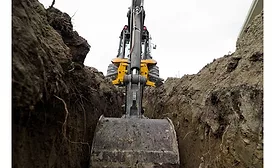
Construction workers are at risk of death or serious injury if they enter an unprotected trench and the walls col¬lapse. A trench is defined as a narrow underground excavation that is deeper than it is wide, and is no wider than 15 feet or 4.5 meters [OSHA]. Hazards associated with trench work and excavation are well defined and preventable.
What happens when an electrical lineman is working on a transformer from the bucket truck and accidentally drops a tool that results in what would otherwise be thought of as a simple spark?
It could easily trigger a dangerous release of energy known as an arc flash (aka arc fault and arc blast). This release of energy, created when electrical current leaves its intended path and travels from one conductor to another, or from one conductor to the ground, can have serious—sometimes tragic—consequences.
Discussions about the U.S. opioid epidemic are frequent, but the impact of opioids on workers may be left out of the conversation. Certain occupations, such as emergency medical services, law enforcement, and environmental services, face a high risk of occupational exposure to opioids — including the extremely toxic fentanyl and carfentanil — when responding to overdoses.
A report on workers comp claims by Colorado teens sheds some light on what are common workplace injuries for young workers across the U.S.
Pinnacol Assurance, which provides workers’ compensation protection to 57,000 Colorado employers, analyzed its claims history for workers under 20. The company found that more than 380 Colorado teens were injured or became ill last year because of their summer jobs.
OSHA inspectors who arrived at a Florida construction site to investigate an employee’s near-fatal fall didn’t have to look far to find fall and other safety hazards at the project. Three of the four Florida-based residential contractors involved with the project earned citations for fall hazard-related violations. The four companies were cited for a total of 12 violations, with $220,114 in proposed penalties.
RedVector / Convergence Training, a Vector Solutions brand and the leading provider of online continuing education, training, and performance management solutions for the architecture, engineering, construction (AEC), industrial and facility management industries, will launch a new virtual reality (VR) ladder safety training experience to help businesses and employees fight falls.
OSHA’s recent call for comments that may be used to help update its Lockout/Tagout (LOTO) standard highlights an area of growing concern for safety professionals: robotics-human interaction. When the agency’s Control of Hazardous Energy (LOTO) standard was issued in 1989, industrial robots were in use – primarily in manufacturing – but they bore little resemblance to their modern day counterparts. In the 1960s, '70s and '80s, industrial robots were capable of gripping objects, moving them from one point to another and performing assembly tasks.
Many facilities fail to conduct arc-flash hazard assessments, exposing workers to dangerous conditions
May 30, 2019
Littelfuse, Inc., a global manufacturer of leading technologies in circuit protection and power control, today announced the results of its recent facility electrical safety survey. The global survey conducted by Littelfuse earlier this year finds that while most workers feel arc-flash mitigation is a priority in their workplace, only half have completed a risk assessment to identify hazardous areas.