Workplace discrimination happens when employers treat employees differently due to factors like their race, age, gender or sexual orientation.
There are federal laws against such treatment in the United States, but it still happens. And, many people initially feel surprised after learning of the link between workplace discrimination and reduced employee safety.
In a landmark case, the Occupational Safety and Health Review Commission (OSHRC) has ruled that Integra Health Management, a social service employer, is accountable for failing to protect workers from workplace violence.
Integra was cited for safety violations following the tragic death of an employee who was stabbed nine times, then left bleeding on a front lawn after a December 2012 home visit to an agency client with a history of mental illness and violent criminal behavior.
In Ohio:
Musical instrument maker exposed workers to copper dust
An Ohio musical instrument manufacturer has been cited by OSHA for exposing workers to copper dust and machine hazards. Conn-Selmer, Inc., is facing penalties of $200,230 for two repeated and seven serious safety and health violations. OSHA inspectors determined that the company exposed workers to copper dust in excess of the recommended permissible exposure levels and machine hazards that included failure to provide machine guarding and adequate controls to minimize exposure.
VelocityEHS, the global leader in cloud-based environment, health, safety (EHS) and sustainability solutions, will showcase its growing family of software solutions at the NAEM Software, Innovation & Technology Showcase in New Orleans, Louisiana. Event attendees can test out VelocityEHS’ full suite of award-winning EHS solutions, including its new Humantech ergonomics software that uses artificial intelligence and sensorless motion-capture technology to accurately conduct ergonomics risk assessments to reduce the risk of musculoskeletal disorders (MSDs) in the workplace.
According to OSHA, one in five deaths in 2017 were in construction with what it calls the “Fatal Four.” These are accidents in construction caused by falls, being struck by objects, electrocution, and caught-in/between.
The first overlooked worksite safety practice is awareness. If employees are not made aware of the dangers they face in the workplace, the burden falls on management to ensure they do.
A more robust system of reporting workplace falls, overseen by a new independent body and a major review of work at height to consider the introduction of tough financial penalties for safety breaches, are just two of the key findings of a UK All Party Parliamentary Group (APPG), led by Alison Thewliss MP.
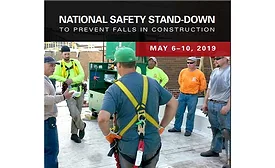
The major players involved in holding the 2019 National Safety Stand-Down to Prevent Falls in Construction will host a webinar to help would-be participants make the most of the event.
Falls are the top cause of construction fatalities and account for a third of on-the-job injuries and deaths in the industry.
People who work outside or who do the heavy lifting for a living are often jealous of office workers. “They have it so easy!” you hear them say, “They never have to worry about the heat, the cold, or being injured.”
While the office temperature is debatable, it is not true that desk jobs carry no risk of injury. The CDC states that in 1999, about 1 million people took time off work to recover from musculoskeletal injuries due to poor economics, costing businesses about $50 billion each year in lost wages and productivity.
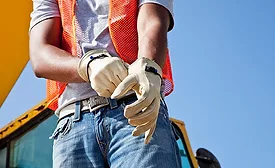
The International Safety Equipment Association (ISEA) has released a new standard — ANSI/ISEA 138-2019, American National Standard for Performance and Classification for Impact Resistant Hand Protection — to improve on the impact performance of industrial gloves. The new standard builds upon the widely used ANSI/ISEA 105-2016, American National Standard for Hand Protection Classification.
OSHA has cited Hilti Inc. – a hardware merchant wholesaler – for exposing employees to struck-by hazards after an employee was injured while operating a forklift at a distribution center in Atlanta, Georgia. The Plano, Texas-based company faces penalties of $164,802.