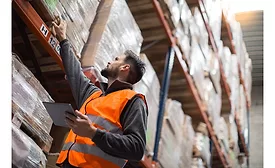
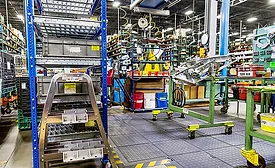
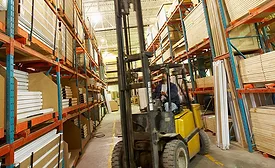
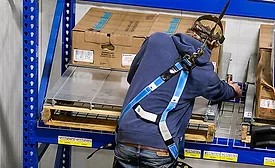
Warehouse workers face dangers that can easily cause serious injury. With the right procedures and design choices in place, it's possible to mitigate many of these issues — but only if organizations know what to look for.
Warehouse hazards are often the cause of workplace accidents. Choosing the correct type of storage will greatly reduce the potential hazard in a facility. The correct storage medium will reduce improper lifting, reaching and travel distance to retrieve an item.
Safety in Amazon warehouses has been scrutinized by the media in recent years, particularly for interactions between humans and robots. TechCrunch reports that the online retail giant has been introducing a new worker safety wearable to 25+ sites to prevent accidents involving robotic systems in their warehouses.
While consumers participate enthusiastically in Prime Day, a sales bonanza staged each year by Amazon, the company’s workers regard it with something less than enthusiasm.
The $5 billion in sales the world’s biggest online retailer is predicted to generate over the 2-day event is expected to exacerbate what are alleged to be already stressful conditions for the company’s employees.
Why do so many workers and building occupants die from falling through plastic skylights? Why do we have a BLS.gov line item on falling through skylights, average about 16-20/year work deaths in the USA through 2017?
If something doesn't bring you joy, popular wisdom advises to get rid of it. Yet, supply chain managers don't have that luxury. Everything in their inventories has a reason to be there. That means organizing is much more complicated than for the average homeowner, and much more important.
Warehouse hazards create more accidents because of the massive quantities of products of all different sizes, shapes and weights stored on shelves, floors and anyplace else someone can find a place to put a box, pallet or carton.
Amazon Fulfillment Services has been on the receiving end of a $7,000 fine and hazard alert letters after OSHA found hazards at its Robbinsville, New Jersey facility.
Industrial facilities are inherently dangerous places. In fact, according to the National Safety Council, workplace injuries account for nearly $190 billion in losses annually.
After a worker was killed in September 2014 by electrocution at Seldat Distribution Inc. in Dayton, N.J., OSHA investigators found 10 serious violations at the warehouse. The fatality was caused by an improperly wired, powered conveyer system.