The opioid epidemic’s toll on the U.S. workforce, retaliation against an undocumented worker leads to his arrest and federal worker safety agencies get a look at what could be their budgets next year. These were among the top stories featured on ISHN.com this week.
OSHA has proposed penalties of $1,326,367 to Dowa THT America Inc. – a metal heat treatment company based in Bowling Green, Ohio – after the company exposed employees to atmospheric, thermal, electrical, and mechanical hazards as they performed maintenance inside heat-treating furnaces. In addition to the penalties, the agency placed the company in the Severe Violator Enforcement Program.
OSHA has filed a lawsuit against a Boston, Massachusetts-based contractor, alleging that the company retaliated against an injured employee by facilitating his arrest.
The complaint filed last month with the U.S. District Court for the District of Massachusetts against Tara Construction Inc. and its chief executive officer, Pedro Pirez, states that the worker sustained a serious injury when he fell from a ladder on March 29, 2017. He reported his injury to his employers. OSHA found out about the fall and investigated.
Companies in two different states were cited by OSHA recently after workers suffered amputations at their facilities. In Iowa, an employee of O'Neal Manufacturing Services was injured while operating an unguarded press brake. In Texas, the injured employee of canned food company Bruce Foods Corporation had not been trained on lockout/tagout procedures.
O'Neal Manufacturing Services was issued one repeat serious citation by Iowa OSHA, which assessed $64,670 in penalties.
What are potential obstacles to building an effective Process Safety Management (PSM) program?
From what I’ve seen there are three related obstacles to building an effective PSM program. The first is engagement. It really takes commitment from everyone up and down the chain of command to build a best-in-class PSM program. Related to this is timely and relevant communication so that everyone from the shop floor up to the C-suite is on the same page. And the third obstacle is availability of decision-useful data.
President Donald Trump’s proposed 2020 budgets for occupational safety and health agencies is a mixed bag, and include increases for certain OSHA activities while decreasing the agency’s overall funding by $254,000.
Key OSH-related items in the budget released earlier this month:
Enforcement funding for OSHA will increase by $4 million. So will the number of full-time employees at the agency, by 33.
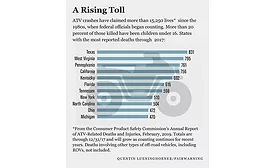
Since the early 1980s, the Consumer Product Safety Commission has conducted a grim census, tracking reports of deaths from crashes of all-terrain vehicles, or ATVs. Now the body count has risen above 15,250, according to the agency’s latest annual report, with more than one in five of the deaths suffered by children under 16.
In these days and times, knowing what we know, with most cars buzzing or beeping until the seat belt is fastened, why on earth would anyone choose to drive or ride without the obvious and easy protection that safety belts provide?
The federal government is pondering how best to accommodate automated vehicles under standards that were developed when all cars were driven solely by humans and self-driving vehicles were not even a glimmer on the horizon.
As a part of the process, the U.S. Department of Transportation’s (USDOT) National Highway Traffic Safety Administration (NHTSA) is inviting the public to comment on a pair of petitions from Nuro and General Motors (GM) about exemptions to those standards.
To enhance safety and environmental protection, the EPA’s Hazardous Waste Generator Improvements Final Rule, which became effective federally last year, requires identification including the words “Hazardous Waste,” a description of the container’s hazards, and the date the accumulation started on each container.